
Delivering more actionable and strategically valuable research, The Business Research Company’s 2026 market reports feature market attractiveness analysis, total addressable market evaluation, company benchmarking matrices, interactive Excel dashboards, expanded supply chain intelligence, emerging startup coverage, and detailed product insights.
Maritime Simulators Market Growth Potential: How Will Market Size Change Through 2030?
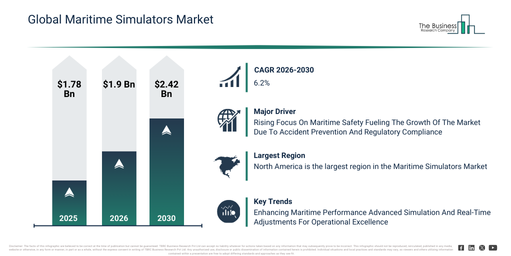
The maritime simulators market size has shown significant growth in recent years. It is projected to expand from $1.78 billion in 2025 to $1.9 billion in 2026, demonstrating a compound annual growth rate (CAGR) of 6.7%. This historical growth can be attributed to increasing global maritime traffic and a demand for skilled personnel, regulatory mandates for maritime safety and crew certification, advancements in simulation technologies like high-fidelity visual and motion systems, the rising adoption of virtual reality (VR) and augmented reality (AR) in maritime training, and growing investment by shipping companies and maritime academies in crew training infrastructure.
The maritime simulators market is anticipated to experience substantial expansion over the upcoming years. This market is projected to reach $2.42 billion by 2030, exhibiting a compound annual growth rate (CAGR) of 6.2%. Several factors will fuel this growth during the forecast timeframe, including the proliferation of autonomous and smart ship technologies increasing the need for simulators, the adoption of artificial intelligence (AI) and machine learning for advanced predictive training, a heightened focus on environmental regulations and reducing emissions in maritime activities, a growing need for remote and cloud-based maritime simulation options, and the development of emerging markets with expanding maritime trade and educational facilities. Key trends anticipated during this period involve the incorporation of VR and AR for immersive maritime training experiences, the rise of cloud-based simulator platforms enabling remote accessibility, the tailoring of simulators for distinct vessel categories and operational demands, a greater uptake of simulation-centric certification and adherence initiatives, and the broadening of maritime simulator training to cover offshore oil & gas and ROV operations.
Download A Free Sample Report For Comprehensive Market Insights:
#Maritime Simulators Market Growth Drivers And Industry Catalysts
A growing emphasis on maritime safety is anticipated to drive expansion within the maritime simulators market in the future. This heightened attention to maritime safety stems from the imperative to reduce accidents, safeguard lives, avert ecological catastrophes, and adhere to strict global safety protocols. Incidents at sea often lead to considerable financial and environmental harm. Simulators offer a safe environment for practicing emergency situations, thereby enhancing crew readiness and diminishing the probability of human mistakes. For example, in 2023, the Seamen’s Church Institute (SCI), a US-based nonprofit organization dedicated to maritime education, legal advocacy, and welfare services globally to ensure seafarer safety, training, and well-being, observed a 13% rise in mariner training engagements year-over-year, which underscores the rising importance placed on safety and skill enhancement. Consequently, the concentrated attention on maritime safety is fueling expansion in the maritime simulators market.
Maritime Simulators Market Segmentation And Category Breakdown
The maritime simulators market covered in this report is segmented –
1) By Type: Ship Bridge Simulators, Engine Room Simulators, Cargo Handling Simulators, Communication Or Global Maritime Distress And Safety System (GMDSS) Simulators, Remotely Operated Vehicle Simulators
2) By Component: Hardware, Software, Services
3) By Application: Maritime Schools, Training Centers, Shipping Companies, Port Authorities, Oil And Gas Companies, Governmental Authorities, Navies And Coast Guards, Other Applications
4) By End User: Civilian And Commercial, Military And Defense
Subsegments:
1) By Ship Bridge Simulators: Full Mission Bridge Simulators, Part Task Bridge Simulators, Desktop Bridge Simulators, Tugboat Bridge Simulators, Naval Bridge Simulators
2) By Engine Room Simulators: Full Mission Engine Room Simulators, Operational Engine Room Simulators, Desktop Engine Room Simulators, Auxiliary Systems Simulators, Emergency Response Engine Simulators
3) By Cargo Handling Simulators: Liquid Cargo Handling Simulators, Dry Bulk Cargo Handling Simulators, Container Terminal Operations Simulators, Refrigerated Cargo Handling Simulators, Hazardous Material (HAZMAT) Cargo Simulators
4) By Communication Or Global Maritime Distress And Safety System (GMDSS) Simulators: Basic GMDSS Simulators, Advanced GMDSS Simulators, Coast Station GMDSS Simulators, SAR (Search And Rescue) Communication Simulators, Emergency Radio Communication Simulators
5) By Remotely Operated Vehicle (ROV) Simulators: Observation-Class ROV Simulators, Work-Class ROV Simulators, Autonomous Underwater Vehicle (AUV) Simulators, Deep-Sea Exploration ROV Simulators, Offshore Oil And Gas ROV Simulators
Maritime Simulators Market Growth Trends Influencing Competitive Dynamics
Leading companies within the maritime simulators market are prioritizing advanced ship handling simulation platforms, such as real-time, voyage-specific optimization, to equip maritime professionals with cutting-edge training solutions that elevate decision-making and operational effectiveness. This real-time, voyage-specific optimization involves the dynamic modification of operational settings during a journey, informed by live data such as weather, cargo status, and route changes, all aimed at boosting efficiency and performance. For example, in August 2024, Danelec Electronics A/S, a Denmark-based maritime technology firm, rolled out a simulation instrument crafted to bolster collaboration between commercial and operations teams for LNG carriers. The system addresses complexities such as harmonizing charter party demands, cargo characteristics, and effective voyage planning amidst challenging weather and route conditions. It models vessel performance, fine-tuning operational parameters for specific routes, cargo, and predicted conditions, enabling on-the-spot adjustments to enhance efficiency. Operators stand to save over 100 MT of LNG per voyage, which translates to $360k annually per vessel. Moreover, it ensures accurate performance monitoring, early issue detection, and compliance with charter agreements.
Maritime Simulators Market Leading Companies: Who Holds Significant Market Presence?
Major companies operating in the maritime simulators market are Lockheed Martin Corporation, BAE Systems Plc, Thales Group, L3 Harris Technology, Rheinmetall AG, Wartsila Oyj Abp, General Dynamics Information Technology Inc., Kongsberg Maritime AS (KM), CAE Inc., FORCE Technology, Furuno Electric Co. Ltd., RH Marine Group, STORM SIM GEO LLC, GSE Systems, Applied Research International Simulation, Virtual Marine Technology Incorporated, Poseidon Simulation, Cruden, PC Maritime, Marine Learning Systems, Oceanus Marine Solutions, VSTEP Simulation, Imagesoft Pty Ltd.
Access The Complete Maritime Simulators Market Report:
Maritime Simulators Market Global Footprint: Which Region Holds Market Leadership?
North America was the largest region in the maritime simulators market in 2025. Asia-Pacific is expected to be the fastest-growing region in the forecast period. The regions covered in the maritime simulators market report are Asia-Pacific, South East Asia, Western Europe, Eastern Europe, North America, South America, Middle East, Africa.
Access a Customized Maritime Simulators Market Report for Deeper Competitive Insights
https://www.thebusinessresearchcompany.com/customise?id=21511&type=smp
The Business Research Company: https://www.thebusinessresearchcompany.com/
Americas: +1 310-496-7795
Asia: +44 7882 955267 & +91 8897263534
Europe: +44 7882 955267
Email us at: marketing@tbrc.info
Follow us on:
LinkedIn: https://in.linkedin.com/company/the-business-research-company
YouTube: https://www.youtube.com/channel/UC24_fI0rV8cR5DxlCpgmyFQ
Global Market Model: https://www.thebusinessresearchcompany.com/global-market-model

Wasay has over a decade of experience in market research, data modelling, and analytics, with prior experience at GlobalData and Decision Tree Consulting Services. At The Business Research Company , he leads research operations across syndicated studies, customized consulting engagements, and the Global Market Model platform. His professional experience includes supporting organizations such as Boston Consulting Group, KPMG, and Ernst & Young. Wasay holds a degree in Electronics and Communications Engineering, postgraduate management qualifications from International Management Institute Belgium and Indian School of Business and Entrepreneurship, and completed the Integrated Program in Business Analytics from Indian Institute of Management Indore.

