
Enhanced with market attractiveness analysis, total addressable market evaluation, company benchmarking matrices, interactive Excel dashboards, expanded supply chain intelligence, emerging startup coverage, and detailed product insights, The Business Research Company’s 2026 market reports deliver more actionable and strategically valuable research.
Medium Heavy Lift Launch Vehicle Market Size Outlook: How Fast Will Revenue Grow Through 2030?
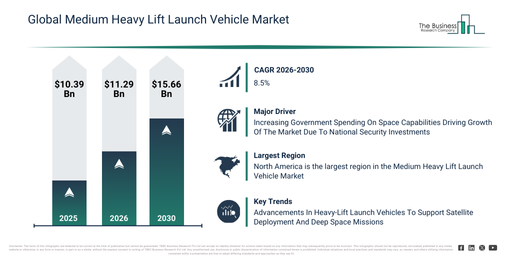
The market size for medium heavy lift launch vehicles has experienced significant growth in recent years. It is projected to increase from $10.39 billion in 2025 to $11.29 billion in 2026, reflecting a compound annual growth rate (CAGR) of 8.6%. This historical growth can be attributed to the development and deployment of early medium-heavy lift launch vehicles, an expansion in government and commercial space programs requiring payload delivery to LEO, advancements in rocket fuel tank and ground support equipment technologies, the adoption of safety systems to enhance launch reliability, and increasing investment in versatile launch solutions for scientific and military missions.
The medium heavy lift launch vehicle market is poised for significant expansion in the coming years, projected to reach $15.66 billion by 2030, exhibiting a compound annual growth rate (CAGR) of 8.5%. Several factors will fuel this growth during the forecast period, including an increased need for medium-heavy lift vehicles for deploying satellite constellations, an uptick in both commercial and defense space missions, progress in developing reusable and economical launch vehicle technologies, greater investment in artificial intelligence and predictive analytics for managing launch operations, and an increase in international partnerships for medium-heavy lift launch services. Key trends anticipated over the forecast period involve a heightened demand for medium-heavy launch capabilities for commercial satellite deployment, boosted financing for national space security and defense initiatives, innovations in propulsion systems for better cost-effectiveness and fuel efficiency, a rise in commercial missions for carrying communication and broadcasting payloads, and the development of ground support and safety infrastructure to facilitate quicker launch turnarounds.
Download A Free Sample Report For Comprehensive Market Insights:
Medium Heavy Lift Launch Vehicle Market Development Factors: Which Trends Are Supporting Demand?
The projected expansion of the medium-heavy lift launch vehicle market is significantly influenced by the rising government expenditure on space capabilities. This spending encompasses funds directed by governments towards fostering and maintaining space-related endeavors, including the development of rockets, satellites, and various other space technologies. The increased governmental investment in space is primarily motivated by national security imperatives, specifically to enhance defense readiness and ensure reliable communication systems. Such governmental outlays stimulate the medium-heavy lift launch vehicle sector through investments in research and development, essential infrastructure, and mission deployments, thereby alleviating financial pressures on private companies. Furthermore, it maintains consistent demand through continuous projects in defense, scientific research, and space exploration. For example, in 2024, worldwide government expenditure on space initiatives was estimated at $135 billion, marking an increase of nearly 10% compared to 2023. The U.S. dominated this spending with a budget of roughly $79.7 billion, comprising nearly 60% of the total global space spending, with China following at approximately $20 billion and Japan at $6.8 billion. Consequently, the growing government investment in space capabilities is a key factor propelling the expansion of the medium-heavy lift launch vehicle market.
Medium Heavy Lift Launch Vehicle Market Segment Breakdown: Which Categories Generate The Most Revenue?
The medium heavy lift launch vehicle market covered in this report is segmented –
1) By Launch Vehicle Class: Medium Lift Launch Vehicle, Heavy Lift Launch Vehicle, Super Heavy Lift Launch Vehicle
2) By Subsystem: Structure, Avionics, Propulsion, Control System, Electrical System, Stage Separation, Thermal System
3) By Payload: Satellite, Cargo, Human
4) By End-User: Defense And Security, Media And Entertainment, Research Institutions, Space Exploration Agencies, Telecommunications
Subsegments:
1) By Medium Lift Launch Vehicle: Payload To Low Earth Orbit (LEO) (2,000–20,000 Kilograms), Reusable Medium-Lift Vehicles, Expendable Medium-Lift Vehicles, Government Missions, Commercial Satellite Launches, Polar And Sun-Synchronous Orbit Missions
2) By Heavy Lift Launch Vehicle: Payload To Low Earth Orbit (LEO) (20,000–50,000 Kilograms), Human Spaceflight Missions, Deep Space Missions, Geostationary Transfer Orbit (GTO) Payloads, Modular Heavy-Lift Vehicles, Military Or Defense Applications
3) By Super Heavy Lift Launch Vehicle: Payload To Low Earth Orbit (LEO) (Greater Than 50,000 Kilograms), Lunar And Mars Missions, Interplanetary Cargo Launches, Space Station Module Launches, Fully Reusable Super Heavy Vehicles, National Flagship Launch Programs
#Medium Heavy Lift Launch Vehicle Market Growth Trends: What Is Influencing The Future Outlook?
Companies operating within the medium-heavy-lift launch vehicle market are concentrating on developing advanced products like heavy-lift rockets to address the escalating demand for satellite deployment and space exploration. A heavy-lift rocket is defined as a launch vehicle engineered to deliver large payloads, typically ranging from 20,000 to 50,000 kilograms, into low Earth orbit (LEO). These rockets are vital for transporting satellites, crewed spacecraft, and cargo essential for deep space missions. For example, in July 2024, ArianeGroup, a France-based aerospace engineering company, introduced Ariane 6, an advanced heavy-lift launch vehicle created for the European space agency. Its payload capacity ranges from 10,300 to 21,600 kg, depending on the variant. Ariane 6 incorporates a reignitable upper stage, propelled by the Vinci engine, enabling it to launch multiple payloads to various orbits within a single flight and to deorbit itself following mission completion, thereby contributing to the reduction of space debris.
Medium Heavy Lift Launch Vehicle Market Competitive Analysis Of Major Industry Participants
Major companies operating in the medium heavy lift launch vehicle market are The Boeing Company, Lockheed Martin Corporation, China Aerospace Science and Technology Corporation (CASC), Northrop Grumman Corporation, Mitsubishi Heavy Industries Ltd., SpaceX, Blue Origin LLC, ArianeGroup, Arianespace, United Launch Alliance LLC, Relativity Space, Rocket Lab USA Inc., Firefly Aerospace Inc., Gilmour Space Technologies, ROSCOSMOS, Virgin Orbit LLC, Galactic Energy, Isar Aerospace, Astra Space Inc., Interorbital System
Access The Complete Medium Heavy Lift Launch Vehicle Market Report:
Medium Heavy Lift Launch Vehicle Market Regional Outlook: Where Are The Largest Opportunities Located?
North America was the largest region in the medium-heavy lift launch vehicle market in 2025. The regions covered in the medium heavy lift launch vehicle market report are Asia-Pacific, South East Asia, Western Europe, Eastern Europe, North America, South America, Middle East, Africa.
Access a Customized Medium Heavy Lift Launch Vehicle Market Report for Deeper Competitive Insights
https://www.thebusinessresearchcompany.com/customise?id=23756&type=smp
The Business Research Company: https://www.thebusinessresearchcompany.com/
Americas: +1 310-496-7795
Asia: +44 7882 955267 & +91 8897263534
Europe: +44 7882 955267
Email us at: marketing@tbrc.info
Follow us on:
LinkedIn: https://in.linkedin.com/company/the-business-research-company
YouTube: https://www.youtube.com/channel/UC24_fI0rV8cR5DxlCpgmyFQ
Global Market Model: https://www.thebusinessresearchcompany.com/global-market-model

Wasay has over a decade of experience in market research, data modelling, and analytics, with prior experience at GlobalData and Decision Tree Consulting Services. At The Business Research Company , he leads research operations across syndicated studies, customized consulting engagements, and the Global Market Model platform. His professional experience includes supporting organizations such as Boston Consulting Group, KPMG, and Ernst & Young. Wasay holds a degree in Electronics and Communications Engineering, postgraduate management qualifications from International Management Institute Belgium and Indian School of Business and Entrepreneurship, and completed the Integrated Program in Business Analytics from Indian Institute of Management Indore.

