
Delivering more actionable and strategically valuable research, The Business Research Company’s 2026 market reports feature market attractiveness analysis, total addressable market evaluation, company benchmarking matrices, interactive Excel dashboards, expanded supply chain intelligence, emerging startup coverage, and detailed product insights.
Nanosatellite And Microsatellite Market Value Analysis: What Growth Is Expected Over The Forecast Period?
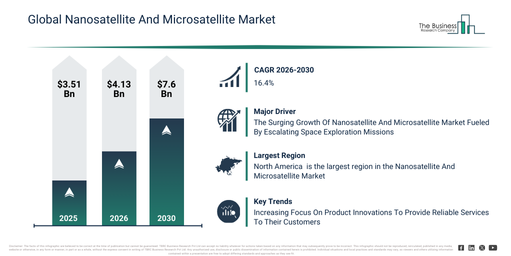
The nanosatellite and microsatellite market has experienced substantial growth in recent times. This market is projected to expand from $3.51 billion in 2025 to $4.13 billion in 2026, exhibiting a compound annual growth rate (CAGR) of 17.7%. Historically, this expansion has been driven by several factors, including the rising uptake of economical small satellites for earth observation, the proliferation of satellite programs within universities and research institutions fostering early deployment, technological progress in miniaturized onboard computers and power subsystems facilitating dependable small-satellite operations, an increasing need for swiftly deployable communication satellites, and the broadening scope of commercial remote sensing uses through nanosatellite and microsatellite constellations.
The nanosatellite and microsatellite market size is anticipated to experience swift expansion over the coming years. This market is projected to reach $7.6 billion by 2030, demonstrating a compound annual growth rate (CAGR) of 16.4%. This projected growth during the forecast period stems from several factors, including increasing investments in extensive small-satellite constellations aimed at global connectivity services, a rising need for advanced imaging and sensing functionalities within compact satellite platforms, improvements in modular and scalable satellite subsystems enhancing mission adaptability, the expanding application of nanosatellites and microsatellites for defense and national security purposes, and the proliferation of commercial launch services, which lowers deployment expenses and facilitates a greater volume of satellites. Key trends anticipated within the forecast timeframe encompass an escalating demand for low-earth-orbit (LEO) remote sensing constellations, the increasing integration of miniaturized satellite components for economical deployment, the broadening availability of commercial launch services catering to small satellites, a surge in academic and research-focused nanosatellite missions, and the expanding utilization of nanosatellites for real-time earth observation data services.
Download A Free Sample Report For Comprehensive Market Insights:
Nanosatellite And Microsatellite Market Growth Drivers: What Factors Are Accelerating Expansion?
The expanding number of space exploration endeavors is a significant factor propelling the expansion of the nanosatellite and microsatellite market. These missions involve undertakings aimed at investigating cosmic regions beyond Earth’s atmosphere, employing both crewed and uncrewed spacecraft. Nanosatellites and microsatellites perform highly specific functions, such as Earth observation, telecommunications, and meteorology. Governments globally are increasing their involvement in space missions, with small satellites playing a crucial role in their successful execution. For example, data released in June 2024 by SpaceNews, a US-based non-governmental organization, revealed that in 2023, U.S. manufacturers were responsible for roughly 85% of all commercially acquired satellites. This contributed to a 9% surge in satellite manufacturing revenue, reaching $17.2 billion, primarily attributed to flexible software-defined payloads and innovative small satellites. Furthermore, a record total of 190 commercially procured launches occurred, representing an 18% rise compared to 2022. These deployments facilitated the placement of 2,781 commercial satellites, a 20% increase year-over-year, largely spearheaded by SpaceX. Consequently, the heightened activity in space exploration missions is indeed fostering the growth of the nanosatellite and microsatellite market.
Nanosatellite And Microsatellite Market Segment Performance And Strategic Opportunities
The nanosatellite and microsatellite market covered in this report is segmented –
1) By Component: Launch Services, Hardware, Software And Data Processing, Space Services
2) By Mass: Nanosatellites (1 kg- 10kg), Microsatellites (11kg- 100 kg)
3) By Application: Communication, Reconnaissance, Scientific Research, Earth Observation And Remote Sensing, Biological Experiments, Academic Training, Technology Demonstration And Verification, Mapping And Navigation
4) By Vertical: Government, Defense, Maritime And Transportation, Civil, Commercial, Energy And Infrastructure
Subsegments:
1) By Launch Services: Dedicated Launch Vehicles, Ride-Share Launch Services
2) By Hardware: Payloads, Communication Systems, Power Systems, On-Board Computers, Structure And Mechanisms
3) By Software And Data Processing: Satellite Control Software, Data Analysis Software, Ground Station Software
4) By Space Services: Satellite Operations And Maintenance, Ground Station Services, Data Distribution Services
Nanosatellite And Microsatellite Market Trends Reshaping Industry Growth
Leading companies in the nanosatellites and microsatellites market are concentrating on developing innovative products, such as tiny satellites, to increase their market revenues. These compact satellites are intended to be cost-effective and lightweight, achievable through the use of off-the-shelf technologies. For example, in April 2024, Planet Labs, a US-based technology company specializing in capturing and analyzing satellite imagery to provide geospatial data for environmental and commercial uses, launched Pelican-1. This was the first satellite in its next-generation Pelican constellation, specifically designed for high-resolution Earth imaging. The small satellite serves as a technology demonstrator, confirming the efficacy of the hardware and software components within Planet’s Smallsat Platform. The Pelican constellation aims to offer superior image resolution and quicker revisit times, thus enabling real-time monitoring applications in sectors like agriculture, urban planning, and disaster response. This particular launch represents a significant stride in Planet’s endeavors to enhance satellite imaging capabilities for global oversight.
Nanosatellite And Microsatellite Market Competitive Analysis Of Major Industry Participants
Major companies operating in the nanosatellite and microsatellite market are Dauria Aerospace, GomSpace Group AB, Innovative Solutions In Space (ISIS), Sierra Nevada Corporation, Spire Global Inc., SpaceQuest Ltd., Survey Satellite Technology Limited, Tyvak Nano-Satellite Systems Inc., AAC Clyde Space AB, Lockheed Martin Corporation, Planet Labs PBC, L3Harris Technologies Inc., Axelspace Corporation, Astro Digital Inc., Berlin Space Technologies, Northrop Grumman Corporation, Raytheon Technologies Corporation, Dynetics Inc., RUAG Group, Swarm Technologies Inc., Blue Canyon Technologies Inc., China Aerospace Science and Technology Corporation, Spaceflight Industries Inc., ECM Space Technologies GmbH, TriSept Corporation, SpaceWorks Enterprises Inc., NanoAvionics Inc., Kepler Communications Inc., Pumpkin Inc., Nanoracks LLC
Access The Complete Nanosatellite And Microsatellite Market Report:
Nanosatellite And Microsatellite Market Regional Outlook: Where Are The Largest Opportunities Located?
North America was the largest region in the nanosatellite and microsatellite market in 2025. The regions covered in the nanosatellite and microsatellite market report are Asia-Pacific, South East Asia, Western Europe, Eastern Europe, North America, South America, Middle East, Africa.
Access a Customized Nanosatellite And Microsatellite Market Report for Deeper Competitive Insights
https://www.thebusinessresearchcompany.com/customise?id=9368&type=smp
The Business Research Company: https://www.thebusinessresearchcompany.com/
Americas: +1 310-496-7795
Asia: +44 7882 955267 & +91 8897263534
Europe: +44 7882 955267
Email us at: marketing@tbrc.info
Follow us on:
LinkedIn: https://in.linkedin.com/company/the-business-research-company
YouTube: https://www.youtube.com/channel/UC24_fI0rV8cR5DxlCpgmyFQ
Global Market Model: https://www.thebusinessresearchcompany.com/global-market-model

Wasay has over a decade of experience in market research, data modelling, and analytics, with prior experience at GlobalData and Decision Tree Consulting Services. At The Business Research Company , he leads research operations across syndicated studies, customized consulting engagements, and the Global Market Model platform. His professional experience includes supporting organizations such as Boston Consulting Group, KPMG, and Ernst & Young. Wasay holds a degree in Electronics and Communications Engineering, postgraduate management qualifications from International Management Institute Belgium and Indian School of Business and Entrepreneurship, and completed the Integrated Program in Business Analytics from Indian Institute of Management Indore.
