Through market attractiveness analysis, total addressable market evaluation, company benchmarking matrices, interactive Excel dashboards, expanded supply chain intelligence, emerging startup coverage, and detailed product insights, The Business Research Company’s 2026 market reports provide more actionable and strategically valuable research.
Military 3D Printing Market Growth From $2.96 Billion In 2026 To $6.97 Billion By 2030 At A CAGR Of 23.87%
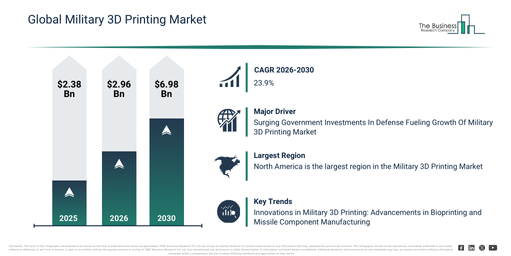
The military 3D printing market has seen a rapid expansion in its size over recent years. This market is projected to grow from $2.38 billion in 2025 to $2.96 billion by 2026, achieving a compound annual growth rate (CAGR) of 24.5%. The historical growth can be attributed to several factors: increased adoption of additive manufacturing for reducing lead times on replacement parts, a rising demand for rapid prototyping that supports the development of mission-specific components, the integration of 3D printing capabilities within military logistics to enhance operational readiness, advancements in printer hardware such as motion controllers and print beds improving production reliability, and the expansion of field-deployable 3D printing units enabling on-site fabrication for maintenance requirements.
The military 3d printing market size is projected to experience substantial expansion over the next few years. It is forecast to grow to $6.98 billion in 2030, exhibiting a compound annual growth rate (CAGR) of 23.9%. This projected growth is driven by several factors, including an increased utilization of advanced materials enabling the production of high-performance military components, rising investment in large-format and metal 3D printing systems that broaden defense manufacturing applications, the increasing adoption of digital inventory strategies to reduce dependence on traditional supply chains, the development of autonomous and AI-optimized printing processes improving precision and efficiency, and expanding collaboration between defense agencies and industry which accelerates innovation in military additive manufacturing. Key trends anticipated during this forecast period include the implementation of expeditionary or on-site additive manufacturing for forward bases, advancements in metal powders and high-performance materials development, a focus on supply-chain resilience and on-demand spare-part consolidation, the establishment of certification, qualification, and defense-grade standards for printed parts, and the adoption of hybrid manufacturing (combining additive and subtractive techniques).
Download A Free Sample Report For Comprehensive Market Insights:
Military 3D Printing Market Growth Drivers: What Factors Are Accelerating Expansion?
The increasing governmental allocation of funds towards defense is a significant factor contributing to the future expansion of the military 3D printing market. These government investments signify public sector financial outlays for acquiring products and delivering services across various domains including defense, social protection, healthcare, and education. Governments are directing investments into 3D printing technology for military applications, recognizing its potential to shorten lead times and decrease costs. For example, in March 2023, the U.S. Department of Defense, a US-based government department, released the President’s Fiscal Year (FY) 2024 Defense Budget, which proposed $842 billion for the Department of Defense (DoD) for FY 2024. This amount marks an increase of $26 billion over 2023 levels and is $100 billion higher than in 2022. Thus, the escalating government investments in defense are set to propel the military 3D printing market.
#Military 3D Printing Market Segment Landscape And Growth Potential
The military 3d printing market covered in this report is segmented –
1) By Type: Printer, Material, Software, Service
2) By Process: Binder Jetting, Direct Energy Deposition, Material Extrusion, Material Jetting, Powder Bed Fusion, Vat Photopolymerization, Sheet Lamination
3) By Application: Functional Part Manufacturing, Tooling, Prototyping
4) By End-Use: Army, Navy, Airforce
Subsegments:
1) By Printer: Fused Deposition Modeling (FDM) Printers, Stereolithography (SLA) Printers, Selective Laser Sintering (SLS) Printers, Metal 3D Printers, Resin Printers
2) By Material: Plastics, Metals, Ceramics, Composites, Bio-materials
3) By Software: CAD Software, Slicing Software, Simulation Software, Printing Management Software
4) By Service: 3D Printing Services, Design And Prototyping Services, Maintenance And Support Services, Training And Consulting Services
Military 3D Printing Market Industry Trends Shaping Future Revenue Growth
Leading companies active in the military 3D printing market are introducing innovative products, such as the BioFabrication Facility (BFF), to enhance their market profitability. The BioFabrication Facility (BFF) functions as a 3D bioprinter, designed to create human tissue on the International Space Station (ISS) and further the realm of microgravity bioprinting. For instance, in September 2024, Agnikul Cosmos, an aerospace company based in India, unveiled 3D-printed missile components. This newly introduced technology offers dramatically reduced production times, shortening rocket motor manufacturing from weeks to mere days, alongside improved design flexibility through additive manufacturing that allows for complex geometries, and swift scalability to support high-demand short-range missile systems. This innovation notably strengthens the defense manufacturing market by enabling faster replenishment and better operational readiness.
Military 3D Printing Market Key Players And Strategic Industry Positioning
Major companies operating in the military 3d printing market are Stratasys Ltd., 3D Systems Corporation, EOS GmbH Electro Optical Systems, Arcam AB, Norsk Titanium AS, American Elements Corporation, Cimetrix Solutions Inc., Artec 3D, Additive Manufacturing Ltd., Optomec Inc., Markforged Inc., Stanford Marsh Group, Autodesk Inc., General Electric Company, Proto Labs Inc., Ultimaker BV, Renishaw Plc, Fracktal Works Private Limited, Materialise NV, Engineering & Manufacturing Services Inc., 3T Additive Manufacturing Ltd., The ExOne Company, Dassault Systèmes, Concept Laser GmbH, Sisma S.p.A., SLM Solutions Group AG, HP Inc., Prodways Group
Access The Complete Military 3D Printing Market Report:
Military 3D Printing Market Regional Analysis: Which Region Leads By Revenue?
North America was the largest region in the military 3D printing market in 2025.Asia-Pacific is expected to be the fastest-growing region in the global military 3D printing market report during the forecast period. The regions covered in the military 3d printing market report are Asia-Pacific, South East Asia, Western Europe, Eastern Europe, North America, South America, Middle East, Africa.
Access a Customized Military 3D Printing Market Report for Deeper Competitive Insights
https://www.thebusinessresearchcompany.com/customise?id=10714&type=smp
The Business Research Company: https://www.thebusinessresearchcompany.com/
Americas: +1 310-496-7795
Asia: +44 7882 955267 & +91 8897263534
Europe: +44 7882 955267
Email us at: marketing@tbrc.info
Follow us on:
LinkedIn: https://in.linkedin.com/company/the-business-research-company
YouTube: https://www.youtube.com/channel/UC24_fI0rV8cR5DxlCpgmyFQ
Global Market Model: https://www.thebusinessresearchcompany.com/global-market-model

Wasay has over a decade of experience in market research, data modelling, and analytics, with prior experience at GlobalData and Decision Tree Consulting Services. At The Business Research Company , he leads research operations across syndicated studies, customized consulting engagements, and the Global Market Model platform. His professional experience includes supporting organizations such as Boston Consulting Group, KPMG, and Ernst & Young. Wasay holds a degree in Electronics and Communications Engineering, postgraduate management qualifications from International Management Institute Belgium and Indian School of Business and Entrepreneurship, and completed the Integrated Program in Business Analytics from Indian Institute of Management Indore.