Backed by market attractiveness analysis, total addressable market sizing, company benchmarking matrices, interactive Excel dashboards, wider supply chain intelligence, emerging startup coverage, and detailed product-level insights, The Business Research Company’s 2026 market reports are designed to offer research that is more actionable and strategically valuable than ever.
Military Antenna Market Poised To Hit $5.69 Billion By 2030 With A 7.6% CAGR
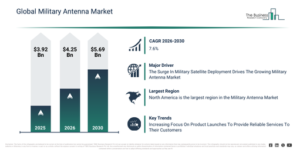
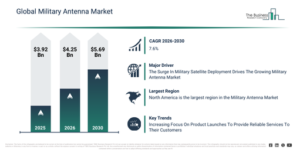
The military antenna market has experienced significant growth in recent years. It is anticipated to expand from $3.92 billion in 2025 to $4.25 billion in 2026, at a compound annual growth rate (CAGR) of 8.5%. This historical growth can be attributed to the increasing deployment of radar antennas to bolster battlefield surveillance and target tracking, the heightened adoption of wideband and microwave antennas for supporting secure high-speed military communications, the expansion of modernization programs focused on upgrading legacy tactical antenna systems, breakthroughs in antenna materials and design that improve signal strength and durability, and the broadening of military operations demanding reliable long-range communication capabilities.
The military antenna market is projected to experience significant expansion in the coming years. It is expected to reach $5.69 billion by 2030, exhibiting a compound annual growth rate (CAGR) of 7.6%. This anticipated growth during the forecast period stems from several factors: a rising demand for compact and lightweight antennas optimized for next-generation military platforms, the increasing integration of electronically steered antennas enabling rapid beamforming and multi-target tracking, the expansion of network-centric warfare which drives the need for interoperable communication antenna systems, the ongoing development of adaptive and reconfigurable antennas to counter electronic warfare threats, and the adoption of advanced satellite communication antennas enhancing global operational connectivity. Key trends identified for the forecast period include advanced radar antennas, wideband tactical antennas, innovations in microwave antenna technology, smart multi-band antenna systems, and compact and lightweight military antennas.
Get A Free Sample Report With In-Depth Market Insights:
Military Antenna Market Growth Momentum: What Factors Are Shaping Demand?
The expanding placement of military satellites is projected to stimulate the growth of the military antenna market in the future. These man-made satellites serve military purposes, including communications, navigation, and the collection of intelligence. The rise in military satellites is driven by a heightened need for improved surveillance, intelligence, and instantaneous defense communication and oversight functionalities. The growing use of military satellites is foreseen to propel the expansion of the military antenna market, enabling superior communication and data transfer capacities. As an illustration, in October 2023, the Russian Federation’s Ministry of Defense, a government entity located in Russia, launched three rockets carrying military satellites from the Plesetsk space center in north western Russia. This event was part of several launches initiated since early 2023. Additionally, specialists from the Titov Main Test Space Center supervised 13 space rocket launches originating from the Plesetsk, Vostochny, and Baikonur cosmodromes, which successfully placed 55 spacecraft into orbit. Consequently, the expanding deployment of military satellites is a key factor in the growth of the military antenna market.
Military Antenna Market Segment Analysis: What Are The Core Market Categories?
The military antenna market covered in this report is segmented –
1) By Type: Dipole Antennas, Monopole Antennas, Array Antennas, Loop Antennas, Other Types
2) By Platform: Airborne, Marine, Ground
3) By Frequency: High Frequency, Ultra High Frequency, Super High Frequency, Extremely High Frequency
4) By Application: Communication, Surveillance, SATCOM, Electronic Warfare, Navigation, Telemetry
Subsegments:
1) By Dipole Antennas: Half-Wave Dipole Antennas, Folded Dipole Antennas
2) By Monopole Antennas: Ground Plane Monopole Antennas, Vertical Monopole Antennas
3) By Array Antennas: Phased Array Antennas, Linear Array Antennas, Planar Array Antennas
4) By Loop Antennas: Magnetic Loop Antennas, Small Loop Antennas
5) By Other Types: Yagi-Uda Antennas, Patch Antennas, Horn Antennas
Military Antenna Market Trends Redefining Industry Growth
Key players within the military antenna market are prioritizing the development and launch of antenna products equipped with multi-orbit capabilities to support real-time data transmission in intricate operational environments. Such an antenna, with its multi-orbit functionalities, ensures seamless communication with satellites across low, medium, and geostationary orbits, thereby providing uninterrupted, high-bandwidth, and resilient connectivity for military missions, even in remote or contested areas. As an illustration, in October 2023, Kymeta Corporation, a US-based entity focused on satellite communication and flat-panel antenna technology, introduced Osprey u8 HGL. The Osprey u8 HGL is a comprehensive, adaptable system designed for straightforward installation on various military vehicles and watercraft. Thanks to its multi-orbit capabilities, the Osprey u8 HGL antenna offers a low profile, minimal power consumption, high availability, durability, and configurability, helping armed forces meet modern warfare requirements. This antenna is engineered to deliver reliable, auto-PACE-ready communications. Lacking moving parts and being entirely electronically steerable, the Osprey u8 HGL antenna is ideal for applications demanding mobility. With its hybrid geostationary/low Earth orbit (GEO/LEO) design, the Osprey u8 HGL antenna significantly improves military application capabilities through LTE, LEO, and GEO connectivity.
Military Antenna Market Top Companies Driving Competitive Growth
Major companies operating in the military antenna market are Alaris Holdings Group, Amphenol Corporation, Antcom Corporation, Antenna Products Corporation, Cobham Limited, Comrod Communication Group, Eylex Pty. Ltd., Hascall Engineering & Manufacturing Co., L3Harris Technologies Inc., Lockheed Martin Corporation, MTI Group, Raytheon Company, Rohde & Schwarz GmbH & Co. KG, Terma A/S, Thales Group, Aselsan A.Ş., Viasat Inc., Norsat International Inc., AvL Technologies, ND SatCom GmbH, Mobile Mark Inc., Southwest Antennas, Gilat Satellite Networks, The Boeing Company, Northrop Grumman Corporation, Elta Systems Ltd.
View The Full Military Antenna Market Report:
Military Antenna Market Leading Geography: Which Region Contributes The Most Revenue?
North America was the largest region in the military antenna market in 2025 Europe is expected to be the fastest-growing region in the military antenna market report during the forecast period. The regions covered in the military antenna market report are Asia-Pacific, South East Asia, Western Europe, Eastern Europe, North America, South America, Middle East, Africa.
Reach Out To Our Team:
The Business Research Company: https://www.thebusinessresearchcompany.com/
Americas: +1 310-496-7795
Asia: +44 7882 955267 & +91 8897263534
Europe: +44 7882 955267
Email us at: marketing@tbrc.info
Follow us on:
LinkedIn: https://in.linkedin.com/company/the-business-research-company
YouTube: https://www.youtube.com/channel/UC24_fI0rV8cR5DxlCpgmyFQ
Global Market Model: https://www.thebusinessresearchcompany.com/global-market-model

Wasay has over a decade of experience in market research, data modelling, and analytics, with prior experience at GlobalData and Decision Tree Consulting Services. At The Business Research Company , he leads research operations across syndicated studies, customized consulting engagements, and the Global Market Model platform. His professional experience includes supporting organizations such as Boston Consulting Group, KPMG, and Ernst & Young. Wasay holds a degree in Electronics and Communications Engineering, postgraduate management qualifications from International Management Institute Belgium and Indian School of Business and Entrepreneurship, and completed the Integrated Program in Business Analytics from Indian Institute of Management Indore.