Featuring market attractiveness scoring, total addressable market sizing, company benchmarking matrices, interactive Excel dashboards, deeper supply chain intelligence, emerging startup tracking, and granular product-level insights, The Business Research Company’s 2026 market reports are built to deliver research that is both more actionable and more strategically valuable.
Military Frigates Market Size Forecast: How Big Could The Market Get By 2030?
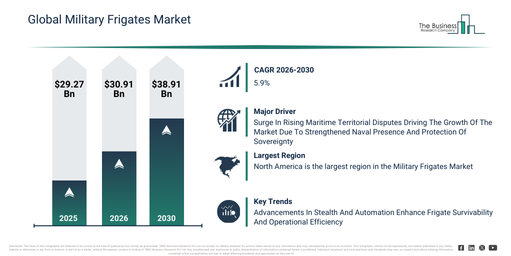
The military frigates market has seen robust expansion in recent years. It is forecast to increase from $29.27 billion in 2025 to $30.91 billion in 2026, achieving a compound annual growth rate (CAGR) of 5.6%. The historical growth can be linked to factors like more extensive naval fleet expansions, the implementation of missile and anti-submarine technologies, the incorporation of electronic warfare systems, a rise in global maritime security operations, and the advancement of stealth and modular frigate designs.
The market for military frigates is projected to experience substantial expansion over the upcoming years. By 2030, this market is anticipated to reach a value of $38.91 billion, growing at a compound annual growth rate (CAGR) of 5.9%. This projected growth during the forecast period is largely due to factors such as the deployment of next-generation stealth frigates, their integration with unmanned naval systems, the implementation of sophisticated command and control technologies, the increase in export and collaborative naval initiatives, and the incorporation of hybrid propulsion and energy-efficient systems. Significant trends expected throughout this period encompass an escalating demand for multi-mission frigate platforms, increasing incorporation of advanced stealth hull designs, broadened long-range maritime surveillance capabilities, a surge in the adoption of modular weapon and sensor upgrades, and an intensified focus on blue-water naval force projection.
Get A Free Sample Report With In-Depth Market Insights:
Military Frigates Market Expansion Drivers: What’s Shaping Future Growth?
The expansion of the military frigates market is projected to be driven by increasing maritime territorial disputes. These disputes involve disagreements or clashes among nations regarding the ownership, management, or utilization of ocean territories, such as territorial waters, exclusive economic zones (EEZs), and maritime boundaries. An increase in such disputes arises when countries frequently assert overlapping claims to sea boundaries, resulting in confrontations over access to resources, strategic waterways, and exclusive economic zones. Military frigates play a role in managing maritime territorial disputes by establishing a nation’s naval presence, protecting claimed sea areas, and discouraging unauthorized entry. For example, in May 2025, the Office of the United Nations High Commissioner for Refugees, a UN agency based in Switzerland, reported that approximately 427 Rohingya refugees lost their lives at sea during two distinct boat incidents near the Myanmar coast. Consequently, the escalating maritime territorial disputes are stimulating the expansion of the military frigates market.
Military Frigates Market Segmentation: How Does The Market Break Down By Category?
The military frigates market covered in this report is segmented –
1) By Type: Multi-role Frigates, Anti-Submarine Warfare (ASW) Frigates, Air Defense Frigates, Gunnery Frigates, Ballistic Surface Vessels (BSV)
2) By Technology: Combat Management Systems, Sensors And Surveillance, Propulsion Systems, Weapon Systems, Communication Systems
3) By Platform: Manned Frigates, Unmanned Frigates
4) By Application: Naval Warfare, Patrol Missions, Humanitarian Assistance And Disaster Relief (HADR), Coastal Surveillance, Training And Exercises
5) By End User: Naval Defense Forces, Coast Guards, Private Security Companies, International Organizations, Research Institutions
Subsegments:
1) By Multi-Role Frigates: General Purpose Frigates, Escort Frigates, Patrol Frigates, Command Frigates
2) By Anti-Submarine Warfare Frigates: Hunter-Killer Frigates, Escort Submarine Frigates, Surveillance And Reconnaissance Frigates, Integrated Anti-Submarine Warfare Frigates
3) By Air Defense Frigates: Surface To Air Missile Frigates, Long Range Air Defense Frigates, Short Range Air Defense Frigates, Multi-Layer Air Defense Frigates
4) By Gunnery Frigates: Artillery Focused Frigates, Close In Weapon System Frigates, Naval Gunfire Support Frigates, Rapid Fire Gun Frigates
5) By Ballistic Surface Vessels (BSV): Missile Equipped Ballistic Surface Vessels, Strategic Strike Ballistic Surface Vessels, Tactical Support Ballistic Surface Vessels, Coastal Defense Ballistic Surface Vessels
Military Frigates Market Strategic Trends: What Defines The Next Growth Phase?
Leading entities within the military frigates market are prioritizing the adoption of cutting-edge technologies, particularly stealth technology, to improve resilience and minimize detection in challenging operational zones. Stealth technology involves employing specific designs and materials to render naval vessels, aircraft, or vehicles less discernible by radar, sonar, and other sensing systems, thereby facilitating evasion, mitigating attack vulnerabilities, and boosting mission efficacy. An example of this is the launch of the 11th Mogami-class multirole frigate, Tatsuta, by Japan’s Mitsubishi Heavy Industries, Ltd. in July 2025, specifically for the Japan Maritime Self-Defense Force. This particular vessel incorporates sophisticated stealth design features, a streamlined hull, and contemporary missile armaments, which contribute to its superior survivability and adaptability during operations in disputed sea areas. The Tatsuta, an 11th Mogami-class multirole frigate, utilizes a combined diesel and gas (CODAG) propulsion system, achieving speeds exceeding 30 knots. Its compact architecture and advanced automated systems permit efficient operation with a minimal crew of approximately 90 individuals, rendering it exceptionally well-suited for prolonged missions and prompt intervention tasks in the waters surrounding Japan.
Military Frigates Market Competitive Overview And Top Companies
Major companies operating in the military frigates market are BAE Systems Plc, Fincantieri S.p.A, Naval Group, Mitsubishi Heavy Industries, Damen Shipyards Group, Hanwha Ocean, Thyssenkrupp Marine Systems (TKMS), China State Shipbuilding Corporation (CSSC), General Dynamics Corp., Huntington Ingalls Industries, Rosoboronexport, Mazagon Dock Shipbuilders Limited, Fr. Lürssen Werft GmbH And Co KG, Garden Reach Shipbuilders, Turkish Naval Shipyards, Navantia S.A, Goa Shipyard Limited, Babcock International, STM (Savunma Teknolojileri Mühendislik), HD Hyundai Heavy Industries (HD HHI) (Formerly Hyundai Heavy Industries), Israel Shipyards Ltd, K Shipbuilding Co Ltd
View The Full Military Frigates Market Report:
Military Frigates Market Top Region: Where Does Most Revenue Come From?
North America was the largest region in the military frigates market in 2025. Asia-Pacific is expected to be the fastest-growing region in the forecast period. The regions covered in the military frigates market report are Asia-Pacific, South East Asia, Western Europe, Eastern Europe, North America, South America, Middle East, Africa.
Reach Out To Our Team:
The Business Research Company: https://www.thebusinessresearchcompany.com/
Americas: +1 310-496-7795
Asia: +44 7882 955267 & +91 8897263534
Europe: +44 7882 955267
Email us at: marketing@tbrc.info
Follow us on:
LinkedIn: https://in.linkedin.com/company/the-business-research-company
YouTube: https://www.youtube.com/channel/UC24_fI0rV8cR5DxlCpgmyFQ
Global Market Model: https://www.thebusinessresearchcompany.com/global-market-model

Wasay has over a decade of experience in market research, data modelling, and analytics, with prior experience at GlobalData and Decision Tree Consulting Services. At The Business Research Company , he leads research operations across syndicated studies, customized consulting engagements, and the Global Market Model platform. His professional experience includes supporting organizations such as Boston Consulting Group, KPMG, and Ernst & Young. Wasay holds a degree in Electronics and Communications Engineering, postgraduate management qualifications from International Management Institute Belgium and Indian School of Business and Entrepreneurship, and completed the Integrated Program in Business Analytics from Indian Institute of Management Indore.