
With a focus on actionable insights and strategic value, The Business Research Company’s 2026 market reports include market attractiveness scoring, total addressable market sizing, company benchmarking matrices, interactive Excel dashboards, deeper supply chain intelligence, emerging startup tracking, and granular product-level insights.
Military Optical Fiber Sensor Market Size Snapshot: 2026 Valuation, 2030 Projection And Key Growth Factors
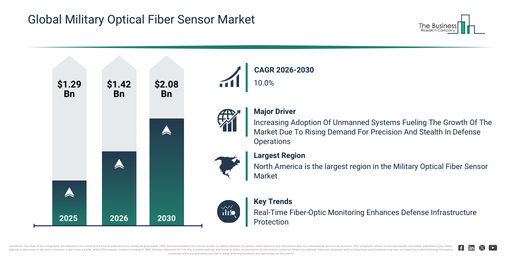
The military optical fiber sensor market size has experienced significant expansion in recent years. It is anticipated to increase from $1.29 billion in 2025 to $1.42 billion in 2026, exhibiting a compound annual growth rate (CAGR) of 10.1%. This historical growth can be attributed to several factors, including the increasing adoption of optical fiber sensors for structural health monitoring in military platforms, the growing deployment of distributed acoustic sensing for perimeter and underwater surveillance, continuous advancements in fiber Bragg grating technology that enhance measurement accuracy, a rising demand for electromagnetic interference–immune sensors in electronic warfare environments, and the expansion of defense research programs that support the development of advanced fiber sensing solutions.
The size of the military optical fiber sensor market is anticipated to experience rapid expansion over the coming years. It is projected to increase to $2.08 billion in 2030, demonstrating a compound annual growth rate (CAGR) of 10.0%. This growth during the forecast period is primarily driven by the increasing demand for high-resolution distributed temperature sensing in vital defense infrastructure, the growing integration of optical fiber sensors into autonomous and unmanned defense systems, rising investment in multi-parameter sensing solutions for enhanced battlefield awareness, the expansion of military modernization efforts necessitating advanced sensing technologies, and accelerating innovation in ruggedized and miniaturized fiber sensor designs for harsh operational environments. Significant trends expected during this period include the increased deployment of distributed acoustic sensing (DAS) for perimeter and border surveillance, a rising demand for FBG-based structural health monitoring across military platforms, the growth in underwater fiber-optic sensing systems for naval intelligence and anti-submarine missions, the integration of optical fiber sensors into advanced missile and UAV guidance systems, and the adoption of robust fiber-optic sensor solutions for extreme battlefield environments.
Get A No-Cost Sample Of The Military Optical Fiber Sensor Market Study:
Major Factor Fueling The Military Optical Fiber Sensor Market Through 2030
The future expansion of the military optical fiber sensor market is anticipated to be driven by the growing integration of unmanned systems. These systems are autonomous or remote-controlled platforms utilized in air, land, sea, or space environments for surveillance, reconnaissance, and combat operations, eliminating the need for human presence on board. The increasing use of unmanned systems stems from their capacity to execute hazardous missions, thereby reducing risks to human staff and enhancing both safety and operational effectiveness. Military optical fiber sensors boost the capabilities of unmanned systems by offering accurate sensing and communication functions with minimal electromagnetic interference, which is crucial for covert and essential missions. As an illustration, in May 2024, the International Trade Administration, a US-based government agency, forecasted a 40% rise in the global number of commercially operated drones between 2022 and 2030. Consequently, the expanding utilization of unmanned systems is a key factor propelling the growth of the military optical fiber sensor market.
Military Optical Fiber Sensor Market Segment Landscape: Main Categories And Subcategories Covered
The military optical fiber sensor market covered in this report is segmented –
1) By Type: Intrinsic Sensors, Extrinsic Sensors
2) By Platform: Airborne, Naval, Ground
3) By Application: Temperature Sensing, Pressure Sensing
4) By End-User: Defense, Homeland Security
Subsegments:
1) By Intrinsic Sensors: Fiber Bragg Grating (FBG) Sensors, Distributed Temperature Sensors (DTS), Distributed Acoustic Sensors (DAS), Interferometric Sensors
2) By Extrinsic Sensors: Intensity-Modulated Sensors, Phase-Modulated Sensors, Polarization-Modulated Sensors, Wavelength-Modulated Sensors
How Are Emerging Trends Influencing The Military Optical Fiber Sensor Market’s Growth Path?
Leading companies operating in the military optical fiber sensors market are focusing on developing innovative solutions, such as real-time, distributed fiber-optic monitoring systems, to enhance threat detection, structural health monitoring, and situational awareness across defense platforms. A real-time, distributed fiber-optic monitoring system is a sensing technology that utilizes optical fibers to continuously and simultaneously identify physical changes like strain, temperature, or vibration along their entire length in real-time. For instance, in July 2024, VIAVI Solutions Inc., a US-based communications equipment company, launched NITRO fiber sensing for real-time, distributed fiber-optic monitoring in the military and critical infrastructure. This solution delivers continuous, real-time critical infrastructure monitoring by employing advanced fiber-optic cable and fiber-enabled technologies to detect, pinpoint, and mitigate threats, thus reducing downtime and lowering ownership costs. Its proactive alerting and accurate location capabilities support swift response and maintenance, improving efficiency, security, and asset protection across multiple industries.
Military Optical Fiber Sensor Market Leading Players And Key Industry Participants In 2026
Major companies operating in the military optical fiber sensor market are Northrop Grumman Corporation, Honeywell International Inc., Prysmian Group, Corning Incorporated, AFL Telecommunications LLC, Exail Holding, Gooch & Housego PLC., KVH Industries Inc., Luna Innovations Incorporated., NKT Photonics A/S, Opsens Solutions Inc., FISO Technologies Inc., Timbercon Inc., Roctest Ltd., AP Sensing GmbH, Ava Risk Group Limited, ITF Technologies Inc., MagiQ Technologies Inc., FBGS Technologies GmbH, Fiber SenSys Inc,
Check Out The Full Military Optical Fiber Sensor Market Report 2026:
Military Optical Fiber Sensor Market By Geography: Revenue Leaders Among Global Regions
North America was the largest region in the military optical fiber sensor market in 2025. Asia-Pacific is expected to be the fastest-growing region in the forecast period. The regions covered in the military optical fiber sensor market report are Asia-Pacific, South East Asia, Western Europe, Eastern Europe, North America, South America, Middle East, Africa.
Reach Out To Our Team:
The Business Research Company: https://www.thebusinessresearchcompany.com/
Americas: +1 310-496-7795
Asia: +44 7882 955267 & +91 8897263534
Europe: +44 7882 955267
Email us at: marketing@tbrc.info
Follow us on:
LinkedIn: https://in.linkedin.com/company/the-business-research-company
YouTube: https://www.youtube.com/channel/UC24_fI0rV8cR5DxlCpgmyFQ
Global Market Model: https://www.thebusinessresearchcompany.com/global-market-model

Wasay has over a decade of experience in market research, data modelling, and analytics, with prior experience at GlobalData and Decision Tree Consulting Services. At The Business Research Company , he leads research operations across syndicated studies, customized consulting engagements, and the Global Market Model platform. His professional experience includes supporting organizations such as Boston Consulting Group, KPMG, and Ernst & Young. Wasay holds a degree in Electronics and Communications Engineering, postgraduate management qualifications from International Management Institute Belgium and Indian School of Business and Entrepreneurship, and completed the Integrated Program in Business Analytics from Indian Institute of Management Indore.

