Featuring market attractiveness scoring, total addressable market sizing, company benchmarking matrices, interactive Excel dashboards, deeper supply chain intelligence, emerging startup tracking, and granular product-level insights, The Business Research Company’s 2026 market reports are built to deliver research that is both more actionable and more strategically valuable.
Military Radars Market Growth From $67.14 Billion In 2026 To $90.94 Billion By 2030 At A CAGR Of 7.9%
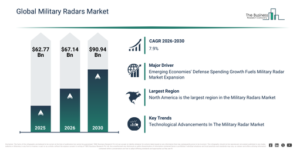
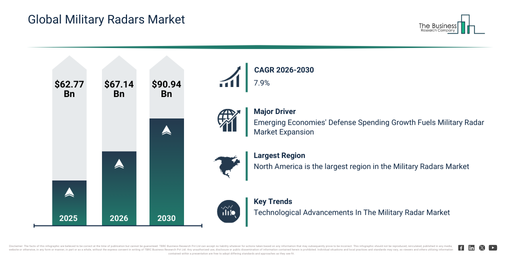
The military radars market has demonstrated robust growth in recent years. It is projected to increase from $62.77 billion in 2025 to $67.14 billion in 2026, at a compound annual growth rate (CAGR) of 7.0%. The expansion observed in the past can be attributed to the development and deployment of pulse and MTL radar systems for military surveillance, enhancements in radar detection and signal processing technologies, the expansion of defense infrastructure requiring advanced radar coverage, government defense contracts fueling radar production, and the integration of imaging radar systems for reconnaissance and targeting.
The military radars market size is anticipated to experience significant expansion in the coming years. It is projected to achieve a valuation of $90.94 billion by 2030, growing at a compound annual growth rate (CAGR) of 7.9%. This expected growth throughout the forecast period stems from factors such as increasing demand for high-resolution and long-range military radars, the adoption of AI and machine learning for enhanced target detection and tracking, the rise of integrated multi-domain radar systems designed for air, land, and sea operations, growing investment in mobile and deployable radar solutions, and the modernization of existing radar networks to improve situational awareness. Prominent trends observed in the forecast period involve the development of high-resolution imaging radar systems, the miniaturization of radar components for mobile deployment, the integration of multi-sensor fusion for superior target tracking, the expansion of radar upgrade and retrofit services for legacy systems, and the implementation of low-probability-of-intercept (LPI) radar technologies.
Get A Free Sample Report With In-Depth Market Insights:
Military Radars Market Growth Factors: What’s Supporting Expansion?
The increasing expenditure on defense is anticipated to drive the expansion of the military radar market in the future. Defense spending encompasses the overall funds allocated by a nation’s government for its armed forces, military operations, technological advancements, and the acquisition of equipment. This expenditure is escalating due to heightened geopolitical tensions and the imperative to modernize military capabilities, bolster national security, and sustain strategic superiority against potential opponents. The rise in defense spending facilitates the development and deployment of military radar systems by equipping governments with the necessary financial means to invest in sophisticated radar technologies, improve surveillance and detection abilities, and enhance current defense infrastructure to effectively counter new security threats. As an illustration, in October 2025, the UK Parliament’s House of Commons Library, a government administration in the UK, reported that defense spending detailed in the 2025 Spending Review is projected to reach USD 83.3 billion (£62.2 billion) in 2025/26, subsequently rising to USD 98.2 billion (£73.5 billion) by 2028/29, representing an average annual real-terms growth rate of 3.8% during this timeframe. This increase in defense expenditure is thus fueling the expansion of the military radar market.
Military Radars Market Breakdown By Product Type And Application
The military radars market covered in this report is segmented –
1) By Type: Land Radar, Naval Radar, Airborne Radar, Space-Based Radar
2) By Functionality: Surveillance And Airborne Early Warning Radar, Tracking And Fire Control Radar, Multi-Function Radar, Synthetic Aperture And Moving Target Indicator Radar, Ground Penetrating Radar
3) By Application: Weapon Guidance, Airspace Monitoring And Traffic Management, Ground Surveillance And Intruder Detection, Air And Missile Defense, Navigation, Airborne Mapping, Ground Force Protection And Counter-Battery, Mine-Detection And Underground Mapping
Subsegments:
1) By Land Radar: Ground Surveillance Radar, Border Surveillance Radar, Tactical Surveillance Radar
2) By Naval Radar: Surface Search Radar, Fire Control Radar, Navigation Radar
3) By Air Radar: Fighter Aircraft Radar, Surveillance Aircraft Radar, Early Warning Radar, Maritime Patrol Radar
4) By Space-Based Radar: Synthetic Aperture Radar (SAR), Early Warning Radar, Surveillance Radar
Military Radars Market Industry Trends: What’s Reshaping Demand?
Leading companies in the military radar market are concentrating on developing innovative products, such as passive radar, to deliver reliable services to customers. Passive radar is a radar system that identifies and tracks objects by analyzing reflections from non-cooperative illumination sources present in the environment, like commercial broadcast and communications signals. For example, in August 2023, Hensoldt AG, a Germany-based supplier of defense and security electronics, unveiled Twinvis Military Sheltered. This passive radar is built with the newest digital technology and holds potential for application in civil air traffic control over the medium term or for long-range military airspace monitoring. Only two individuals are needed to set up and dismantle the Twinvis Sheltered in the field, and it can be flexibly and easily transported on military carrier trucks. The system encompasses infrastructure, a processor, and a high-performance antenna unit. Furthermore, its modular system architecture supports the processing of multiple digital frequency bands, empowering users and procurers to plan for future incremental upgrades and growth potential.
Military Radars Market Company Landscape And Competitive Strategy
Major companies operating in the military radars market are Lockheed Martin Corporation, Raytheon Technologies Corporation, Thales Group, BAE Systems plc, Israel Aerospace Industries, Leonardo, Saab AB, Aselsan A.Ş., Hensoldt AG, Airbus SE, General Dynamics Corp, Northrop Grumman, Honeywell International Inc., L3Harris Technologies Inc., Terma A/S, QinetiQ Group PLC, Reutech Radar Systems, Easat Radar Systems Limited, Indra Sistemas S.A., Bharat Electronics Limited, ZTE Corporation, Elbit Systems Ltd., Wartsila Corporation, Mitsubishi Electric Corporation, Safran Electronics & Defense, Selex ES Inc.
View The Full Military Radars Market Report:
Military Radars Market Regional Breakdown: Where Is Demand Concentrated?
North America was the largest region in the military radar market in 2025. North America is expected to be the fastest-growing region in the military radars market during the forecast period. The regions covered in the military radars market report are Asia-Pacific, South East Asia, Western Europe, Eastern Europe, North America, South America, Middle East, Africa.
Reach Out To Our Team:
The Business Research Company: https://www.thebusinessresearchcompany.com/
Americas: +1 310-496-7795
Asia: +44 7882 955267 & +91 8897263534
Europe: +44 7882 955267
Email us at: marketing@tbrc.info
Follow us on:
LinkedIn: https://in.linkedin.com/company/the-business-research-company
YouTube: https://www.youtube.com/channel/UC24_fI0rV8cR5DxlCpgmyFQ
Global Market Model: https://www.thebusinessresearchcompany.com/global-market-model

Wasay has over a decade of experience in market research, data modelling, and analytics, with prior experience at GlobalData and Decision Tree Consulting Services. At The Business Research Company , he leads research operations across syndicated studies, customized consulting engagements, and the Global Market Model platform. His professional experience includes supporting organizations such as Boston Consulting Group, KPMG, and Ernst & Young. Wasay holds a degree in Electronics and Communications Engineering, postgraduate management qualifications from International Management Institute Belgium and Indian School of Business and Entrepreneurship, and completed the Integrated Program in Business Analytics from Indian Institute of Management Indore.