
Designed to make market research more actionable and strategically valuable, The Business Research Company’s 2026 market reports feature market attractiveness scoring, total addressable market sizing, company benchmarking matrices, interactive Excel dashboards, deeper supply chain intelligence, emerging startup tracking, and granular product-level insights.
Military Robotic and Autonomous System (RAS) Market Forecast 2026–2030: Size, Value And Compound Annual Growth Rate
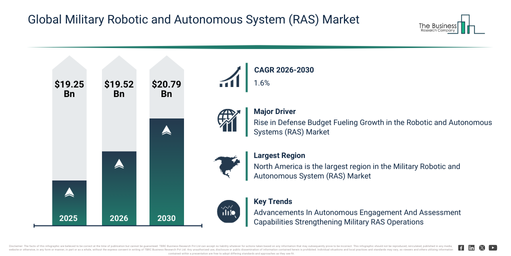
The market size for military robotic and autonomous systems (RAS) has seen a slight expansion over recent years. This market is projected to expand, reaching $19.25 billion in 2025 and subsequently $19.52 billion in 2026, demonstrating a compound annual growth rate (CAGR) of 1.4%. Historically, this growth was driven by several factors, including the heightened need for unmanned vehicles in military operations, developments in AI and sensor technologies facilitating autonomous decision-making, increased funding for surveillance, reconnaissance, and combat robotics, the wider implementation of teleoperated robotic systems for explosive ordnance disposal, and governmental defense budgets fueling research and development in military robotics and automation.
The military robotic and autonomous system (ras) market size is anticipated to experience modest expansion over the coming years. It is projected to reach $20.79 billion in 2030, exhibiting a compound annual growth rate (CAGR) of 1.6%. This growth during the projection period can be ascribed to factors such as the expanding use of autonomous systems in logistics and maintenance operations, the integration of AI-driven target recognition and threat assessment, the development of swarm robotics for coordinated military missions, the increasing adoption of lidar, radar, and advanced sensing devices in autonomous platforms, and a heightened focus on personnel management and operational efficiency through robotic systems. Furthermore, major trends in the forecast period encompass a rising demand for multi-role unmanned systems integrating ISR and combat functions, an increasing deployment of autonomous ground robots for logistics and support tasks, advancements in sensor fusion incorporating lidar, radar, and visual systems, growth in maritime autonomous platforms for underwater reconnaissance, and the adoption of robotic EOD systems for high-risk mine clearance and CBRN operations.
Try Before You Buy: Free Sample Of The Military Robotic and Autonomous System (RAS) Market Report:
Military Robotic and Autonomous System (RAS) Market Growth Engine: The Factor Boosting Demand Globally
An anticipated increase in defense expenditure is projected to fuel expansion within the military robotic and autonomous systems (RAS) market in the future. A defense budget represents the financial allocation and strategic resources assigned to a nation’s armed forces, covering diverse areas like research, development, procurement, and ongoing support for military hardware, advanced technologies, and operational capacities. This budget specifically incorporates financial provisions for the creation, integration, and acquisition of RAS technologies, aiming to bolster military capabilities and elevate operational effectiveness. As an illustration, the UK Defence in Numbers 2023 report, issued by the UK-based government body, the Ministry of Defence, indicated in April 2024 that £2.3 billion was allocated for military support in both 2022 and 2023, with plans to increase this to £2.5 billion in the subsequent year. Concurrently, overall defense spending climbed from £52.8 billion in 2022/23 to £54.2 billion in 2023/24. Consequently, increased defense spending is a primary catalyst for the expansion of the military robotic and autonomous systems (RAS) market.
Which Categories And Subcategories Shape The Military Robotic and Autonomous System (RAS) Market?
The military robotic and autonomous system (ras) market covered in this report is segmented –
1) By Platform: Unmanned Aircraft Systems, Unmanned Ground And Robotic Systems, Unmanned Maritime Systems
2) By Operation: Remote Controlled, Semi-Autonomous, Fully Autonomous
3) By Application: Intelligence, Surveillance, And Reconnaissance (ISR), Combat Operation, Target Acquisition, Logistics, Mine Clearance, Explosive Ordnance Disposal (EOD), And Chemical, Biological, Radiological, And Nuclear (CBRN), Infantry Support, Other Applications
Subsegments:
1) By Unmanned Aircraft Systems (UAS): Fixed-Wing Drones, Rotary-Wing Drones (Helicopters), Hybrid Systems, Surveillance And Reconnaissance Drones
2) By Unmanned Ground And Robotic Systems: Robotic Vehicles (UGVs), Bomb Disposal Robots, Tactical Ground Robots, Supply And Logistics Robots
3) By Unmanned Maritime Systems (UMS): Unmanned Surface Vehicles (USVs), Unmanned Underwater Vehicles (UUVs), Autonomous Naval Systems, Maritime Surveillance Drones
Military Robotic and Autonomous System (RAS) Market Trend Insights: Strategic Focus Areas Of Leading Companies
Leading companies in the military robotic and autonomous systems (RAS) market are prioritizing the development of innovative solutions, such as autonomous manned-unmanned teaming, to improve mission efficiency, situational awareness, and operational effectiveness in complex combat environments. Autonomous manned-unmanned teaming describes the synchronized operation of human-controlled and autonomous robotic systems that collaborate to share data, accomplish missions, and enhance overall battlefield effectiveness. For example, in October 2024, RTX Corp., a US-based aerospace and defense enterprise, unveiled effects autonomy capabilities during the U.S. Army’s Experimental Demonstration Gateway Event (EDGE). The demonstration highlighted cooperative solutions from its Collins Aerospace and Raytheon businesses: Collins’ RapidEdge mission system functioned as the control hub for a group of UAVs, while Raytheon deployed autonomy stemming from its battle-tested Coyote unmanned aircraft system. The systems successfully exchanged data via a mesh network to detect, target, and monitor threats and notably proceeded with their mission independently even when command connections to human operators were lost.
Leading Organizations In The Military Robotic and Autonomous System (RAS) Market
Major companies operating in the military robotic and autonomous system (ras) market are RTX Corporation, The Boeing Company, Lockheed Martin Corporation, Hanwha Group, General Dynamics Corporation, Northrop Grumman Corporation, BAE Systems plc, SZ DJI Technology Co. Ltd., Thales Group, L3Harris Technologies Inc., Leonardo SpA, Elbit Systems Ltd., Teledyne Technologies Inc., Israel Aerospace Industries Ltd., Saab AB, General Atomics, Cobham Ltd., QinetiQ Group PLC, iRobot Corporation, Kratos Defense & Security Solutions Inc., AeroVironment Inc., Exail Technologies- Groupe Gorge, Anduril Industries Inc., Parrot Drone SAS, Skydio Inc., Boston Dynamics, Milrem Robotics, Auterion AG, AutoNaut Ltd., Saildrone Inc.
Continue Reading: The Full Military Robotic and Autonomous System (RAS) Market Report:
Military Robotic and Autonomous System (RAS) Market Regional Spotlight: Top Geography And Report Coverage
North America was the largest region in the military robotic and autonomous system market in 2025. The regions covered in the military robotic and autonomous system (ras) market report are Asia-Pacific, South East Asia, Western Europe, Eastern Europe, North America, South America, Middle East, Africa.
Reach Out To Our Team:
The Business Research Company: https://www.thebusinessresearchcompany.com/
Americas: +1 310-496-7795
Asia: +44 7882 955267 & +91 8897263534
Europe: +44 7882 955267
Email us at: marketing@tbrc.info
Follow us on:
LinkedIn: https://in.linkedin.com/company/the-business-research-company
YouTube: https://www.youtube.com/channel/UC24_fI0rV8cR5DxlCpgmyFQ
Global Market Model: https://www.thebusinessresearchcompany.com/global-market-model

Wasay has over a decade of experience in market research, data modelling, and analytics, with prior experience at GlobalData and Decision Tree Consulting Services. At The Business Research Company , he leads research operations across syndicated studies, customized consulting engagements, and the Global Market Model platform. His professional experience includes supporting organizations such as Boston Consulting Group, KPMG, and Ernst & Young. Wasay holds a degree in Electronics and Communications Engineering, postgraduate management qualifications from International Management Institute Belgium and Indian School of Business and Entrepreneurship, and completed the Integrated Program in Business Analytics from Indian Institute of Management Indore.

