
With a focus on actionable insights and strategic value, The Business Research Company’s 2026 market reports include market attractiveness scoring, total addressable market sizing, company benchmarking matrices, interactive Excel dashboards, deeper supply chain intelligence, emerging startup tracking, and granular product-level insights.
Military Sensors Market Size Outlook: A $15.32 Billion Market By 2030, Growing At 6.1% Annually
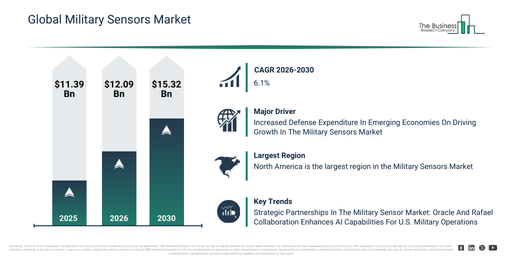
The military sensors market has experienced robust expansion in recent years. Projections indicate this market will increase from $11.39 billion in 2025 to $12.09 billion in 2026, demonstrating a compound annual growth rate (CAGR) of 6.2%. Historically, this growth can be attributed to several factors: the increased adoption of imaging and acoustic sensors for improved target detection and tracking capabilities; the rising deployment of proximity and pressure sensors that support weapon control and navigation systems; the expansion of night-vision surveillance operations which has driven demand for sophisticated sensor technologies; the broadening of counter-IED activities leading to greater use of seismic and magnetic sensors for hidden bomb detection; and advancements in GPS sensor integration, which have enhanced real-time situational awareness across various platforms.
The military sensors market size is projected to experience robust expansion in the coming years, with its value anticipated to reach $15.32 billion by 2030, exhibiting a compound annual growth rate (CAGR) of 6.1%. This growth during the forecast period can be linked to several factors, including the creation of AI-powered sensor fusion systems that enhance data accuracy and decision-making, an increasing need for compact, low-power sensors ideal for unmanned platforms, greater funding in multi-spectral and hyperspectral sensing to improve battlefield awareness, the rise of autonomous weapon systems necessitating precise environmental sensing, and the expansion of network-centric warfare programs facilitating the deployment of integrated, real-time military sensor networks. Key trends expected over the forecast period encompass smaller and lighter sensor designs, capabilities for integrating and fusing multiple sensors, real-time data processing and analytical tools, improved resilience against environmental conditions and combat, and functionalities for wireless connectivity and remote surveillance.
Make Data-Driven Decisions With A Free Military Sensors Market Sample Report:
Key Demand Driver Expected To Lift Military Sensors Market Revenue
The rising defense expenditure by developing nations is a major factor boosting the military sensors market’s expansion. This expenditure signifies the financial resources a nation allocates to establish and maintain its military forces or engage in other defense initiatives. It encompasses operational costs, upkeep, the acquisition of armaments and armored vehicles, and military-focused research and development. Such spending is directed towards obtaining goods and services like weapons, sensors, and military R&D, thereby fueling the demand for military sensors. For example, data released in April 2025 by the Stockholm International Peace Research Institute (SIPRI), an independent international research body based in Sweden, indicated that global military expenditure climbed to $2718 billion in 2024. This marked a continuous annual increase for ten years, with spending escalating by 37 per cent between 2015 and 2024. Consequently, the increasing defense outlay by emerging economies is expected to propel the military sensors market in the foreseeable future.
Exploring The Military Sensors Market Through Its Key Segments
The military sensors market covered in this report is segmented –
1) By Component: Software, Hardware
2) By Platform: Airborne, Land, Naval
3) By Application: Intelligence, Surveillance, And Reconnaissance (ISR), Communication And Navigation, Target Recognition, Electronic Warfare, Command And Control, Other Applications
Subsegments:
1) By Software: Data Analysis Software, Sensor Fusion Software, Monitoring And Control Software, Simulation Software, Operating Systems for Sensors
2) By Hardware: Radar Sensors, Infrared Sensors, Acoustic Sensors, Electro-Optical Sensors, Chemical Sensors, Pressure Sensors, Temperature Sensors, Motion Sensors
New Trends Redefining Competition In The Military Sensors Market
Companies prominently involved in the military sensor market are concentrating on forging strategic partnerships to achieve a competitive advantage. These alliances are critical for meeting the evolving requirements of modern military operations. For instance, in September 2024, Oracle, a US-based technology company, formed a partnership with Rafael Advanced Defense Systems, an Israeli-based defense technology company. This collaboration aimed at enhancing the capabilities of the U.S. military using cloud-based artificial intelligence (AI) solutions. The focus of this joint effort is to integrate Rafael’s advanced systems, specifically the IMILITE and FIRE WEAVER, into Oracle’s Cloud Infrastructure (OCI) to improve decision-making in vital battlefield scenarios. This partnership will provide the U.S. military access to Rafael’s AI-powered imagery intelligence and sensor-to-shooter systems, which are essential for making swift and informed decisions during missions.
Military Sensors Market Competition: Key Players And Industry Participants
Major companies operating in the military sensors market are BAE Systems PLC, Curtiss-Wright Corporation, Esterline Technologies Corporation, Honeywell International Inc., Lockheed Martin Corporation, Raytheon Technologies Corporation, TE Connectivity Ltd., Thales Group, General Electric Company, Imperx Inc., Microflown AVISA BV, Vectornav Technologies LLC, Rock West Solutions Inc., KONGSBERG GRUPPEN ASA, Ultra Electronics, Aerosonic LLC, Viooa Imaging Technology Inc., Northrop Grumman Corporation, L3Harris Technologies Inc., Safran Electronics & Defense, Leonardo S.p.A., Rheinmetall AG, Elbit Systems Ltd., FLIR Systems Inc., Collins Aerospace, Cobham plc, Moog Inc., Meggitt PLC, QinetiQ Group plc, Terma A/S, ASELSAN A.S., RADA Electronic Industries Ltd., Israel Aerospace Industries Ltd., Rafael Advanced Defense Systems Ltd., Bharat Electronics Limited, Hindustan Aeronautics Limited
Get The Detailed Military Sensors Market Research Report Here:
Military Sensors Market Regional Overview: Largest Market And Global Coverage
North America was the largest region in the military sensors market in 2025. The regions covered in the military sensors market report are Asia-Pacific, South East Asia, Western Europe, Eastern Europe, North America, South America, Middle East, Africa.
Reach Out To Our Team:
The Business Research Company: https://www.thebusinessresearchcompany.com/
Americas: +1 310-496-7795
Asia: +44 7882 955267 & +91 8897263534
Europe: +44 7882 955267
Email us at: marketing@tbrc.info
Follow us on:
LinkedIn: https://in.linkedin.com/company/the-business-research-company
YouTube: https://www.youtube.com/channel/UC24_fI0rV8cR5DxlCpgmyFQ
Global Market Model: https://www.thebusinessresearchcompany.com/global-market-model

Wasay has over a decade of experience in market research, data modelling, and analytics, with prior experience at GlobalData and Decision Tree Consulting Services. At The Business Research Company , he leads research operations across syndicated studies, customized consulting engagements, and the Global Market Model platform. His professional experience includes supporting organizations such as Boston Consulting Group, KPMG, and Ernst & Young. Wasay holds a degree in Electronics and Communications Engineering, postgraduate management qualifications from International Management Institute Belgium and Indian School of Business and Entrepreneurship, and completed the Integrated Program in Business Analytics from Indian Institute of Management Indore.

