
Delivering more actionable and strategically valuable research, The Business Research Company’s 2026 market reports feature market attractiveness analysis, total addressable market evaluation, company benchmarking matrices, interactive Excel dashboards, expanded supply chain intelligence, emerging startup coverage, and detailed product insights.
#Military Simulation And Virtual Training Market Size And Revenue Forecast Through 2030
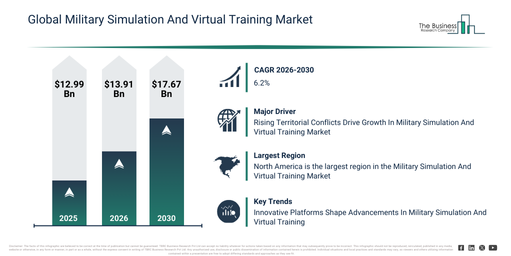
The military simulation and virtual training market size has shown robust growth in recent years. It is forecast to increase from $12.99 billion in 2025 to $13.91 billion in 2026, achieving a compound annual growth rate (CAGR) of 7.1%. This historical expansion can be attributed to an accelerating transition from live training to virtual simulation for cost reduction, initial progress in simulation software enhancing training accuracy, a growing requirement for secure training environments in high-risk military scenarios, the increasing intricacy of military equipment demanding simulation-based skill enhancement, and the broader integration of virtual training motivated by the necessity to minimize wear on armaments and gear.
The military simulation and virtual training market is projected for substantial expansion in the coming years. It is anticipated to reach $17.67 billion by 2030, exhibiting a compound annual growth rate (CAGR) of 6.2%. This anticipated growth is driven by several factors, including the increasing integration of artificial intelligence for more adaptive and personalized military training, the expanding use of immersive technologies like augmented and virtual reality for realistic mission rehearsals, a rising need for interconnected and multi-domain simulation platforms, the expansion of defense modernization initiatives fueling investments in advanced simulation systems, and the embrace of cloud-enabled simulation architectures to facilitate scalable and remote training setups. Key trends during this forecast period involve a greater uptake of equipment skill simulation training, the broadening of campaign tactics simulation training, an increase in strategy simulation and operational planning training, a rising demand for multi-platform training encompassing flight, vehicle, battlefield, and virtual boot camp scenarios, and a strong focus on training methods that are both time and cost-efficient.
Download A Free Sample Report For Comprehensive Market Insights:
Military Simulation And Virtual Training Market Opportunity Drivers: What Is Creating New Revenue Potential?
The future expansion of the military simulation and virtual training market is anticipated due to a surge in territorial conflicts. These disputes involve disagreements over the control of a specific geographic area. Annually, individuals undergo military training to safeguard national security. In many military equipment training programs, military simulation and virtual training are employed, offering benefits such as conservation of time and effort, alongside mitigating technical wear on weaponry and gear. As an illustration, data from the Home Office, a UK government department, indicated that by September 2025, 83 individuals had faced trials for terrorism-related offenses in the year concluding 30 June 2025, representing an increase of five compared to the figure for the year ending 30 June 2024. Consequently, the escalation of territorial conflicts fuels the expansion of the military simulation and virtual training market.
Military Simulation And Virtual Training Market Segment Landscape: Which Areas Lead Market Development?
The military simulation and virtual training market covered in this report is segmented –
1) By Platform Type: Flight, Vehicle, Battlefield, Virtual Boot Camp
2) By Training Type: Gaming Solution, Virtual, Constructive, Live
3) By End-User: Air Force, Army, Navy, Medical
Subsegments:
1) By Flight: Fixed-Wing Aircraft, Rotary-Wing Aircraft, Unmanned Aerial Vehicles (UAVs)
2) By Vehicle: Ground Vehicles, Armored Vehicles, Naval Vehicles
3) By Battlefield: Individual Soldier Training, Unit-Level Training, Command And Staff Training
4) By Virtual Boot Camp: Basic Combat Training, Advanced Individual Training, Specialized Skill Training
#Military Simulation And Virtual Training Market Growth Trends: What Is Influencing The Future Outlook?
Major companies within the military simulation and virtual training market are increasingly focusing on technological advancements, such as the integration of radio over internet protocol (ROIP), to elevate realism, foster interoperability, and enhance communication efficiency between live and simulated training environments. Radio over Internet Protocol (RoIP) integration establishes connections between traditional radio systems and IP networks, enabling the transmission of voice and data across the internet, which facilitates long-distance communication, system compatibility, centralized management, and cost-effective connectivity. For instance, in June 2024, PLEXSYS Interface Products, Inc., a US-based company providing simulation and training solutions, introduced Sonomarc 4.11, which brought significant enhancements to improve simulation and training capabilities. Key features include Dynamic Weather, offering real-time weather updates that influence RF propagation, and Virtual People Integration, which permits voice recognition and response over the radio. This virtual person can execute commands, interact with ASCOT 5/7, and respond to radio calls. Users are able to configure voice settings and customize commands. The system integrates effortlessly with ASCOT 7 via the Sonomarc REST API, allowing for dynamic voice control configurations without requiring modifications to the software.
Military Simulation And Virtual Training Market Industry Leaders And Market Competition
Major companies operating in the military simulation and virtual training market are Northrop Grumman Corporation, Cubic Corporation, CAE Inc., RTX Corporation, Lockheed Martin Corporation, BAE Systems PLC, The Boeing Company, Saab AB, Thales Group, Rheinmetall AG, Raytheon Technologies Corporation, General Dynamics Information Technology Inc., Kratos Defense & Security Solutions Inc., L3Harris Technologies Inc., Elbit Systems Ltd., AAI Corporation, Barco NV, Fidelity Technologies Corporation, Meggitt Training Systems, Simthetiq Inc., Bohemia Interactive Simulations, Presagis Inc., Epic Games Inc., DiSTI Corporation, MAK Technologies Inc., Antycip Simulation Limited, SimCentric Technologies, QuantaDyn Corporation, ThoroughTec Simulation (Pty) Ltd., Leonardo S.p.A
Access The Complete Military Simulation And Virtual Training Market Report:
Military Simulation And Virtual Training Market Geographic Distribution And Regional Opportunities
North America was the largest region in the military simulation and virtual training market in 2025. The regions covered in the military simulation and virtual training market report are Asia-Pacific, South East Asia, Western Europe, Eastern Europe, North America, South America, Middle East, Africa.
Access a Customized Military Simulation And Virtual Training Market Report for Deeper Competitive Insights
https://www.thebusinessresearchcompany.com/customise?id=8474&type=smp
The Business Research Company: https://www.thebusinessresearchcompany.com/
Americas: +1 310-496-7795
Asia: +44 7882 955267 & +91 8897263534
Europe: +44 7882 955267
Email us at: marketing@tbrc.info
Follow us on:
LinkedIn: https://in.linkedin.com/company/the-business-research-company
YouTube: https://www.youtube.com/channel/UC24_fI0rV8cR5DxlCpgmyFQ
Global Market Model: https://www.thebusinessresearchcompany.com/global-market-model

Wasay has over a decade of experience in market research, data modelling, and analytics, with prior experience at GlobalData and Decision Tree Consulting Services. At The Business Research Company , he leads research operations across syndicated studies, customized consulting engagements, and the Global Market Model platform. His professional experience includes supporting organizations such as Boston Consulting Group, KPMG, and Ernst & Young. Wasay holds a degree in Electronics and Communications Engineering, postgraduate management qualifications from International Management Institute Belgium and Indian School of Business and Entrepreneurship, and completed the Integrated Program in Business Analytics from Indian Institute of Management Indore.
