
Backed by market attractiveness analysis, total addressable market sizing, company benchmarking matrices, interactive Excel dashboards, wider supply chain intelligence, emerging startup coverage, and detailed product-level insights, The Business Research Company’s 2026 market reports are designed to offer research that is more actionable and strategically valuable than ever.
Military Tactical Vehicle Market Size And Revenue Outlook Through 2030
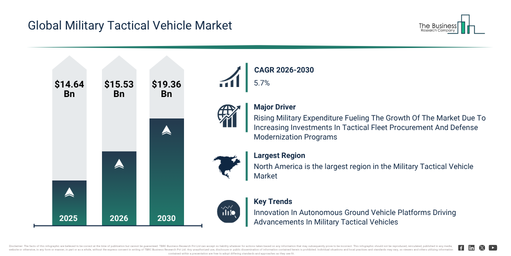
The military tactical vehicle market has shown significant growth over recent years. This market is expected to expand from $14.64 billion in 2025 to $15.53 billion in 2026, achieving a compound annual growth rate (CAGR) of 6.1%. The historical increase in market size can be attributed to several factors including an increase in defense modernization programs, a greater need for battlefield mobility, expanding military vehicle replacement initiatives, an escalating demand for armored personnel protection, and an uptick in the procurement of reconnaissance vehicles.
The military tactical vehicle market is projected to experience robust expansion over the coming years. By 2030, its valuation is set to reach $19.36 billion, demonstrating a compound annual growth rate (CAGR) of 5.7%. This anticipated growth during the forecast period is fueled by several factors, including the rising integration of unmanned tactical vehicles, an increasing appetite for hybrid and electric tactical vehicles, heightened investment in sophisticated vehicle protection technologies, a growing need for network-enabled tactical platforms, and the expanding acquisition of multi-role tactical vehicles. Key trends anticipated during this period encompass a heightened call for lightweight tactical vehicles, the increasing deployment of armored tactical platforms, the deepening integration of advanced vehicle protection systems, a surge in demand for tactical vehicle configurations tailored for specific missions, and the expanding use of hybrid tactical vehicle propulsion.
Get A Free Sample Report With In-Depth Market Insights:
Military Tactical Vehicle Market Demand Drivers: What’s Powering Industry Growth?
Increased military spending is projected to boost the growth of the military tactical vehicle market moving forward. Military expenditure is defined as government outlays on armed forces, encompassing personnel, equipment acquisition, research and development, ongoing operations, maintenance, and defense infrastructure. This rise in military expenditure is predominantly fueled by escalating geopolitical tensions and concerns over national security. Elevated military expenditure benefits the military tactical vehicle sector by empowering governments to invest in the purchase, modernization, and expansion of tactical vehicle fleets, thus improving defense mobility, operational readiness, and mission effectiveness. For example, in April 2025, the Stockholm International Peace Research Institute, a Sweden-based independent international institute, stated that global military expenditure reached $2.72 trillion in 2024, indicating a 9.4% increase in real terms compared to 2023. Hence, the growing military expenditure is a significant driver for the expansion of the military tactical vehicle market.
Military Tactical Vehicle Market Breakdown By Product Type And Application
The military tactical vehicle market covered in this report is segmented –
1) By Vehicle Type: Light Tactical Vehicles, Medium Tactical Vehicles, Heavy Tactical Vehicles, Armored Vehicles, Mine Resistant Ambush Protected Vehicles
2) By Technology: Conventional Vehicles, Electrically Powered Vehicles, Hybrid Vehicles, Automated And Unmanned Vehicles, Thruster Assisted Vehicles
3) By Application: Transportation, Combat, Logistics And Supply, Reconnaissance, Medical Evacuation
4) By End User: Army, Navy, Air Force, Special Operations Forces, Border Security Forces
Subsegments:
1) By Light Tactical Vehicles: Utility Vehicles, Reconnaissance Vehicles, Command And Control Vehicles, Communication Vehicles, Transport Vehicles
2) By Medium Tactical Vehicles: Cargo Transport Vehicles, Troop Carrier Vehicles, Fuel Tanker Vehicles, Recovery Vehicles, Medical Support Vehicles
3) By Heavy Tactical Vehicles: Heavy Transport Vehicles, Logistics Support Vehicles, Missile Carrier Vehicles, Engineering Vehicles, Armored Recovery Vehicles
4) By Armored Vehicles: Armored Personnel Carriers, Infantry Fighting Vehicles, Armored Command Vehicles, Armored Reconnaissance Vehicles, Armored Utility Vehicles
5) By Mine Resistant Ambush Protected Vehicles: Troop Transport Vehicles, Command Vehicles, Medical Evacuation Vehicles, Patrol Vehicles, Convoy Protection Vehicles
Military Tactical Vehicle Market Innovation Trends: What Developments Are Reshaping The Industry?
Leading companies operating within the military tactical vehicle market are prioritizing the development of sophisticated solutions, including hybrid and digitally connected tactical vehicles, to elevate mission accomplishment, enhance operational agility, boost crew protection, support both autonomous and manned activities, and reinforce battlefield communication. Hybrid and digitally connected tactical vehicles are military assets that integrate hybrid-electric propulsion with advanced digital communication, networking, and autonomous features to improve mobility, operational effectiveness, situational understanding, and mission success. For instance, in June 2026, Renault Group, a France-based automotive manufacturer, and Thales, a France-based aerospace, defense, and technology company, unveiled the 4 TROOP tactical vehicle, an inventive hybrid 4×4 multi-mission tactical vehicle designed for upcoming land force operations. This vehicle incorporates advanced capabilities for mobility, battlefield connectivity, reconnaissance, surveillance, troop synchronization, and drone operation, thereby supporting modern military missions that require adaptable and network-enabled platforms. The 4 TROOP vehicle exemplifies the growing integration of autonomous and semi-autonomous technologies into military tactical vehicles, enabling improved situational awareness, enhanced mission coordination, and reduced exposure of personnel in high-risk zones.
Military Tactical Vehicle Market Competitive Analysis Of Leading Industry Participants
Major companies operating in the military tactical vehicle market are Lockheed Martin Corporation, General Dynamics Corporation, BAE Systems plc, Mahindra Defence Systems Limited, Oshkosh Corporation, Singapore Technologies Engineering Ltd, Rheinmetall AG, Hanwha Aerospace Co. Ltd., Elbit Systems Ltd, Ashok Leyland Limited, KNDS N.V., Hyundai Rotem Company, Textron Systems Corporation, Paramount Group Limited, Supacat Limited, Otokar Otomotiv ve Savunma Sanayi A.S., Mack Defense LLC, Lenco Industries Inc, The Armored Group LLC, Streit Group FZE, Kalyani Strategic Systems Limited
View The Full Military Tactical Vehicle Market Report:
Military Tactical Vehicle Market Geographic Spread And Regional Opportunities
North America was the largest region in the military tactical vehicle market in 2025. Asia-Pacific is expected to be the fastest-growing region in the forecast period. The regions covered in the military tactical vehicle market report are Asia-Pacific, South East Asia, Western Europe, Eastern Europe, North America, South America, Middle East, Africa.
Reach Out To Our Team:
The Business Research Company: https://www.thebusinessresearchcompany.com/
Americas: +1 310-496-7795
Asia: +44 7882 955267 & +91 8897263534
Europe: +44 7882 955267
Email us at: marketing@tbrc.info
Follow us on:
LinkedIn: https://in.linkedin.com/company/the-business-research-company
YouTube: https://www.youtube.com/channel/UC24_fI0rV8cR5DxlCpgmyFQ
Global Market Model: https://www.thebusinessresearchcompany.com/global-market-model

Wasay has over a decade of experience in market research, data modelling, and analytics, with prior experience at GlobalData and Decision Tree Consulting Services. At The Business Research Company , he leads research operations across syndicated studies, customized consulting engagements, and the Global Market Model platform. His professional experience includes supporting organizations such as Boston Consulting Group, KPMG, and Ernst & Young. Wasay holds a degree in Electronics and Communications Engineering, postgraduate management qualifications from International Management Institute Belgium and Indian School of Business and Entrepreneurship, and completed the Integrated Program in Business Analytics from Indian Institute of Management Indore.