Designed to make market research more actionable and strategically valuable, The Business Research Company’s 2026 market reports feature market attractiveness scoring, total addressable market sizing, company benchmarking matrices, interactive Excel dashboards, deeper supply chain intelligence, emerging startup tracking, and granular product-level insights.
Military Vehicle Driver Vision Enhancer (DVE) Market To Expand At A 8.2% CAGR: Size And Growth Projections Through 2030
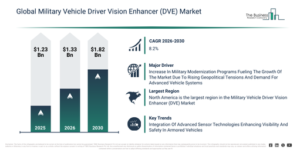
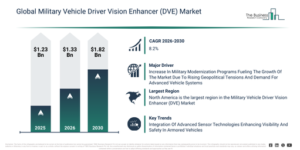
The military vehicle driver vision enhancer (dve) market size has demonstrated significant expansion in recent years. It is forecast to grow from $1.23 billion in 2025 to $1.33 billion in 2026, achieving a compound annual growth rate (CAGR) of 8.1%. The historical increase in this market can be attributed to several factors, including the increasing deployment of armored and tactical vehicles that require enhanced night-driving capability, the rising adoption of thermal imaging systems to improve visibility in dust, smoke, and fog, advancements in infrared sensors that enhance clarity and detection range, the growth in modernization programs upgrading legacy vehicles with DVE solutions, and the expanding use of DVE systems in convoy protection and battlefield mobility operations.
The military vehicle driver vision enhancer (dve) market is projected for substantial expansion in the coming years, expected to grow to $1.82 billion in 2030 at a compound annual growth rate (CAGR) of 8.2%. This anticipated growth during the forecast period is driven by factors such as the increasing integration of DVE systems with advanced driver-assist and autonomous navigation technologies, a rising demand for lightweight and ruggedized displays and control units, intensified investment in high-resolution uncooled thermal sensors to improve performance and reduce cost, the expansion of lifecycle support and maintenance services as fleets adopt next-generation DVE platforms, and the accelerating development of network-enabled DVE systems that facilitate shared situational awareness across vehicles. Major trends observed for this period include a heightened demand for all-weather and all-terrain driving capability in armored and tactical vehicles, expanding retrofit and modernization programs for legacy military vehicle fleets with advanced DVE kits, a shift towards compact, rugged, and low-SWaP thermal camera modules for driver viewing, the increasing adoption of multi-spectral driver viewing (thermal, low-light visible, and near-IR) to broaden usable scenarios, and an enhanced focus on crew safety and ergonomics through better display layouts, intuitive controls, and minimal driver distraction.
Get Your Free Military Vehicle Driver Vision Enhancer (DVE) Market Report Sample Today:
Which Factor Is Expected To Drive The Military Vehicle Driver Vision Enhancer (DVE) Market Over The Forecast Period?
The increasing number of military modernization programs is projected to boost the growth of the military vehicle driver vision enhancer (DVE) market moving forward. Military modernization programs are government-led initiatives designed to enhance armed forces by integrating advanced technology, contemporary equipment, and updated strategies to confront current and future security challenges. These programs are on the rise due to escalating geopolitical tensions, which compel nations to strengthen their defense capabilities with cutting-edge technologies to safeguard national security and maintain a strategic advantage. Growing military modernization programs support military vehicle driver vision enhancers (DVE) by stimulating investment in sophisticated situational awareness systems, ensuring military vehicles are equipped to operate effectively in environments with low visibility and high risk. For instance, in December 2024, a report released by the Department of Defense, a US executive department, noted that China’s public defense budget rose to $220 billion in 2023, when adjusted for inflation, aligning with its military modernization targets for 2027 and 2035. Consequently, the expansion of military modernization programs is propelling the military vehicle driver vision enhancer (DVE) market growth.
Military Vehicle Driver Vision Enhancer (DVE) Market Segmentation Insights: How Is The Industry Categorized?
The military vehicle driver vision enhancer (dve) market covered in this report is segmented –
1) By Type: Dual Camera, Single Camera
2) By Technology: Thermal Imaging Systems, Night Vision Systems, Low-Light Cameras, Lidar Systems
3) By Application: Surveillance, Reconnaissance, Target Acquisition, Navigation, Driver Safety
4) By End User: Defense Forces, Law Enforcement Agencies, Border Security Forces
Subsegments:
1) By Dual Camera: Long-Range Infrared Camera, Short-Range Infrared Camera, Thermal Imaging Camera, Visible Light Camera
2) By Single Camera: Monocular Thermal Camera, Night Vision Camera, Low-Light Visible Camera, Fused Sensor Camera
Military Vehicle Driver Vision Enhancer (DVE) Market Trends Explained: What Is Changing And Why It Matters
Leading companies in the military vehicle driver vision enhancer (DVE) market are concentrating on developing advanced solutions, such as day sight sensor-integrated DVEs, to enhance operational safety and efficiency. Day sight sensor-integrated DVEs are systems that utilize optical sensors to improve driver visibility and situational awareness in military vehicles during daylight conditions. For instance, in May 2023, Nedinsco BV, a Netherlands-based developer of opto-mechatronical systems, introduced the SCOPUS Driver Vision Enhancement camera solution for armored military vehicles. A notable feature of the SCOPUS system is its wide 106-degree field of view combined with day sight and LWIR thermal sensors, delivering enhanced image fusion to support improved situational awareness and navigation in challenging visibility. Engineered to endure shocks up to 150G and meet various military standards, it offers dependable performance and seamless integration into armored vehicles such as main battle tanks and tracked howitzers.
Military Vehicle Driver Vision Enhancer (DVE) Market Competitor Landscape: Who Are The Major Companies?
Major companies operating in the military vehicle driver vision enhancer (dve) market are Raytheon Company, BAE Systems plc, Safran S.A., Thales Group, L3Harris Technologies Inc., Rheinmetall AG, Elbit Systems Ltd., Leonardo DRS, Curtiss-Wright Corporation, ASELSAN A.S., Hensoldt AG, Excelitas Technologies Corp., Bertin Technologies SAS, Kappa optronics GmbH, Opgal Optronic Industries Ltd., Nedinsco B.V., Digital Systems Engineering Inc., Copenhagen Sensor Technology A/S, Allwan Security France, NVTS Night Vision Technology Solutions Inc.
See The Full Military Vehicle Driver Vision Enhancer (DVE) Market Report For Complete Market Sizing And Trends:
Military Vehicle Driver Vision Enhancer (DVE) Market Regional Demand Analysis And Leading Geography
North America was the largest region in the military vehicle driver vision enhancer (DVE) market in 2025. Asia-Pacific is expected to be the fastest-growing region in the forecast period. The regions covered in the military vehicle driver vision enhancer (dve) market report are Asia-Pacific, South East Asia, Western Europe, Eastern Europe, North America, South America, Middle East, Africa.
Reach Out To Our Team:
The Business Research Company: https://www.thebusinessresearchcompany.com/
Americas: +1 310-496-7795
Asia: +44 7882 955267 & +91 8897263534
Europe: +44 7882 955267
Email us at: marketing@tbrc.info
Follow us on:
LinkedIn: https://in.linkedin.com/company/the-business-research-company
YouTube: https://www.youtube.com/channel/UC24_fI0rV8cR5DxlCpgmyFQ
Global Market Model: https://www.thebusinessresearchcompany.com/global-market-model

Wasay has over a decade of experience in market research, data modelling, and analytics, with prior experience at GlobalData and Decision Tree Consulting Services. At The Business Research Company , he leads research operations across syndicated studies, customized consulting engagements, and the Global Market Model platform. His professional experience includes supporting organizations such as Boston Consulting Group, KPMG, and Ernst & Young. Wasay holds a degree in Electronics and Communications Engineering, postgraduate management qualifications from International Management Institute Belgium and Indian School of Business and Entrepreneurship, and completed the Integrated Program in Business Analytics from Indian Institute of Management Indore.