Enhanced with market attractiveness analysis, total addressable market evaluation, company benchmarking matrices, interactive Excel dashboards, expanded supply chain intelligence, emerging startup coverage, and detailed product insights, The Business Research Company’s 2026 market reports deliver more actionable and strategically valuable research.
Military Vehicle Electrification Market Growth Potential: How Will Market Size Change Through 2030?
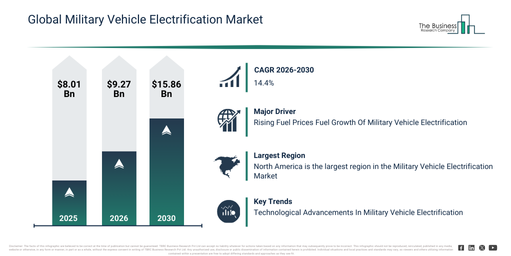
The military vehicle electrification market size has experienced swift expansion in recent years. This market is projected to expand from $8.01 billion in 2025 to reach $9.27 billion by 2026, demonstrating a compound annual growth rate (CAGR) of 15.8%. Historically, this expansion has been driven by several factors, including the launch of initial modernization initiatives aimed at enhancing onboard power generation for military vehicles. Additionally, a growing need for decreased fuel reliance within tactical and logistic fleets, the initial implementation of hybrid powertrains to boost vehicle endurance, intensified research into battery technologies robust enough for challenging military conditions, and the embrace of electrification methods to enable quiet movement and diminished acoustic signatures have all contributed.
The military vehicle electrification market size is projected for substantial expansion in the coming years. This market is anticipated to reach $15.86 billion by 2030, demonstrating a compound annual growth rate (CAGR) of 14.4%. Several factors will contribute to this growth during the forecast period, including the increasing demand for high-power electric systems to support sophisticated onboard sensors and directed-energy weapons. Other drivers include the proliferation of fully electric and hybrid platforms across light, medium, and heavy military vehicles, improvements in fast-charging and battlefield energy-storage infrastructure, a rise in defense spending on low-emission technologies to fulfill sustainability requirements, and the creation of modular electrification kits for upgrading existing military vehicles. Key trends anticipated for the forecast period encompass improved battery and energy storage systems, high-efficiency traction drive systems, comprehensive onboard power management and optimization, adaptable modular hybrid and electric vehicle platforms, and the establishment of specific military vehicle electrification standards.
Download A Free Sample Report For Comprehensive Market Insights:
Military Vehicle Electrification Market Growth Momentum: Which Factors Are Influencing Demand?
The increasing cost of fuel is projected to stimulate the expansion of the military vehicle electrification market in the upcoming period. Fuel prices denote the expense associated with various types of fuel, primarily gasoline and diesel, paid by consumers to power their vehicles or equipment. With elevated fuel prices, the operation of traditional military vehicles, powered by internal combustion engines, becomes more expensive, thus military vehicle electrification presents an alternative to decrease fuel usage and operational expenditures for military entities. For instance, in February 2024, data from the Department for Energy Security and Net Zero (DESNZ), a UK-based government department, indicated that the median fuel cost was estimated at $3,670 (₤2,950), in contrast to the actual net fuel cost estimate of $2,735 (₤2,200) in 2023. Therefore, the upward trend in fuel prices is a significant driver for the growth of the military vehicle electrification market.
Military Vehicle Electrification Market Segmentation And Category Breakdown
The military vehicle electrification market covered in this report is segmented –
1) By Technology: Hybrid, Fully Electric
2) By Operation: Manned, Autonomous/Semi-Autonomous
3) By Platform: Combat Vehicles, Support Vehicles, Unmanned Armored Vehicles
4) By System: Power Generation, Cooling Systems, Energy Storage, Traction Drive Systems, Power Conversion
Subsegments:
1) By Hybrid: Series Hybrid Systems, Parallel Hybrid Systems, Plug-in Hybrid Systems
2) By Fully Electric: Battery Electric Vehicles (BEVs), Fuel Cell Electric Vehicles (FCEVs)
Military Vehicle Electrification Market Industry Trends: What Changes Are Reshaping Demand?
Major companies operating in the military vehicle electrification market are prioritizing the development of technological advancements, such as infantry fighting vehicles, to deliver both robust armored protection and improved mobility. An infantry fighting vehicle (IFV) is fundamentally a substantially armed and armored combat unit, engineered to transport and support infantry during conflict, while simultaneously providing offensive capabilities and defense against adversaries. As an illustration, in February 2024, ST Engineering, a Singapore-based technology, defence, and engineering firm, unveiled its Hybrid-Electric 35-ton Armored Fighting Vehicle. The company’s hybrid-electric drive kit, which can also be integrated into other platforms, supplies supplementary power for digital functions like enhanced situational awareness and facilitates an open architecture for AI-driven software integrations. Furthermore, the vehicle incorporates an AI-powered surveillance optical radar that utilizes machine learning to detect and map target locations and distances, and manned-unmanned teaming capabilities enable efficient mission planning and execution.
Military Vehicle Electrification Market Leading Companies Driving Competitive Growth
Major companies operating in the military vehicle electrification market are BAE Systems plc, Arquus, Leonardo S.p.A., Textron Inc., General Motors Company, Oshkosh Corporation, Ballard Power Systems Inc., AM General LLC, Nikola Corporation, Alke S.r.l., Aselsan A.S., Epsilor Electric Fuel Ltd., Flensberg Fahrzeugbau Gesellschaft mbH, Kongsberg Gruppen, Lockheed Martin Corporation, Magna International Inc., Navistar International Corporation, Otokar Otomotiv ve Savunma Sanayi A.S., Rheinmetall AG, Ricardo plc, Siemens AG, Tata Motors Limited, RTX Corporation, Thales Group, UQM Technologies Inc., Visedo Oy, Wrightspeed Inc., XALT Energy LLC
Access The Complete Military Vehicle Electrification Market Report:
Military Vehicle Electrification Market Global Footprint: Which Region Holds Market Leadership?
North America was the largest region in the military vehicle electrification market in 2025. Asia-Pacific is expected to be the fastest-growing region in the forecast period. The regions covered in the military vehicle electrification market report are Asia-Pacific, South East Asia, Western Europe, Eastern Europe, North America, South America, Middle East, Africa.
Access a Customized Military Vehicle Electrification Market Report for Deeper Competitive Insights
https://www.thebusinessresearchcompany.com/customise?id=7431&type=smp
The Business Research Company: https://www.thebusinessresearchcompany.com/
Americas: +1 310-496-7795
Asia: +44 7882 955267 & +91 8897263534
Europe: +44 7882 955267
Email us at: marketing@tbrc.info
Follow us on:
LinkedIn: https://in.linkedin.com/company/the-business-research-company
YouTube: https://www.youtube.com/channel/UC24_fI0rV8cR5DxlCpgmyFQ
Global Market Model: https://www.thebusinessresearchcompany.com/global-market-model

Wasay has over a decade of experience in market research, data modelling, and analytics, with prior experience at GlobalData and Decision Tree Consulting Services. At The Business Research Company , he leads research operations across syndicated studies, customized consulting engagements, and the Global Market Model platform. His professional experience includes supporting organizations such as Boston Consulting Group, KPMG, and Ernst & Young. Wasay holds a degree in Electronics and Communications Engineering, postgraduate management qualifications from International Management Institute Belgium and Indian School of Business and Entrepreneurship, and completed the Integrated Program in Business Analytics from Indian Institute of Management Indore.