
The Business Research Company’s 2026 market reports combine market attractiveness scoring, total addressable market sizing, company benchmarking matrices, interactive Excel dashboards, deeper supply chain intelligence, emerging startup tracking, and granular product-level insights to deliver research that is more actionable and strategically valuable.
Military Vehicle Simulations Market Size Trajectory: Key Numbers Every Industry Stakeholder Should Know
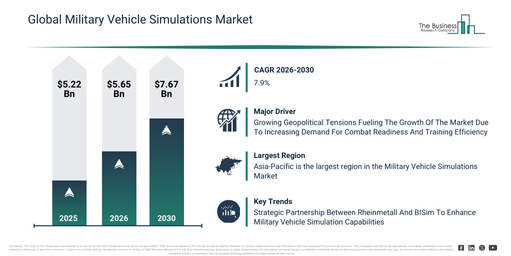
The military vehicle simulations market has experienced robust expansion over the past few years. This market is projected to expand from $5.22 billion in 2025 to $5.65 billion in 2026, exhibiting a compound annual growth rate (CAGR) of 8.2%. The expansion observed in previous periods can be linked to the rising adoption of simulation-based training to curb operational training expenses, an increased demand for realistic vehicle cabin replicas that enhance driver preparedness, continuous advancements in visual display systems boosting training immersion, a greater utilization of simulations for performance testing under varied battlefield conditions, and the expansion of defense training programs that require scalable simulation platforms.
The military vehicle simulations market is projected to experience substantial expansion in the coming years. It is anticipated to reach $7.67 billion by 2030, exhibiting a compound annual growth rate (CAGR) of 7.9%. This anticipated growth during the forecast period stems from factors such as the expanding integration of artificial intelligence into adaptive and scenario-specific simulation training, the rising need for networked simulations to facilitate joint and multi-vehicle training settings, increased capital outlay in virtual and augmented reality to boost realism, the broadening use of simulation-driven readiness evaluations for modern military fleets, and the rapid progress in developing modular simulation systems for quick adaptation to various vehicle types. Key trends expected over the forecast horizon encompass the increasing uptake of comprehensive multi-vehicle simulation packages, a transition from physical exercises towards more economical synthetic training solutions, an amplified focus on interoperability and collaborative joint-force or multi-nation simulations, the tailoring of training scenarios to align with specific national doctrines and geographical conditions, and the extension of agreements for long-term simulation upkeep, enhancements, and technical assistance.
Looking For Reliable Military Vehicle Simulations Market Data? Request A Free Sample:
What Is Behind The Rising Demand In The Military Vehicle Simulations Market?
The increasing geopolitical tensions are projected to stimulate the growth of the military vehicle simulation market in the future. Geopolitical tensions describe disagreements or strained relations among nations that could intensify into military confrontations or prolonged defense preparations. These tensions are escalating due to heightened competition for vital resources, including energy, rare earth minerals, and water, as countries strive to secure strategic advantages amid vulnerabilities in global supply chains. Military vehicle simulation improves strategic readiness by offering realistic training and scenario planning, which helps nations manage geopolitical complexities with a reduced risk of direct conflict. For example, a report released in December 2024 by the International Institute for Strategic Studies (IISS), a UK-based international research institute focusing on defense and security issues, revealed that the global number of fatalities from violent events increased by 37% from July 2023 to June 2024, totaling nearly 200,000. Thus, the rising geopolitical tensions are driving the expansion of the military vehicle simulation market.
Military Vehicle Simulations Market Segment Coverage And Subsegment Analysis
The military vehicle simulations market covered in this report is segmented –
1) By Type: Military Vehicles Simulations Platforms, Military Vehicles Simulations Systems, Military Vehicles Simulations Maintenances, Other Types
2) By Vehicle Type: Armored Vehicles, Trucks and Transport Vehicles, Tanks, Light Tactical Vehicles, Reconnaissance Vehicles
3) By Technology: Artificial Intelligence, Augmented Reality, Virtual Reality, Cloud-Based Simulation, Data Analytics And Big Data
4) By Application: Training And Education, Mission Planning, Operational Support, Research And Development, Testing And Evaluation
5) By End User: Defense Forces, Government Agencies, Private Contractors, Educational Institutions, Research Organizations
Subsegments:
1) By Military Vehicles Simulations Platforms: Desktop-Based Simulation Platforms, Full Mission Simulators, Mobile Training Units, Cloud-Based Simulation Platforms
2) By Military Vehicles Simulations Systems: Driver Training Systems, Gunnery Training Systems, Command And Control Simulators, Navigation And Convoy Training Systems
3) By Military Vehicles Simulations Maintenances: Predictive Maintenance Simulation, Virtual Maintenance Trainers (VMT), Diagnostics And Repair Simulation, Troubleshooting Training Systems
4) By Other Types: Mixed Reality Simulators, Artificial Intelligence (AI)-Integrated Simulation Systems, Logistics And Supply Chain Simulators, Multi-Domain Integration Simulators
Military Vehicle Simulations Market Future Trends: Where Is The Industry Heading?
Leading firms within the military vehicle simulation market are concentrating on forming strategic alliances to decrease their operational expenditures. These alliances represent enduring collaborations between multiple entities, established to attain common goals through the mutual utilization of strengths and resources. An example of this is seen in January 2025, when Rheinmetall AG, a technology company headquartered in Germany, collaborated with Bohemia Interactive Simulations (BISim), a Czech Republic-based supplier of military vehicle simulations, with the aim of progressing defense simulation technologies. This joint effort intends to provide highly realistic, adaptable, and compatible training environments capable of supporting diverse mission scenarios, ranging from individual soldier instruction to extensive joint force maneuvers. By integrating BISim’s modular simulation software with Rheinmetall’s actual defense systems, the alliance is poised to quicken the pace of innovation in synthetic training, thus allowing armed forces to conduct training more efficiently, securely, and economically within intricate, multi-domain operational settings.
Military Vehicle Simulations Market Top Players List For 2026
Major companies operating in the military vehicle simulations market are Raytheon Technologies Corp., Boeing Co., Lockheed Martin Corporation, General Dynamics Corp., Northrop Grumman Corp., Collins Aerospace Companies, BAE Systems plc, Thales Group, L3Harris Technologies Inc., Leonardo S.p.A., ST Engineering Ltd., Rheinmetall AG, Israel Aerospace Industries Ltd., Saab AB, CAE Inc., FlightSafety International Inc., Arotech Corporation, FAAC Incorporated, Frasca International Inc., AVT Simulation Inc.
Order Your Copy Of The Military Vehicle Simulations Market Report 2026:
How Does The Military Vehicle Simulations Market Vary By Region?
Asia-Pacific was the largest region in the military vehicle simulations market in 2025. The regions covered in the military vehicle simulations market report are Asia-Pacific, South East Asia, Western Europe, Eastern Europe, North America, South America, Middle East, Africa.
Reach Out To Our Team:
The Business Research Company: https://www.thebusinessresearchcompany.com/
Americas: +1 310-496-7795
Asia: +44 7882 955267 & +91 8897263534
Europe: +44 7882 955267
Email us at: marketing@tbrc.info
Follow us on:
LinkedIn: https://in.linkedin.com/company/the-business-research-company
YouTube: https://www.youtube.com/channel/UC24_fI0rV8cR5DxlCpgmyFQ
Global Market Model: https://www.thebusinessresearchcompany.com/global-market-model

Wasay has over a decade of experience in market research, data modelling, and analytics, with prior experience at GlobalData and Decision Tree Consulting Services. At The Business Research Company , he leads research operations across syndicated studies, customized consulting engagements, and the Global Market Model platform. His professional experience includes supporting organizations such as Boston Consulting Group, KPMG, and Ernst & Young. Wasay holds a degree in Electronics and Communications Engineering, postgraduate management qualifications from International Management Institute Belgium and Indian School of Business and Entrepreneurship, and completed the Integrated Program in Business Analytics from Indian Institute of Management Indore.

