Featuring market attractiveness scoring, total addressable market sizing, company benchmarking matrices, interactive Excel dashboards, deeper supply chain intelligence, emerging startup tracking, and granular product-level insights, The Business Research Company’s 2026 market reports are built to deliver research that is both more actionable and more strategically valuable.
Military Wearables Market Revenue Growth On Track For A 6.9% CAGR Through 2030
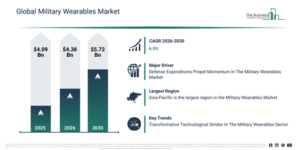
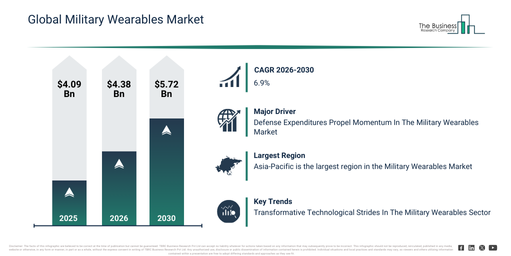
The military wearables market size has experienced strong growth in recent years. It is forecast to grow from $4.09 billion in 2025 to $4.38 billion in 2026, exhibiting a compound annual growth rate (CAGR) of 6.9%. This historical growth can be attributed to various factors, including the increased adoption of heads-up displays that enhance real-time situational awareness for soldiers, the rising deployment of augmented reality glasses supporting mission planning and navigation, a growth in demand for advanced body armor improving troop protection and survivability, the expansion of soldier modernization programs driving the procurement of integrated wearable technologies, and advancements in wearable sensors enabling continuous monitoring of soldier health and performance.
The military wearables market size is anticipated to experience robust growth over the coming years. It is projected to reach $5.72 billion in 2030, exhibiting a compound annual growth rate (CAGR) of 6.9%. This expansion during the forecast period is attributed to the advancement of next-generation AR and mixed-reality wearables, which enhance immersive battlefield visualization; the increasing integration of biometric and physiological monitoring systems, improving soldier readiness; the growing adoption of lightweight and energy-efficient wearables, boosting mobility and endurance; the rise in connected battlefield initiatives, driving demand for interoperable wearable systems; and progress in power management and battery technologies, extending the operational life of military wearables. Key trends foreseen in this period encompass the incorporation of heads-up displays (HUD) into tactical gear, the evolution of AR glasses for enhanced situational awareness, sophisticated wearable health and performance monitoring systems, versatile modular and multi-functional wearable equipment, and smart textiles along with energy management systems for field operations.
Get A Free Sample Report With In-Depth Market Insights:
Military Wearables Market Growth Factors Behind Sustained Expansion
The expanding spending on defense is anticipated to stimulate the growth of the military wearables market in the future. Defense expenditure encompasses all current and prospective investments made in military forces, including peacekeeping endeavors undertaken by defense ministries and other governmental bodies engaged in defense initiatives, as well as paramilitary units considered capable of engaging in military operations, having been trained, equipped, and prepared for such roles. Within military organizations, various wearable devices and gear can be integrated directly into a soldier’s uniform or existing wearables, thus alleviating the need for them to carry extra loads. Wearable technology is poised to significantly influence armed forces in the coming years. For example, as reported in April 2025 by the Stockholm International Peace Research Institute (SIPRI), a Sweden-based global security research institute, global military spending amounted to $2,718 billion in 2024. This figure represents a 9.4% rise in real terms from 2023, which is the sharpest annual increase recorded since the conclusion of the Cold War. Consequently, the rising defense expenditures are propelling the expansion of the military wearables market.
Military Wearables Market Segments: Where Is Growth Concentrated?
The military wearables market covered in this report is segmented –
1) By Type: Wrist Wear, Modular, Eyewear, Smart Key Chains, Ear Wear, Other Types
2) By Technology: Communication And Computing, Connectivity, Navigation, Vision And Surveillance, Exoskeleton, Monitoring, Power And Energy Management, Smart Textiles
3) By End-User: Land Forces, Naval Forces, Airborne Forces
Subsegments:
1) By Wrist Wear: Smartwatches, Fitness Trackers, Health Monitors, Tactical Wrist Devices, GPS-enabled Wrist Wear
2) By Modular: Modular Systems With Detachable Components, Adaptable Wearable Technology, Multi-Function Modular Gear
3) By Eyewear: Smart Glasses, Augmented Reality (AR) Glasses, Night Vision Goggles, Heads-Up Displays (HUDs), Vision Enhancement Systems
4) By Smart Key Chains: Location Tracking Key Chains, Communication-Enabled Key Chains, Smart Key Fobs with Sensors
5) By Ear Wear: Smart Earbuds, Communication Headsets, Hearing Protection Earplugs, Bone Conduction Headphones
6) By Other Types: Body Cameras, Smart Textiles, Health Monitoring Patches, Tactical Wearable Sensors
Military Wearables Market Industry Trends Fueling Future Revenue Growth
Key companies in the military wearable sector are focusing on product innovation to bolster their market position and ensure sustained presence. For instance, in June 2023, AFRL initiated a two-year voluntary study with U.S. Space Force Guardians to evaluate the application of wearable fitness devices for measuring physical activity. This study, which began enrolling participants in May 2023, is part of the U.S. Space Force’s Continuous Fitness Assessment (CFA) line of effort. The research aims to explore the usability, reliability, and effectiveness of these devices while integrating feedback from Guardians, with the results intended to inform leaders about the role of wearable devices in potential fitness strategies that could replace annual tests.
Military Wearables Market Key Participants And Competitive Landscape
Major companies operating in the military wearables market are Aselsan A.S., Bionic Power Inc., Lockheed Martin Corporation, BAE Systems plc, Saab AB, General Dynamics Corporation, Elbit Systems Ltd., L3Harris Corporation, Rheinmetall AG, Safran S.A, Thales Group, Northrop Grumman Corporation, Ultra Electronics Holdings, Teledyne Flir LLC, Leonardo S.P.A., Viasat Inc., TE Connectivity Ltd., TT Electronics PLC., Interactive Wear AG, Epsilor-Electric Fuel Ltd., Glenair Inc., Milpower Source Inc., Safariland L.L.C., Singapore Technologies Engineering Ltd., Honeywell International Inc., Raytheon Technologies Corporation, Alpha Design Technologies, Revision Military, SECRE International Inc., Tactical Systems Group
View The Full Military Wearables Market Report:
Military Wearables Market Geographic Landscape: Which Region Dominates Industry Growth?
Asia-Pacific was the largest region in the military wearables market in 2025. The regions covered in the military wearables market report are Asia-Pacific, South East Asia, Western Europe, Eastern Europe, North America, South America, Middle East, Africa.
Reach Out To Our Team:
The Business Research Company: https://www.thebusinessresearchcompany.com/
Americas: +1 310-496-7795
Asia: +44 7882 955267 & +91 8897263534
Europe: +44 7882 955267
Email us at: marketing@tbrc.info
Follow us on:
LinkedIn: https://in.linkedin.com/company/the-business-research-company
YouTube: https://www.youtube.com/channel/UC24_fI0rV8cR5DxlCpgmyFQ
Global Market Model: https://www.thebusinessresearchcompany.com/global-market-model

Wasay has over a decade of experience in market research, data modelling, and analytics, with prior experience at GlobalData and Decision Tree Consulting Services. At The Business Research Company , he leads research operations across syndicated studies, customized consulting engagements, and the Global Market Model platform. His professional experience includes supporting organizations such as Boston Consulting Group, KPMG, and Ernst & Young. Wasay holds a degree in Electronics and Communications Engineering, postgraduate management qualifications from International Management Institute Belgium and Indian School of Business and Entrepreneurship, and completed the Integrated Program in Business Analytics from Indian Institute of Management Indore.