
Delivering more actionable and strategically valuable research, The Business Research Company’s 2026 market reports feature market attractiveness analysis, total addressable market evaluation, company benchmarking matrices, interactive Excel dashboards, expanded supply chain intelligence, emerging startup coverage, and detailed product insights.
Multi-Band Global Navigation Satellite System (GNSS) Receiver Market Forecast Highlighting Growth From $3.35 Billion To $5.77 Billion
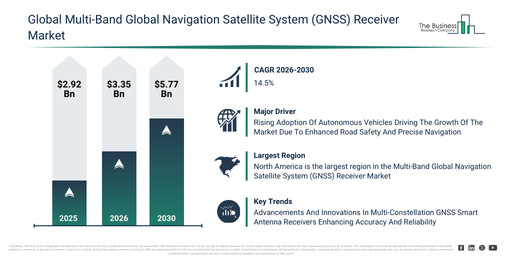
The multi-band global navigation satellite system (gnss) receiver market size has seen rapid growth in recent years. It is expected to increase from $2.92 billion in 2025 to $3.35 billion in 2026, progressing at a compound annual growth rate (CAGR) of 14.8%. This historical expansion can be attributed to the adoption of single-band gnss receivers in civil and military applications, enhancements in multi-frequency antenna technologies, the development of precise timing and positioning algorithms, an escalating demand for reliable geospatial data, and the integration of gnss receivers into surveying and mapping equipment.
The multi-band global navigation satellite system (gnss) receiver market is expected to experience substantial growth in the coming years. It is projected to achieve a value of $5.77 billion by 2030, growing at a compound annual growth rate (CAGR) of 14.5%. This growth in the forecast period can be attributed to the expanding support for multi-constellation GNSS, the creation of anti-jamming and interference-resistant receivers, increased adoption in autonomous vehicles and drones, the integration with AI for predictive positioning analytics, and enhanced miniaturization for portable and wearable applications. Key trends during this period include a rising demand for high-precision multi-frequency GNSS solutions, the broadening integration of GNSS in new commercial and industrial applications, the increasing deployment of GNSS receivers in drones and autonomous surveying platforms, greater development of interference-resistant and anti-spoofing receiver architectures, and advancements in compact, low-power GNSS modules for mobile and wearable systems.
Download A Free Sample Report For Comprehensive Market Insights:
Multi-Band Global Navigation Satellite System (GNSS) Receiver Market Industry Drivers: What Is Driving Revenue Growth?
The increasing use of autonomous vehicles is anticipated to boost the expansion of the multi-band global navigation satellite system (GNSS) receiver market in the future. These are self-driving cars, operating independently through sensors and artificial intelligence, requiring no human input for navigation or operation. The uptake of autonomous vehicles is growing due to increasing worries about road safety, which in turn fuels the need for technologies capable of minimizing accidents caused by human error and providing more reliable and efficient transportation. Multi-band GNSS receivers aid autonomous vehicles by delivering precise and dependable real-time location data derived from various satellite signals, thereby facilitating safer and more effective navigation. For example, according to the Insurance Institute for Highway Safety, a US-based non-profit organization, self-driving vehicles on U.S. roads are projected to hit 3.5 million by 2025 and 4.5 million by 2030. Consequently, the expanding deployment of autonomous vehicles is fueling the growth of the multi-band global navigation satellite system (GNSS) receiver market.
Multi-Band Global Navigation Satellite System (GNSS) Receiver Market Segment Breakdown: Which Categories Generate The Most Revenue?
The multi-band global navigation satellite system (gnss) receiver market covered in this report is segmented –
1) By Product Type: Handheld Receivers, Fixed Receivers, Wearable Receivers, Other Product Types
2) By Frequency Band: Dual-Band, Triple-Band, Quad-Band, Other Frequency Bands
3) By Distribution Channel: Direct Sales, Distributors Or Resellers, Online Sales, Other Distribution Channels
4) By Application: Surveying And Mapping, Precision Agriculture, Marine, Aviation, Automotive, Military And Defense, Other Applications
5) By End-User: Commercial, Industrial, Government, Other End-Users
Subsegments:
1) By Handheld Receivers: Surveying, Mapping, Navigation, Geolocation
2) By Fixed Receivers: Base Stations, Reference Stations, Monitoring Stations, Infrastructure Receivers
3) By Wearable Receivers: Smart Watches, Fitness Trackers, Outdoor Activity Devices, Personal Navigation Devices
4) By Other Product Types: Vehicle-Mounted Receivers, Drone-Mounted Receivers, Marine Receivers, Aviation Receivers
Multi-Band Global Navigation Satellite System (GNSS) Receiver Market Growth Trends Influencing Competitive Dynamics
Major companies operating in the multi-band global navigation satellite system (GNSS) receiver market are focusing on developing innovative solutions, such as multi-constellation GNSS smart antenna receivers, to enhance accuracy, reliability, and overall performance across diverse navigation applications. These multi-constellation GNSS smart antenna receivers are advanced devices designed to receive signals from multiple satellite systems concurrently, utilizing intelligent antennas to improve positioning accuracy and reliability. For instance, in September 2024, Quectel Wireless Solutions Co., Ltd., a China-based IoT solutions provider, launched the QLM29H series, which is a dual-band, multi-constellation GNSS smart antenna receiver integrating their LC29H GNSS module with an embedded patch antenna. This receiver supports the simultaneous reception of signals from global GNSS constellations like GPS, GLONASS, Galileo, BDS, and NavIC across both L1 and L5 frequency bands, significantly improving positioning accuracy and reducing multipath interference, especially in challenging urban environments. With an autonomous positioning accuracy of 1 meter and centimeter-level precision in RTK versions, it also incorporates dead reckoning for reliable performance even in areas with weak or absent GNSS signals.
Multi-Band Global Navigation Satellite System (GNSS) Receiver Market Key Players: Which Companies Shape Industry Competition?
Major companies operating in the multi-band global navigation satellite system (gnss) receiver market are Raytheon Technologies Corporation, Broadcom Inc., Qualcomm Technologies Inc., STMicroelectronics, Garmin Ltd., Trimble Inc., Quectel Wireless Solutions Co. Ltd., Topcon Corporation, Hexagon AB, Furuno Electric Co. Ltd., u-blox AG, NovAtel Inc., Satlabs Geosolutions AB, Unicore Communications Inc., LOCOSYS Technology Inc., SkyTraq Technology Inc., Allystar Technology Co. Ltd., NavCom Technology Inc., ComNav Technology Ltd., Navika Electronics, Tersus GNSS Inc.
Access The Complete Multi-Band Global Navigation Satellite System (GNSS) Receiver Market Report:
Multi-Band Global Navigation Satellite System (GNSS) Receiver Market Regional Distribution: Which Areas Drive Market Expansion?
North America was the largest region in the multi-band global navigation satellite system (GNSS) receiver market in 2025. Asia-Pacific is expected to be the fastest-growing region in the forecast period. The regions covered in the multi-band global navigation satellite system (gnss) receiver market report are Asia-Pacific, South East Asia, Western Europe, Eastern Europe, North America, South America, Middle East, Africa.
Access a Customized Multi-Band Global Navigation Satellite System (GNSS) Receiver Market Report for Deeper Competitive Insights
https://www.thebusinessresearchcompany.com/customise?id=28728&type=smp
The Business Research Company: https://www.thebusinessresearchcompany.com/
Americas: +1 310-496-7795
Asia: +44 7882 955267 & +91 8897263534
Europe: +44 7882 955267
Email us at: marketing@tbrc.info
Follow us on:
LinkedIn: https://in.linkedin.com/company/the-business-research-company
YouTube: https://www.youtube.com/channel/UC24_fI0rV8cR5DxlCpgmyFQ
Global Market Model: https://www.thebusinessresearchcompany.com/global-market-model

Wasay has over a decade of experience in market research, data modelling, and analytics, with prior experience at GlobalData and Decision Tree Consulting Services. At The Business Research Company , he leads research operations across syndicated studies, customized consulting engagements, and the Global Market Model platform. His professional experience includes supporting organizations such as Boston Consulting Group, KPMG, and Ernst & Young. Wasay holds a degree in Electronics and Communications Engineering, postgraduate management qualifications from International Management Institute Belgium and Indian School of Business and Entrepreneurship, and completed the Integrated Program in Business Analytics from Indian Institute of Management Indore.
