With a focus on actionable insights and strategic value, The Business Research Company’s 2026 market reports include market attractiveness scoring, total addressable market sizing, company benchmarking matrices, interactive Excel dashboards, deeper supply chain intelligence, emerging startup tracking, and granular product-level insights.
Naval-Based Remote Weapons Station Market Size Snapshot: 2026 Valuation, 2030 Projection And Key Growth Factors
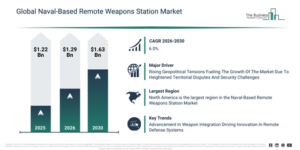
The naval-based remote weapons station market size has demonstrated robust expansion in recent years. It will grow from $1.22 billion in 2025 to $1.29 billion in 2026 at a compound annual growth rate (CAGR) of 5.7%. The historical increase in market size is due to several factors, including the increasing modernization of naval fleets requiring advanced remote weapon capabilities, the rising adoption of stabilized weapon mounts for improved accuracy in rough sea conditions, continuous advancements in electro-optical sensors enhancing target identification and tracking, the broader integration of remote weapon stations on patrol boats and surface combatants, and the expanding demand for operator safety solutions enabling weapon control from protected interiors.
The naval-based remote weapons station market is poised for significant expansion over the coming years, projected to reach $1.63 billion in 2030, exhibiting a compound annual growth rate (CAGR) of 6.0%. This anticipated growth is driven by several factors, including the increasing deployment of multi-sensor, network-enabled remote weapon stations crucial for integrated maritime warfare, heightened investment in software enhancements and automation to boost targeting accuracy, and the growing embrace of modular weapon station designs that support various weapon setups. Additionally, the expansion of lifecycle management and retrofitting initiatives for older naval vessels, along with the accelerated development of remote stations compatible with unmanned surface vessels for future naval engagements, will contribute to this surge. Key developments expected during this period involve more extensive retrofitting of existing naval platforms with remote weapon stations, the rising integration of these systems onto offshore patrol vessels and smaller combatants, and a stronger emphasis on modular, multi-caliber weapon station structures. A significant focus will also be placed on ensuring crew survivability and minimizing on-deck personnel in naval operations, alongside the broadened application of naval remote weapon stations in homeland security and maritime law enforcement duties.
Get A No-Cost Sample Of The Naval-Based Remote Weapons Station Market Study:
Major Factor Fueling The Naval-Based Remote Weapons Station Market Through 2030
Growing geopolitical conflicts are anticipated to drive the expansion of the naval-based remote weapons station market in the future. Geopolitical tensions denote struggles, disagreements, or competitions among nations or areas stemming from political, economic, territorial, or strategic considerations. An increase in geopolitical tensions is often caused by territorial disputes, which jeopardize national sovereignty and influence over vital strategic zones. Naval-based remote weapons stations help mitigate geopolitical tensions by boosting naval defense capabilities using remotely controlled precise firepower. These systems enhance maritime security by minimizing crew vulnerability and facilitating quick responses to threats, thereby fostering stability in disputed areas. As an illustration, in October 2024, data from the U.S. Department of Homeland Security, a US-based federal agency, showed that migrant encounters at the US-Canada border surpassed 181,000 in 2024, representing a 6.5% rise from 170,000 in 2023. Consequently, increasing geopolitical tensions are fueling the expansion of the naval-based remote weapons station market.
Naval-Based Remote Weapons Station Market Segment Landscape: Main Categories And Subcategories Covered
The naval-based remote weapons station market covered in this report is segmented –
1) By Components: Weaponry, Vision Systems
2) By Weapon Type: Lethal Weapons, Non-Lethal Weapons
3) By Platform: Destroyers, Frigates, Corvettes, Patrol And Mine Countermeasures Vessels, Offshore Patrol Vessels (OPVs), Amphibious Vessels, Unmanned Surface Vehicles
4) By Application: Military, Homeland Security
Subsegments:
1) By Weaponry: Guns, Cannons, Launchers, Missiles
2) By Vision Systems: Thermal Cameras, Daylight Cameras, Laser Range Finders, Infrared Sensors
How Are Emerging Trends Influencing The Naval-Based Remote Weapons Station Market’s Growth Path?
Leading firms in the naval-based remote weapons station market are concentrating on creating sophisticated solutions, including weapon-compatible stations, to facilitate standardized weapon integration across diverse platforms. These stations are systems built to efficiently and securely house and deploy various weapon types on a specific platform. As an example, in February 2025, the Australian defense technology company, Electro Optic Systems (EOS), introduced the R500 Remote Weapon System (RWS). This RWS is a modular, turreted, weapon-compatible station that integrates a robust electro-optical sensor suite, a stabilized mount, and digital fire-control hardware. It supports multiple weapon categories (such as machine guns, grenade launchers, and missiles), incorporates AI-driven targeting and edge-AI processing, provides STANAG-level add-on armor and low-latency digital architecture. Its design caters to armored vehicles, tactical platforms, and fixed installations, aiming to extend standoff engagement ranges (stated as exceeding 2,500 m), enhance situational awareness, minimize crew exposure, and allow for quick, mission-specific modular setups.
Naval-Based Remote Weapons Station Market Leading Players And Key Industry Participants In 2026
Major companies operating in the naval-based remote weapons station market are BAE Systems plc, Thales Group, Leonardo S.p.A., Singapore Technologies Engineering Ltd, Rheinmetall AG, Elbit Systems Ltd, Saab AB, Kongsberg Gruppen ASA, Moog Inc., Bharat Electronics Limited, LIG Nex1 Co. Ltd, FN Herstal S.A, Kollmorgen Corporation, Nexter Group, Safran Electronics & Defense Services India Private Limited, Aselsan A.S., Electro Optic Systems Holdings Ltd, Reutech Solutions (Pty) Ltd, Escribano Mechanical & Engineering, S.L.U., Rafael Advanced Defense Systems Ltd.
Check Out The Full Naval-Based Remote Weapons Station Market Report 2026:
Naval-Based Remote Weapons Station Market By Geography: Revenue Leaders Among Global Regions
North America was the largest region in the naval-based remote weapons station market in 2025. The regions covered in the naval-based remote weapons station market report are Asia-Pacific, South East Asia, Western Europe, Eastern Europe, North America, South America, Middle East, Africa.
Reach Out To Our Team:
The Business Research Company: https://www.thebusinessresearchcompany.com/
Americas: +1 310-496-7795
Asia: +44 7882 955267 & +91 8897263534
Europe: +44 7882 955267
Email us at: marketing@tbrc.info
Follow us on:
LinkedIn: https://in.linkedin.com/company/the-business-research-company
YouTube: https://www.youtube.com/channel/UC24_fI0rV8cR5DxlCpgmyFQ
Global Market Model: https://www.thebusinessresearchcompany.com/global-market-model

Wasay has over a decade of experience in market research, data modelling, and analytics, with prior experience at GlobalData and Decision Tree Consulting Services. At The Business Research Company , he leads research operations across syndicated studies, customized consulting engagements, and the Global Market Model platform. His professional experience includes supporting organizations such as Boston Consulting Group, KPMG, and Ernst & Young. Wasay holds a degree in Electronics and Communications Engineering, postgraduate management qualifications from International Management Institute Belgium and Indian School of Business and Entrepreneurship, and completed the Integrated Program in Business Analytics from Indian Institute of Management Indore.