Built to provide research that’s more actionable and strategically valuable, The Business Research Company’s 2026 market reports include market attractiveness analysis, total addressable market sizing, company benchmarking matrices, interactive Excel dashboards, broader supply chain intelligence, emerging startup tracking, and in-depth product insights.
Naval Radar Market Poised To Hit $16.48 Billion By 2030 With A 4.4% CAGR
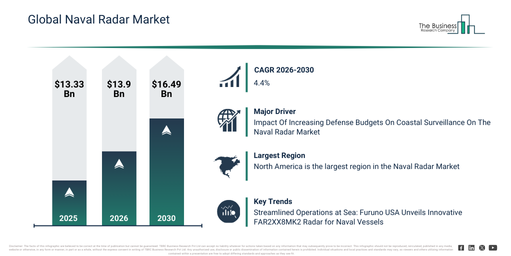
The naval radar market has experienced consistent expansion in recent years. This market is projected to expand from $13.33 billion in 2025 to $13.9 billion by 2026, exhibiting a compound annual growth rate (CAGR) of 4.3%. Historically, this expansion has been driven by several factors, including larger naval defense allocations leading to the acquisition of sophisticated radar systems, a heightened need for situational awareness and threat identification functionalities, innovations in radar signal processing and antenna technologies, the expansion of naval modernization efforts and upgrades to existing ships, and the use of radar systems for maritime surveillance and search and rescue missions.
The naval radar market is projected to experience consistent expansion in the upcoming years. By 2030, this market is anticipated to reach $16.49 billion, expanding at a compound annual growth rate (CAGR) of 4.4%. This projected growth can be attributed to the incorporation of artificial intelligence and machine learning to improve target identification and tracking capabilities, an increased need for multi-functional and phased-array naval radar systems, growing investments into electronic warfare and radar countermeasure solutions, the broadened scope of naval radar services encompassing maintenance, system enhancements, and tailored customization, and a rising trend in adopting compact and lightweight radar systems suitable for smaller vessels and uncrewed naval platforms. Key trends for this period include the merging of multi-function radar systems to boost operational effectiveness, the development of modular and upgradeable radar platforms to support extended lifecycle management, the growth of naval radar services within developing maritime defense sectors, a greater uptake of lightweight and compact radar components for smaller ships and uncrewed systems, and an emphasis on ensuring reliability and peak performance even in harsh maritime environments.
Get A Free Sample Report With In-Depth Market Insights:
Naval Radar Market Opportunity Drivers: What’s Unlocking New Revenue Potential?
The future growth of the naval radar market is expected to be driven by increasing defense budgets directed towards coastal surveillance. These defense budgets support coastal surveillance by allocating funds for equipment, technological advancement, infrastructure, training, and coordinated efforts, thereby enhancing maritime security and safeguarding coastal areas. Naval radar plays a crucial role in coastal surveillance by continuously monitoring marine activities along coastlines, enabling the detection and tracking of vessels, oversight of maritime traffic, and support for marine security and law enforcement operations. For example, according to the United States Department of Defense, a US-based government agency, the US Navy’s budget proposal for the fiscal year 2024 totaled $211.7 billion, marking a 1.8% rise compared to 2023. This budget allocation included $58.5 billion designated for shipbuilding and conversion, $18.8 billion for weapons procurement, $49.8 billion for operation and maintenance, and $20.4 billion allocated for research and development initiatives. Therefore, the growing defense budgets for coastal surveillance are propelling the expansion of the naval radar market.
Naval Radar Market Segment Landscape And Growth Outlook
The naval radar market covered in this report is segmented –
1) By Type: Naval Surveillance Radar, Naval Fire Control Radar, Naval Navigation Radar
2) By Component: Antennas, Transmitters, Receivers, Power Amplifiers
3) By Application: Naval Ships, Submarines, Unmanned Surface Vehicles, Other Applications
Subsegments:
1) By Naval Surveillance Radar: Long-Range Surveillance Radar, Medium-Range Surveillance Radar, Short-Range Surveillance Radar, Air Surveillance Radar, Sea Surveillance Radar
2) By Naval Fire Control Radar: Target Tracking Radar, Gun Fire Control Radar, Missile Fire Control Radar, Weapon Guidance Radar
3) By Naval Navigation Radar: Surface Navigation Radar, Collision Avoidance Radar, Navigation For Submarines, Radar For Port And Harbor Navigation
Naval Radar Market Innovation Trends Shaping Future Development
Major companies within the naval radar market are focusing on advanced technologies, such as enhanced imaging, automation features, and brushless DC motors, to provide cutting-edge radar systems that improve maritime safety, navigation, and operational efficiency for naval and commercial vessels. A brushless DC motor functions as an electric motor without brushes, utilizing electronic commutation to enhance efficiency, reduce maintenance needs, and boost reliability across various applications. For instance, in July 2024, Furuno USA, Inc., a US-based marine electronics company, launched the FAR2XX8MK2 commercial radar series, developed to elevate bridge operations and safety at sea with clearer, more accurate radar images. This series incorporates simplified maintenance, ergonomic controls, and advanced tracking capabilities, rendering it user-friendly and efficient for maritime operations. Additionally, the use of a brushless DC motor enables extended operational periods without requiring frequent maintenance, which further reduces downtime.
Naval Radar Market Competitive Landscape: Who Leads The Industry?
Major companies operating in the naval radar market are RTX Corporation, Lockheed Martin Corporation, Airbus Group, Northrop Grumman Corporation, BAE Systems PLC, Thales Group, Leonardo S.p.A., Rheinmetall AG, Garmin Ltd., SAAB AB, Israel Aerospace Industries Ltd., Hensoldt AG, Japan Radio Co., Furuno Electric Co. Ltd., West Marine, Navico Group, Aselsan A.S., Tokyo Keiki Inc., Terma A.S., Alphatron Marine, Koden Electronics Co. Ltd., GEM Elettronica, Kongsberg Maritime AS, FLIR Systems Inc., Kelvin Hughes Limited, Rutter Inc., Transas Marine International AB, Wärtsilä SAM Electronics Gmbh
View The Full Naval Radar Market Report:
Naval Radar Market Largest Region: Which Geography Holds The Biggest Share?
North America was the largest region in the naval radar market in 2025. Asia-Pacific is expected to be the fastest-growing region in the forecast period. The regions covered in the naval radar market report are Asia-Pacific, South East Asia, Western Europe, Eastern Europe, North America, South America, Middle East, Africa.
Reach Out To Our Team:
The Business Research Company: https://www.thebusinessresearchcompany.com/
Americas: +1 310-496-7795
Asia: +44 7882 955267 & +91 8897263534
Europe: +44 7882 955267
Email us at: marketing@tbrc.info
Follow us on:
LinkedIn: https://in.linkedin.com/company/the-business-research-company
YouTube: https://www.youtube.com/channel/UC24_fI0rV8cR5DxlCpgmyFQ
Global Market Model: https://www.thebusinessresearchcompany.com/global-market-model

Wasay has over a decade of experience in market research, data modelling, and analytics, with prior experience at GlobalData and Decision Tree Consulting Services. At The Business Research Company , he leads research operations across syndicated studies, customized consulting engagements, and the Global Market Model platform. His professional experience includes supporting organizations such as Boston Consulting Group, KPMG, and Ernst & Young. Wasay holds a degree in Electronics and Communications Engineering, postgraduate management qualifications from International Management Institute Belgium and Indian School of Business and Entrepreneurship, and completed the Integrated Program in Business Analytics from Indian Institute of Management Indore.