
Designed to make market research more actionable and strategically valuable, The Business Research Company’s 2026 market reports feature market attractiveness scoring, total addressable market sizing, company benchmarking matrices, interactive Excel dashboards, deeper supply chain intelligence, emerging startup tracking, and granular product-level insights.
Space Propulsion Systems Market Forecast 2026–2030: Size, Value And Compound Annual Growth Rate
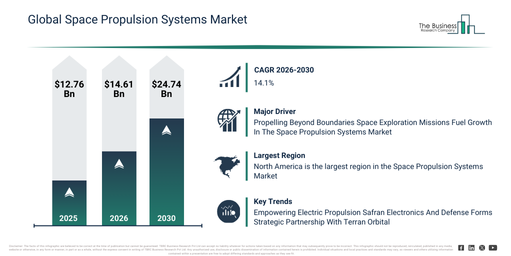
The space propulsion systems market has expanded rapidly in recent years. It is forecast to increase from $12.76 billion in 2025 to $14.61 billion in 2026, at a compound annual growth rate (CAGR) of 14.5%. This historical growth can be attributed to several factors including growing government investments in national space programs, the increasing deployment of commercial satellites for communication and broadcasting, the reliance on chemical propulsion technologies for traditional launch systems, the rise of defense-driven space missions requiring advanced propulsion, and the early development of electric propulsion for station-keeping in geostationary satellites.
The space propulsion systems market is projected for significant expansion in the coming years, reaching $24.74 billion by 2030, with a compound annual growth rate (CAGR) of 14.1%. This growth during the forecast period is driven by several factors, including the increasing number of private spaceflight and mega-constellation satellite initiatives, the growing uptake of electric and solar electric propulsion systems for enhanced efficiency, the escalating need for advanced propulsion designs for reusable launch vehicles, the ongoing development of green propulsion technologies aimed at reducing toxic propellants, and an intensifying focus on deep-space exploration missions that demand innovations in high-performance propulsion. Key trends anticipated during this period involve a greater embrace of high-efficiency electric propulsion systems, ongoing advancements in reusable propulsion components, a wider application of advanced propellant formulations, an increase in propulsion demand for small satellites and cubesats, and breakthroughs in high-temperature materials crucial for extreme thrust operations.
Try Before You Buy: Free Sample Of The Space Propulsion Systems Market Report:
Space Propulsion Systems Market Growth Engine: The Factor Boosting Demand Globally
Future expansion of the space propulsion systems market is anticipated due to the increasing number of space exploration missions. Space exploration involves the ongoing discovery and study of celestial bodies in outer space, facilitated by continuously advancing space technologies. These increasing missions contribute to the expansion of the space propulsion systems market because such systems are essential for generating the necessary thrust for rockets and spacecraft to travel into space. For example, the UK Space Agency, a UK-based government body overseeing the civil space program, reported in July 2024 that 175 new UK organizations were identified as participating in space-related activities in 2023, marking an 11% growth from 2022. Consequently, the rise in space exploration missions is a key driver for the space propulsion systems market.
Which Categories And Subcategories Shape The Space Propulsion Systems Market?
The space propulsion systems market covered in this report is segmented –
1) By Component: Thrusters, Rocket Motors, Propellant Feed Systems, Propulsion Thermal Control, Nozzles, Power Processing Units, Other Components
2) By Spacecraft Type: Satellites, Rovers, Capsules, Launch Vehicles, Interplanetary Spacecraft And Probes
3) By Application: Space Simulation, Rocket Launch, Other Applications
4) By End User: Civil And Earth Observation, Government And Military, Commercial
Subsegments:
1) By Thrusters: Chemical Thrusters, Electric Thrusters, Hybrid Thrusters
2) By Rocket Motors: Solid Rocket Motors, Liquid Rocket Motors, Hybrid Rocket Motors
3) By Propellant Feed Systems: Pressure-Fed Systems, Pump-fed Systems
4) By Propulsion Thermal Control: Thermal Insulation Systems, Heat Exchangers
5) By Nozzles: Bell Nozzles, Aerospike Nozzles, De Laval Nozzles
6) By Power Processing Units: Power Control Units, Power Distribution Units
7) By Other Components: Sensors, Control Valves, Connectors
Space Propulsion Systems Market Trend Insights: Strategic Focus Areas Of Leading Companies
Leading companies within the space propulsion systems market are adopting a strategic partnership approach, with the goal of manufacturing electric propulsion systems in the United States of America. These strategic partnerships involve companies leveraging each other’s strengths and resources to achieve mutual benefits and success. For instance, in June 2023, Safran Electronics & Defense, a France-based company specializing in electrical systems, avionics, and optronics, signed a Memorandum of Agreement with Terran Orbital, a US-based defense and aerospace company. This agreement aims to research and verify the requirements for producing a new generation of satellite electric propulsion systems. This transaction demonstrates Safran Electronics & Defense’s belief in the value of Terran Orbital’s industry-leading products and inventive individuals, while also supporting strategic efforts to create more adaptable, computerized, vertically integrated manufacturing systems. Safran Electronics & Defense and Terran Orbital will conduct a comprehensive study to evaluate the technical, industrial, and economic requirements for an innovative U.S.-based manufacturing facility for electric propulsion systems.
Leading Organizations In The Space Propulsion Systems Market
Major companies operating in the space propulsion systems market are IHI Corporation, Safran S.A., Aerojet Rocketdyne Holdings Inc., Space Exploration Technologies Corp., Northrop Grumman Corporation, Moog Inc., OHB SE, Sierra Nevada Corporation, Thales Alenia Space, Accion Systems Inc., ArianeGroup, Rafael Advanced Defense Systems Ltd., Mitsubishi Heavy Industries Ltd., Lockheed Martin Corporation, NanoAvionics Corp., L3Harris Technologies Inc., Blue Origin LLC, Avio SpA, Yuzhnoye State Design Office, Honeywell International Inc., The Boeing Company, Ball Aerospace & Technologies Corp., Antrix Corporation Limited, Exotrail SA, Terran Orbital Corporation, Rocket Lab USA Inc., Firefly Aerospace Inc., Relativity Space Inc., Momentus Inc.
Continue Reading: The Full Space Propulsion Systems Market Report:
Space Propulsion Systems Market Regional Spotlight: Top Geography And Report Coverage
North America was the largest region in the space propulsion systems market in 2025.Asia-Pacific is expected to be the fastest-growing region in the global space propulsion system market report during the forecast period. The regions covered in the space propulsion systems market report are Asia-Pacific, South East Asia, Western Europe, Eastern Europe, North America, South America, Middle East, Africa.
Reach Out To Our Team:
The Business Research Company: https://www.thebusinessresearchcompany.com/
Americas: +1 310-496-7795
Asia: +44 7882 955267 & +91 8897263534
Europe: +44 7882 955267
Email us at: marketing@tbrc.info
Follow us on:
LinkedIn: https://in.linkedin.com/company/the-business-research-company
YouTube: https://www.youtube.com/channel/UC24_fI0rV8cR5DxlCpgmyFQ
Global Market Model: https://www.thebusinessresearchcompany.com/global-market-model

Wasay has over a decade of experience in market research, data modelling, and analytics, with prior experience at GlobalData and Decision Tree Consulting Services. At The Business Research Company , he leads research operations across syndicated studies, customized consulting engagements, and the Global Market Model platform. His professional experience includes supporting organizations such as Boston Consulting Group, KPMG, and Ernst & Young. Wasay holds a degree in Electronics and Communications Engineering, postgraduate management qualifications from International Management Institute Belgium and Indian School of Business and Entrepreneurship, and completed the Integrated Program in Business Analytics from Indian Institute of Management Indore.


