
Designed to make market research more actionable and strategically valuable, The Business Research Company’s 2026 market reports feature market attractiveness scoring, total addressable market sizing, company benchmarking matrices, interactive Excel dashboards, deeper supply chain intelligence, emerging startup tracking, and granular product-level insights.
Non-Chemical Space Propulsion System Market Forecast 2026–2030: Size, Value And Compound Annual Growth Rate
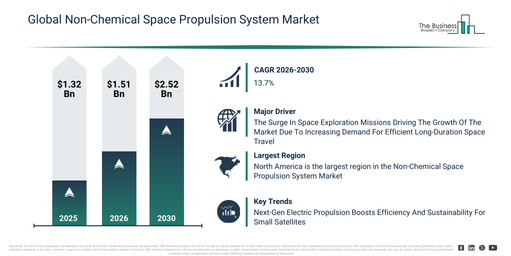
The non-chemical space propulsion system market has shown rapid expansion in recent years. It is forecast to increase from $1.32 billion in 2025 to $1.51 billion in 2026, with a compound annual growth rate (CAGR) of 14.0%. This historical growth is driven by factors such as the growing adoption of electric propulsion systems for satellite station-keeping and orbit raising, improvements in power processing units leading to better efficiency and thrust control, an increase in deep-space missions needing long-duration propulsion, the rise in small satellite launches boosting demand for compact non-chemical thrusters, and intensified research into ion and Hall-effect propulsion technologies.
The non-chemical space propulsion system market is projected to experience substantial expansion over the coming years. Its valuation is set to reach $2.52 billion in 2030, exhibiting a compound annual growth rate (CAGR) of 13.7%. This anticipated growth is driven by several factors, such as increased investment in powerful electric propulsion for missions to other planets and the Moon, a rising need for adaptable propulsion systems for extensive satellite networks, advancements in nuclear-based and plasma propulsion for future exploration endeavors, the proliferation of commercial space operations requiring effective in-space movement systems, and accelerated advancements in thermal management and propellant supply technologies to boost propulsion efficiency. Key trends during this period encompass the miniaturization and modular design of non-chemical propulsion systems for smaller satellites and large constellations, the convergence of power and propulsion subsystems (PPS) to achieve greater system efficiency and reduce mass, an increasing uptake of high-specific-impulse propulsion for prolonged deep space and interplanetary journeys, the standardization of non-chemical propulsion interfaces for rideshare services and orbital transfer vehicles, and an escalating requirement for propulsion systems supporting in-orbit servicing, space debris removal, and extending satellite operational lifetimes.
Try Before You Buy: Free Sample Of The Non-Chemical Space Propulsion System Market Report:
Non-Chemical Space Propulsion System Market Growth Engine: The Factor Boosting Demand Globally
The expanding number of space exploration endeavors is anticipated to stimulate the advancement of the non-chemical space propulsion system market in the future. These missions involve structured undertakings, utilizing either human crews or robotic probes, aimed at examining and collecting data concerning outer space situated beyond Earth’s atmospheric layer. This increase in space exploration is attributable to a scientific desire to comprehend the universe, progress in technology enabling deep-space journeys, and the ambition to locate novel resources and possible living environments outside of Earth. A greater volume of space exploration initiatives aids current and prospective space projects through promoting technological progress, encouraging global partnerships, and broadening scientific knowledge. As an illustration, in May 2024, data from the National Space Operations Centre (NSpOC), a UK-based government agency, indicated that the count of operational satellites in orbit, as of April 2024, surpassed 9,000, with certain projections indicating that by 2030, there could be in excess of 60,000 active satellites in space. Consequently, the heightened activity in space exploration missions is fueling the expansion of the non-chemical space propulsion system market.
Which Categories And Subcategories Shape The Non-Chemical Space Propulsion System Market?
The non-chemical space propulsion system market covered in this report is segmented –
1) By Type: Nuclear Propulsion, Laser Propulsion
2) By Application: Commercial, Satellite Operators And Owners, Space Launch Service Providers, Government And Defense, Departments Of Defense, National Space Agencies, Other Applications
3) By End User: Civil And Earth Observation, Government And Military, Commercial
Subsegments:
1) By Nuclear Propulsion: Nuclear Thermal Propulsion, Nuclear Electric Propulsion, Radioisotope Thermoelectric Propulsion, Fission Fragment Propulsion, Fusion-Based Propulsion
2) By Laser Propulsion: Photon Pressure Propulsion, Laser Ablation Propulsion, Beamed Energy Propulsion, Laser Thermal Propulsion, Direct Energy Transfer Systems
Non-Chemical Space Propulsion System Market Trend Insights: Strategic Focus Areas Of Leading Companies
Leading companies operating in the non-chemical space propulsion system market are concentrating on developing advanced technologies, such as electric propulsion systems, to boost efficiency and sustainability. Electric propulsion systems leverage electrical energy to generate thrust, enabling quieter, more efficient, and cleaner movement for vehicles or spacecraft without relying on traditional chemical fuels. For instance, in May 2025, Enpulsion GmbH, an Austria-based aerospace and defense company, introduced Nexus, an advanced propulsion system. Designed for spacecraft weighing up to 500 kilograms, Nexus provides significantly higher thrust and improved orbit-raising capabilities to satisfy the increasing demand for responsive, high-performance electric propulsion in small satellite missions. The system features a compact, modular design that delivers up to 7.1 mN of thrust and a specific impulse of 4,500 seconds, utilizing a safe, non-toxic indium propellant. With plug-and-play integration, no pressurized tanks, and a scalable architecture, Nexus ensures exceptional performance, safety, and flexibility across various satellite applications.
Leading Organizations In The Non-Chemical Space Propulsion System Market
Major companies operating in the non-chemical space propulsion system market are Airbus SE, Northrop Grumman Corporation, Safran SA, Thales Group, L3Harris Technologies Inc., IHI Corporation, Space Exploration Technologies Corp., Hanwha Aerospace Co. Ltd., Moog Inc., ArianeGroup, Sierra Space Corp., Benchmark Space Systems, Dawn Aerospace, Bradford Space, Busek Co. Inc., Comat Aerospace Corp., CU Aerospace LLC, Ad Astra Rocket Company, Enpulsion GmbH, LIA Aerospace Ltd., ThrustMe.
Continue Reading: The Full Non-Chemical Space Propulsion System Market Report:
Non-Chemical Space Propulsion System Market Regional Spotlight: Top Geography And Report Coverage
North America was the largest region in the non-chemical space propulsion system market in 2025. Asia-Pacific is expected to be the fastest-growing region in the forecast period. The regions covered in the non-chemical space propulsion system market report are Asia-Pacific, South East Asia, Western Europe, Eastern Europe, North America, South America, Middle East, Africa.
Reach Out To Our Team:
The Business Research Company: https://www.thebusinessresearchcompany.com/
Americas: +1 310-496-7795
Asia: +44 7882 955267 & +91 8897263534
Europe: +44 7882 955267
Email us at: marketing@tbrc.info
Follow us on:
LinkedIn: https://in.linkedin.com/company/the-business-research-company
YouTube: https://www.youtube.com/channel/UC24_fI0rV8cR5DxlCpgmyFQ
Global Market Model: https://www.thebusinessresearchcompany.com/global-market-model

Wasay has over a decade of experience in market research, data modelling, and analytics, with prior experience at GlobalData and Decision Tree Consulting Services. At The Business Research Company , he leads research operations across syndicated studies, customized consulting engagements, and the Global Market Model platform. His professional experience includes supporting organizations such as Boston Consulting Group, KPMG, and Ernst & Young. Wasay holds a degree in Electronics and Communications Engineering, postgraduate management qualifications from International Management Institute Belgium and Indian School of Business and Entrepreneurship, and completed the Integrated Program in Business Analytics from Indian Institute of Management Indore.
