
Delivering more actionable and strategically valuable research, The Business Research Company’s 2026 market reports feature market attractiveness analysis, total addressable market evaluation, company benchmarking matrices, interactive Excel dashboards, expanded supply chain intelligence, emerging startup coverage, and detailed product insights.
Non-Ferrous Metal Recycling Market Revenue Outlook: What CAGR Is Expected Through 2030?
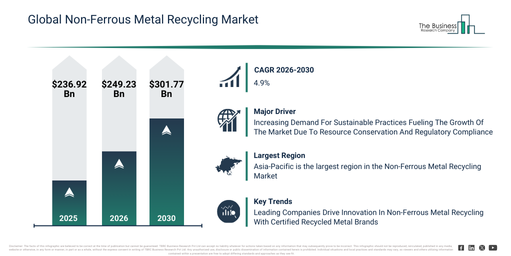
The non-ferrous metal recycling market size has experienced significant expansion in recent times. Projections indicate an expansion from $236.92 billion in 2025 to $249.23 billion by 2026, reflecting a compound annual growth rate (CAGR) of 5.2%. This historical development is largely attributable to a surge in industrial demand for recycled non-ferrous metals like aluminum and copper, enhanced capabilities in scrap collection and processing consequently increasing recycling output, the increasing preference for recycling to minimize energy consumption relative to primary metal manufacturing, the growth of the automotive and construction industries which has fueled the demand for recycled metal products, and improvements in sorting and separation technologies that have boosted recovery efficiency.
The non-ferrous metal recycling market is projected for consistent growth in the coming years. Its size is anticipated to reach $301.77 billion by 2030, exhibiting a compound annual growth rate (CAGR) of 4.9%. This growth during the forecast period stems from several factors, including an increased focus on circular economy principles promoting greater recycling, an escalating need for high-purity recycled metals in electronics and renewable energy, the expansion of urban mining efforts to retrieve valuable non-ferrous materials from waste streams, more investment in automated and AI-driven recycling technologies, and intensified regulatory pressure to lower carbon emissions, which in turn drives the use of recycled non-ferrous metals. Key trends anticipated for the forecast period encompass greater scrap collection from retired vehicles and consumer electronics, the proliferation of specialized facilities for non-ferrous sorting and pre-processing, a move towards higher-purity recycled metal grades to satisfy more stringent quality standards, increasing vertical integration among scrap collectors, recyclers, and metal manufacturers, and the regional diversification of scrap sources to mitigate supply and price fluctuations.
Download A Free Sample Report For Comprehensive Market Insights:
Non-Ferrous Metal Recycling Market Expansion Drivers: What Is Shaping Future Growth?
The rising requirement for sustainable approaches is anticipated to fuel expansion within the non-ferrous metal recycling market in the future. These practices involve strategies that concurrently support economic development, safeguard the environment, and promote societal welfare, thereby ensuring responsible resource utilization and their preservation for coming generations. This heightened demand for sustainable methods stems from more stringent governmental rules and policies, which mandate adherence and encourage judicious resource stewardship. Recycling non-ferrous metals contributes significantly to sustainable practices by preserving natural resources and lowering energy usage, rendering it vital for environmentally conscious production and waste handling. Furthermore, it mitigates environmental harm through decreased emissions and less waste going to landfills, thus fostering a circular economic model. An illustrative example from April 2024 reveals that a survey conducted by PDI Technologies, a US-based software solutions provider, among over 1,200 US consumers, indicated that 80% expressed a desire to purchase sustainable items. This figure represents an uptick from 66% in 2022 to 68% in 2023. Consequently, the escalating need for sustainable approaches is propelling the expansion of the non-ferrous metal recycling market.
Non-Ferrous Metal Recycling Market Segments: Where Are The Largest Growth Opportunities?
The non-ferrous metal recycling market covered in this report is segmented –
1) By Recycling Process Type: Mechanical Recycling, Pyrometallurgical Recycling, Hydrometallurgical Recycling, Biotechnology-Based Recycling
2) By Type Of Non-Ferrous Metal: Copper, Aluminum, Lead, Zinc, Nickel, Graphite, Precious Metals
3) By Source Of Scrap Material: Industrial Scrap, End-Of-Life Vehicles, Construction And Demolition Debris, Consumer Electronics, Household Appliances
4) By End-Use Industry: Automotive, Building And Construction, Electrical And Electronics, Industrial Machinery, Other End Users
Subsegments:
1) By Mechanical Recycling, Shredding, Sorting, Baling, Dismantling
2) By Pyrometallurgical Recycling, Smelting, Refining, Incineration, Thermal Treatment
3) By Hydrometallurgical Recycling, Leaching, Solvent Extraction, Precipitation, Electro-Winning
4) By Biotechnology-Based Recycling, Bioleaching, Biosorption, Bioprecipitation, Enzymatic Treatment
Non-Ferrous Metal Recycling Market Innovation Trends Driving Future Development
Companies operating significantly within the non-ferrous metal recycling market are prioritizing the development of innovative products, like recycled metal, to bolster product credibility, satisfy regulatory mandates, and appeal to environmentally conscious clientele. Recycled metal refers to material recovered from used items, scrap, or industrial waste, subsequently reprocessed for manufacturing reuse. It encompasses both ferrous metals (such as steel and iron) and non-ferrous metals (including aluminum, copper, and brass). For instance, in January 2024, Mitsubishi Materials Corporation, a Japan-based cement manufacturing company, introduced REMINE, a recycled metal brand designed to specify and certify the recycled content in non-ferrous metal products, including refined tin and lead. This initiative enhances transparency, traceability, and sustainability by adhering to certified environmental labeling and employing advanced recycling technologies.
Non-Ferrous Metal Recycling Market Company Landscape And Strategic Competition
Major companies operating in the non-ferrous metal recycling market are Aurubis Aktiengesellschaft, Gerdau North America Corporation, Novelis Inc., Dowa Holdings Co. Ltd., Sims Limited, Chiho Environmental Group Limited, OmniSource Corporation, Alter Trading Corporation, SA Recycling Limited Liability Company, Triple M Metal LP, Harmony Enterprises Inc., MS Enterprises, STEINERT GmbH, Quest Resource Management Group LLC, Jansen Recycling Group B.V., Jain Metal Group, ASM Recycling Inc., Aruhya Enterprises, Stena Metall Aktiebolag, GLE Scrap Metal Inc.
Access The Complete Non-Ferrous Metal Recycling Market Report:
Non-Ferrous Metal Recycling Market Regional Outlook: Where Are The Largest Opportunities Located?
Asia-Pacific was the largest region in the non-ferrous metal recycling market in 2025. North America is expected to be the fastest-growing region in the forecast period. The regions covered in the non-ferrous metal recycling market report are Asia-Pacific, South East Asia, Western Europe, Eastern Europe, North America, South America, Middle East, Africa.
Access a Customized Non-Ferrous Metal Recycling Market Report for Deeper Competitive Insights
https://www.thebusinessresearchcompany.com/customise?id=25438&type=smp
The Business Research Company: https://www.thebusinessresearchcompany.com/
Americas: +1 310-496-7795
Asia: +44 7882 955267 & +91 8897263534
Europe: +44 7882 955267
Email us at: marketing@tbrc.info
Follow us on:
LinkedIn: https://in.linkedin.com/company/the-business-research-company
YouTube: https://www.youtube.com/channel/UC24_fI0rV8cR5DxlCpgmyFQ
Global Market Model: https://www.thebusinessresearchcompany.com/global-market-model

Wasay has over a decade of experience in market research, data modelling, and analytics, with prior experience at GlobalData and Decision Tree Consulting Services. At The Business Research Company , he leads research operations across syndicated studies, customized consulting engagements, and the Global Market Model platform. His professional experience includes supporting organizations such as Boston Consulting Group, KPMG, and Ernst & Young. Wasay holds a degree in Electronics and Communications Engineering, postgraduate management qualifications from International Management Institute Belgium and Indian School of Business and Entrepreneurship, and completed the Integrated Program in Business Analytics from Indian Institute of Management Indore.