Built to provide research that’s more actionable and strategically valuable, The Business Research Company’s 2026 market reports include market attractiveness analysis, total addressable market sizing, company benchmarking matrices, interactive Excel dashboards, broader supply chain intelligence, emerging startup tracking, and in-depth product insights.
#Nuclear Facility Physical Protection Systems Market Growth Potential: How Will Market Size Shift Through 2030?#_x000D_
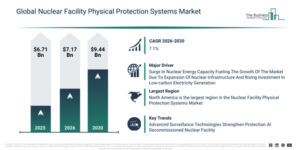
The nuclear facility physical protection systems market size has shown substantial growth in recent years. It is projected to expand from $6.71 billion in 2025 to $7.17 billion in 2026, reflecting a compound annual growth rate (CAGR) of 6.9%. The market’s historical development is attributable to an increase in nuclear energy installations, evolving regulatory compliance requirements, heightened concerns over nuclear theft and sabotage, the adoption of advanced intrusion detection technologies, and the broadening of nuclear power plant infrastructure._x000D_
_x000D_
The market for nuclear facility physical protection systems is projected to experience robust expansion in the coming years, anticipated to reach $9.44 billion by 2030, showing a compound annual growth rate (CAGR) of 7.1%. This growth during the forecast period is primarily driven by heightened investments in cybersecurity for nuclear facilities, the increasing integration of artificial intelligence and analytics into security systems, the rising uptake of IoT-enabled monitoring solutions, the expansion of advanced access control systems, and a growing emphasis on modernizing nuclear facilities and implementing digital surveillance. Key trends anticipated over the forecast timeframe involve the increasing adoption of integrated perimeter intrusion detection systems, a rise in the deployment of radiation detection and nuclear material monitoring technologies, an escalating demand for biometric and sophisticated access control systems, the expansion of services for security monitoring and incident response, and an enhanced focus on predictive maintenance and overall system reliability._x000D_
_x000D_
#Get A Free Sample Report With In-Depth Market Insights:#_x000D_
_x000D_
#Nuclear Facility Physical Protection Systems Market Growth Catalysts And Demand Drivers#_x000D_
The expanding nuclear energy capacity is anticipated to drive the advancement of the nuclear facility physical protection systems market in the future. This capacity denotes the full installed and active power generation capability derived from nuclear reactors, specifically for electricity production. The global rise in nuclear energy capacity stems from the expansion of nuclear infrastructure, as nations invest in dependable, low-carbon electricity to satisfy increasing energy requirements and climate objectives. Nuclear facility physical protection systems aid the growth in nuclear energy capacity by guaranteeing strong security, effective access control, and comprehensive threat detection at power plants, thus proving crucial for expanding nuclear infrastructure. These systems mitigate the dangers of unauthorized entry and operational interruptions, simultaneously boosting regulatory adherence and safety, which in turn strengthens overall energy reliability and facility resilience. For example, the World Nuclear Association, a UK-based nuclear industry organization, reported in August 2024 that nuclear electricity generation climbed from 2,544 terawatt hours in 2022 to 2,602 terawatt hours in 2023, with 64 reactors currently being built. Consequently, the expanding nuclear energy capacity is propelling the growth of the nuclear facility physical protection systems market. The escalating dangers posed by cyberattacks are projected to drive the expansion of the nuclear facility physical protection systems market in the coming years. Cyberattacks describe malicious efforts aimed at gaining unauthorized access to, disrupting, or damaging computer systems or data, frequently conducted for information theft or to inflict damage. These rising cyber threats arise from the increasing centralization of digital asset storage, which establishes attractive single points of failure for hackers. Nuclear facility physical protection systems assist in mitigating cyberattacks through the integration of physical security measures with cybersecurity controls to protect critical infrastructure. These systems lessen vulnerabilities and enhance overall capabilities for threat detection and response. For instance, Check Point Software Technologies Ltd., an Israel-based cybersecurity company, reported in July 2024 that cyberattacks on corporate networks are increasing, showing a 30% rise in weekly attacks during the second quarter of 2024 compared to the corresponding period in 2023, and a 25% increase from the first quarter of 2024. Consequently, the growing threats of cyberattacks are propelling the expansion of the nuclear facility physical protection systems market._x000D_
_x000D_
#Nuclear Facility Physical Protection Systems Market Segment Landscape: Which Areas Lead Development?#_x000D_
The nuclear facility physical protection systems market covered in this report is segmented – _x000D_
_x000D_
1) By Component: Hardware, Software, Services_x000D_
2) By Facility Type: Nuclear Power Plants, Research Reactors, Fuel Cycle Facilities, Waste Management Facilities, Other Facility Types_x000D_
3) By Security Type: Access Control, Intrusion Detection, Video Surveillance, Perimeter Security, Cybersecurity, Other Security Types_x000D_
4) By End-User: Government, Private Operators, Defense, Other End-Users_x000D_
_x000D_
Subsegments:_x000D_
1) By Hardware: Surveillance Cameras, Biometric Access Control Devices, Intrusion Detection Sensors, Perimeter Security Barriers, Radiation Detection Equipment, Command And Control Consoles_x000D_
2) By Software: Security Information Management Software, Access Control Management Software, Video Monitoring And Analytics Software, Threat Detection And Response Software, Incident Management Software, Integrated Security Control Platforms_x000D_
3) By Services: System Integration Services, Installation And Deployment Services, Maintenance And Support Services, Security Monitoring Services, Consulting And Risk Assessment Services, Training And Compliance Services_x000D_
_x000D_
#Nuclear Facility Physical Protection Systems Market Trends Shaping Long-Term Demand#_x000D_
Leading companies in the nuclear facility physical protection systems market are concentrating on developing sophisticated security technologies, such as AI-driven surveillance and autonomous monitoring solutions. This focus aims to bolster perimeter defense, improve threat detection, and ensure adherence to regulations at sensitive sites. AI-enabled surveillance and autonomous monitoring systems refer to integrated security platforms that combine intelligent sensors, video analytics, automated intrusion detection, and real-time alert mechanisms to safeguard high-risk infrastructure. For instance, in February 2025, the UK’s Nuclear Decommissioning Authority (NDA), a UK-based government agency, launched trials of four innovative new security systems at the former Winfrith nuclear reactor test site in Dorset, in collaboration with security technology partners. This initiative prioritized deploying advanced detection technologies, including intelligent video monitoring and automated response capabilities, which enhance situational awareness and reduce reliance on traditional manpower-intensive security methods. The systems are engineered to support highly sensitive nuclear environments, ensuring resilient, scalable, and high-reliability physical protection for mission-critical infrastructure, regulatory compliance, and long-term site safety initiatives._x000D_
_x000D_
#Nuclear Facility Physical Protection Systems Market Competitive Landscape: Who Leads The Industry?#_x000D_
Major companies operating in the nuclear facility physical protection systems market are Siemens AG, Raytheon Technologies Corporation, Lockheed Martin Corporation, Schneider Electric SE, Northrop Grumman Corporation, Honeywell International Inc., ABB Ltd., BAE Systems plc, Johnson Controls International plc, Thales Group, Leidos Holdings Inc., Ametek Inc., Amentum Services Inc., Smiths Group plc, Curtiss-Wright Corporation, Bosch Security Systems GmbH, Axis Communications AB, Mirion Technologies Inc., ARES Security Corporation, and Magal Security Systems Ltd._x000D_
_x000D_
#View The Full Nuclear Facility Physical Protection Systems Market Report:#_x000D_
_x000D_
#Nuclear Facility Physical Protection Systems Market Geographic Landscape: Which Region Leads Industry Growth?#_x000D_
North America was the largest region in the nuclear facility physical protection systems market in 2025. Asia-Pacific is expected to be the fastest-growing region in the forecast period. The regions covered in the nuclear facility physical protection systems market report are Asia-Pacific, South East Asia, Western Europe, Eastern Europe, North America, South America, Middle East, Africa._x000D_
_x000D_
#Reach Out To Our Team:#_x000D_
_x000D_
The Business Research Company: https://www.thebusinessresearchcompany.com/_x000D_
Americas: +1 310-496-7795_x000D_
Asia: +44 7882 955267 & +91 8897263534_x000D_
Europe: +44 7882 955267_x000D_
Email us at: marketing@tbrc.info_x000D_
_x000D_
#Follow us on:#_x000D_
_x000D_
LinkedIn: https://in.linkedin.com/company/the-business-research-company_x000D_
YouTube: https://www.youtube.com/channel/UC24_fI0rV8cR5DxlCpgmyFQ_x000D_
Global Market Model: https://www.thebusinessresearchcompany.com/global-market-model

Wasay has over a decade of experience in market research, data modelling, and analytics, with prior experience at GlobalData and Decision Tree Consulting Services. At The Business Research Company , he leads research operations across syndicated studies, customized consulting engagements, and the Global Market Model platform. His professional experience includes supporting organizations such as Boston Consulting Group, KPMG, and Ernst & Young. Wasay holds a degree in Electronics and Communications Engineering, postgraduate management qualifications from International Management Institute Belgium and Indian School of Business and Entrepreneurship, and completed the Integrated Program in Business Analytics from Indian Institute of Management Indore.