The Business Research Company’s 2026 market reports are designed to deliver research that is more actionable and strategically valuable. Key offerings include market attractiveness scoring, total addressable market sizing, company benchmarking matrices, interactive Excel dashboards, deeper supply chain intelligence, emerging startup tracking, and granular product-level insights.
Orbital Repair Services Market Size, Growth Rate And Key Forecast Highlights For 2026–2030
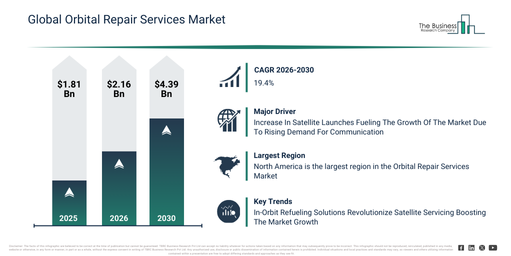
The orbital repair services market has seen rapid expansion in recent years. This market is set to expand from $1.81 billion in 2025 to $2.16 billion in 2026, achieving a compound annual growth rate (CAGR) of 19.3%. Historically, its growth can be linked to factors such as the increasing failure rates and aging of satellites, which stimulated early interest in orbital servicing. Other contributors include the growing demand for services like orbital relocation and station-keeping support, alongside advancements in robotic servicing technologies that enable remote inspection and repair. Furthermore, the rise in geostationary satellite deployments requiring extensive maintenance and increasing concerns over space debris, which spurred the development of cleanup and collision-avoidance solutions, have also played a significant role.
The orbital repair services market is projected to experience substantial expansion over the coming years, forecast to reach $4.39 billion by 2030, exhibiting a compound annual growth rate (CAGR) of 19.4%. This growth during the forecast period is driven by factors such as the increasing embrace of on-orbit refueling and life-extension operations for valuable satellites, greater financial commitments towards autonomous servicing vehicles proficient in intricate repairs, a heightened need for orbital tug services to assist with satellite repositioning and constellation oversight, the broadening of commercial debris removal projects spurred by rising regulatory demands, and the accelerating progress in modular spacecraft designs that facilitate simpler in-orbit enhancements and maintenance. Key trends anticipated in this period encompass a surging requirement for satellite life-extension and on-orbit mission reliability services, a movement towards modular and maintainable satellite designs tailored for in-orbit modifications and fixes, the proliferation of commercial space tugs and in-space transport solutions for moving satellites and taking them out of orbit, an increase in government and defense-led demonstrations of in-orbit servicing and debris reduction efforts, and the development of standardized docking and refueling interfaces to foster collaborative servicing environments among multiple vendors.
See What’s Inside The Orbital Repair Services Market Report With A Free Sample:
Orbital Repair Services Market Expansion: The Major Factor Driving Growth
The increasing quantity of satellites in space is anticipated to drive the expansion of the orbital repair services market in the future. Satellites are man-made objects positioned in orbit around Earth or other celestial bodies, used for data collection, communication, navigation, weather prediction, or scientific studies. This growth in orbiting satellites largely stems from a greater need for earth observation uses like environmental tracking, disaster response, farming, and city planning, all of which necessitate regular, detailed imagery of Earth. Orbital repair services enable satellites in space to prolong their working life through maintenance, refueling, and part replacements, eliminating the requirement to come back to Earth. For example, the National Space Operations Centre (NSpOC), a UK government body, reported in May 2024 that over 9,000 active satellites were in orbit as of April 2024, with forecasts suggesting this figure might surpass 60,000 by 2030. Consequently, the growing population of satellites in space is fueling the development of the orbital repair services market.
Understanding Orbital Repair Services Market Segmentation For Strategic Planning
The orbital repair services market covered in this report is segmented –
1) By Service Type: Satellite Refueling, Satellite Servicing, Satellite Deorbiting, Other Service Types
2) By Platform: Low Earth Orbit, Medium Earth Orbit, Geostationary Earth Orbit, Beyond Low Earth Orbit
3) By Application: Commercial, Military, Government
4) By End-User: Satellite Operators, Satellite Manufacturers, Other End-Users
Subsegments:
1) By Satellite Refueling: Chemical Propellant Refueling, Electric Propulsion Refueling, Cryogenic Propellant Refueling, Hybrid Propellant Refueling
2) By Satellite Servicing: Component Replacement, Software Upgrades, Structural Repairs, Orbit Adjustment And Relocation, Inspection And Diagnostics
3) By Satellite Deorbiting: Controlled Reentry, Passive Deorbiting Devices, Active Removal By Servicer Spacecraft, Tether-Based Systems, Drag Augmentation Devices
4) By Other Service Types: Orbital Debris Removal, Assembly Of Satellite Structures In Orbit, Tug And Tow Services, Payload Reconfiguration, Robotic Arm-Based Operations
Key Orbital Repair Services Market Trends To Watch In 2026
Major companies in the orbital repair service market are concentrating on advanced technologies, such including in-orbit refueling solutions, to extend the operational lifespan of both pre-designed and non-pre-designed satellites. In-orbit refueling solutions facilitate the transfer of propellant to satellites already deployed in space, allowing them to continue operations beyond their scheduled operational lifetimes without needing to carry fuel at launch. For example, in August 2024, PIAP Space, a space technology company based in Poland, announced the launch of the in-orbit refueling technology for unprepared and prepared satellites (INORT) project. The INORT initiative aims to develop modular refueling capabilities that are adaptable for a broad spectrum of satellites, irrespective of their original design for servicing. This technology can substantially cut down the costs linked with satellite replacements by addressing both anticipated and unexpected refueling demands, thus promoting a more sustainable approach to space infrastructure use.
Key Companies Active In The Orbital Repair Services Market
Major companies operating in the orbital repair services market are Lockheed Martin Corporation, Airbus SE, Northrop Grumman Corporation, Thales Alenia Space SAS, MDA Space Ltd., Telespazio S.p.A., Astroscale Holdings Inc., ClearSpace SA, D-Orbit S.p.A., Starfish Space Inc., Exotrail SAS, Orbit Fab Inc., Katalyst Space Technologies Inc., ThinkOrbital Inc., KINETIK Space Ltd, Obruta Space Solutions Inc., ORBITAID Aerospace Private Limited, Infinite Orbits SAS, Kurs Orbital Inc., Orbital Lasers
Explore Detailed Orbital Repair Services Market Research And Forecasts:
Which Geography Dominates The Orbital Repair Services Market?
North America was the largest region in the orbital repair services market in 2025. Asia-Pacific is expected to be the fastest-growing region in the forecast period. The regions covered in the orbital repair services market report are Asia-Pacific, South East Asia, Western Europe, Eastern Europe, North America, South America, Middle East, Africa.
Reach Out To Our Team:
The Business Research Company: https://www.thebusinessresearchcompany.com/
Americas: +1 310-496-7795
Asia: +44 7882 955267 & +91 8897263534
Europe: +44 7882 955267
Email us at: marketing@tbrc.info
Follow us on:
LinkedIn: https://in.linkedin.com/company/the-business-research-company
YouTube: https://www.youtube.com/channel/UC24_fI0rV8cR5DxlCpgmyFQ
Global Market Model: https://www.thebusinessresearchcompany.com/global-market-model

Wasay has over a decade of experience in market research, data modelling, and analytics, with prior experience at GlobalData and Decision Tree Consulting Services. At The Business Research Company , he leads research operations across syndicated studies, customized consulting engagements, and the Global Market Model platform. His professional experience includes supporting organizations such as Boston Consulting Group, KPMG, and Ernst & Young. Wasay holds a degree in Electronics and Communications Engineering, postgraduate management qualifications from International Management Institute Belgium and Indian School of Business and Entrepreneurship, and completed the Integrated Program in Business Analytics from Indian Institute of Management Indore.