Enhanced with market attractiveness analysis, total addressable market evaluation, company benchmarking matrices, interactive Excel dashboards, expanded supply chain intelligence, emerging startup coverage, and detailed product insights, The Business Research Company’s 2026 market reports deliver more actionable and strategically valuable research.
Planetary Geology Market Size Outlook: How Fast Will Revenue Grow Through 2030?
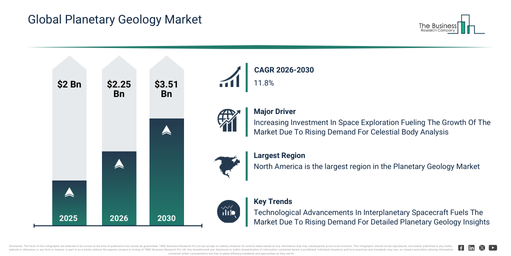
The market size for planetary geology has demonstrated rapid expansion in recent years. This market is anticipated to grow from $2 billion in 2025 to $2.25 billion in 2026, achieving a compound annual growth rate (CAGR) of 12.5%. The historical growth can be attributed to several factors: an increase in government-funded planetary exploration missions driving demand for geological mapping services; the rising utilization of remote sensing instruments and spectrometers for analyzing planetary surfaces; the early development of planetary rovers and landers enabling in-situ geological studies; the expansion of scientific data interpretation services spurred by growing deep-space missions; and an increased reliance on assessing mineral and chemical composition for effective mission planning.
The planetary geology market is anticipated to experience substantial growth in the upcoming years, with projections indicating it will reach a value of $3.51 billion by 2030, driven by a compound annual growth rate (CAGR) of 11.8%. This expansion during the forecast period can be attributed to several factors, including the increasing commercial involvement in lunar and asteroid exploration demanding advanced geological analysis, the broader adoption of high-resolution imaging and autonomous mapping technologies, and a rising requirement for data analytics tools to process vast amounts of planetary research data. Other contributing factors are a growing emphasis on identifying extraterrestrial resources to support future mining feasibility studies and the advancement of next-generation planetary rovers and landers that enhance the precision of geological investigations. Significant trends expected in this period include a heightened demand for high-resolution multispectral planetary imaging, an increased application of in-situ geological analysis tools for extraterrestrial missions, the wider integration of advanced geological mapping for planning lunar and Martian colonization, an expansion of contract-based planetary data interpretation services, and the incorporation of miniaturized scientific instruments into compact planetary rovers.
Download A Free Sample Report For Comprehensive Market Insights:
Planetary Geology Market Growth Momentum: Which Factors Are Influencing Demand?
The future expansion of the planetary geology market is anticipated to be significantly propelled by the increasing investment in space exploration. Such investments represent the financial support channeled towards developing and advancing technologies, infrastructure, and services critical for space exploration and operations. A primary driver behind the growth of these space exploration investments is the surging interest from private companies, which are actively seeking commercial opportunities in areas like satellite deployment, space tourism, and data services. By funding missions focused on studying the composition, structure, and history of planets, moons, and asteroids, these investments directly support planetary geology. For example, as reported in December 2024 by the European Space Agency, a France-based intergovernmental organization, global space budgets climbed to €121 billion ($138.75 billion) in 2024, marking a 7% increase from 2023. Of this total, 47% was allocated to civil space programs, demonstrating a 5% increase compared to the preceding year. Thus, the escalating investment in space exploration is a key factor driving the growth of the planetary geology market.
Planetary Geology Market Segment Analysis: What Are The Major Market Categories?
The planetary geology market covered in this report is segmented –
1) By Component: Instruments, Software, Services
2) By Application: Space Exploration, Research And Development, Academic Institutions, Government Agencies, Other Applications
3) By End-User: Aerospace, Defense, Research Institutes, Other End-Users
Subsegments:
1) By Instruments: Spectrometers, Seismometers, Ground Penetrating Radar (GPR), Gravimeters, Magnetometers, Cameras, Sample Collection Tools, Drill Systems, Inertial Measurement Units (IMUs), Robotic Arms And Mobility Systems
2) By Software: Geospatial Mapping Software, 3Dimensional Geological Modeling Tools, Remote Sensing Data Processing, Planetary Simulation Software, Mission Planning And Navigation Systems, Spectral Analysis Tools, Data Visualization Platforms, Artificial Intelligence Or Machine Learning-Based Geological Interpretation Tools
3) By Services: Geological Survey And Data Interpretation, Calibration And Maintenance Services, Mission Design And Support Services, Data Analytics And Consulting, Software Integration And Customization, Training And Education, Remote Operation And Monitoring, Sample Return And Analysis Services
Planetary Geology Market Trends Reshaping Industry Growth
Leading companies within the planetary geology market are prioritizing technological advancements, such as interplanetary spacecraft, to enhance the exploration and analysis of extraterrestrial surfaces. An interplanetary spacecraft is defined as a space vehicle engineered to travel between planets within a solar system, operating beyond Earth’s orbit to investigate other planetary bodies like Mars, Venus, Jupiter, or even asteroids and comets. For example, in October 2024, the National Aeronautics and Space Administration (NASA), a US-based independent space agency, launched the Europa Clipper mission, an interplanetary spacecraft designed to explore Jupiter’s icy moon, Europa. This spacecraft is equipped with high-resolution cameras, ice-penetrating radar, thermal instruments, and a magnetometer to study the moon’s surface, its subsurface ocean, and potential habitability. It has a mass of about 6,000 kg and is powered by solar arrays over 30 meters. The Europa Clipper aims to make nearly 50 flybys of Europa. Its collected data will help determine if conditions exist to support life beneath the moon’s icy crust.
Planetary Geology Market Leading Players Shaping Industry Direction
Major companies operating in the planetary geology market are Lockheed Martin Corporation, Airbus SE, Thales SA, Ball Aerospace & Technologies Corp, Carl Zeiss Microscopy GmbH, Bruker Corporation, Maxar Technologies Inc, Leica Geosystems AG, Earth Science Systems Inc, Sensors & Software Inc, Sercel SAS, ESG Solutions Ltd, GEOSPACE Technologies Corporation, Honeybee Robotics Ltd, Güralp Systems Ltd, Malin Space Science Systems Inc, Scintrex Limited, Officina Stellare, RMS Instruments Inc, Radar Systems Inc., Geonics Ltd
Access The Complete Planetary Geology Market Report:
Planetary Geology Market Global Footprint: Which Region Holds Market Leadership?
North America was the largest region in the planetary geology market in 2025. Asia-Pacific is expected to be the fastest-growing region in the forecast period. The regions covered in the planetary geology market report are Asia-Pacific, South East Asia, Western Europe, Eastern Europe, North America, South America, Middle East, Africa.
Access a Customized Planetary Geology Market Report for Deeper Competitive Insights
https://www.thebusinessresearchcompany.com/customise?id=25463&type=smp
The Business Research Company: https://www.thebusinessresearchcompany.com/
Americas: +1 310-496-7795
Asia: +44 7882 955267 & +91 8897263534
Europe: +44 7882 955267
Email us at: marketing@tbrc.info
Follow us on:
LinkedIn: https://in.linkedin.com/company/the-business-research-company
YouTube: https://www.youtube.com/channel/UC24_fI0rV8cR5DxlCpgmyFQ
Global Market Model: https://www.thebusinessresearchcompany.com/global-market-model

Wasay has over a decade of experience in market research, data modelling, and analytics, with prior experience at GlobalData and Decision Tree Consulting Services. At The Business Research Company , he leads research operations across syndicated studies, customized consulting engagements, and the Global Market Model platform. His professional experience includes supporting organizations such as Boston Consulting Group, KPMG, and Ernst & Young. Wasay holds a degree in Electronics and Communications Engineering, postgraduate management qualifications from International Management Institute Belgium and Indian School of Business and Entrepreneurship, and completed the Integrated Program in Business Analytics from Indian Institute of Management Indore.