Designed to make market research more actionable and strategically valuable, The Business Research Company’s 2026 market reports feature market attractiveness scoring, total addressable market sizing, company benchmarking matrices, interactive Excel dashboards, deeper supply chain intelligence, emerging startup tracking, and granular product-level insights.
Pollution Absorbing Bricks Market Forecast 2026–2030: Size, Value And Compound Annual Growth Rate
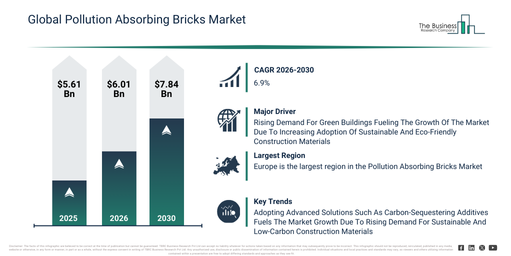
The pollution absorbing bricks market has experienced robust growth in recent years. It is forecast to grow from $5.61 billion in 2025 to $6.01 billion in 2026, exhibiting a compound annual growth rate (CAGR) of 7.1%. The expansion observed in the past can be ascribed to the increasing adoption of eco-friendly construction materials aimed at reducing urban air pollution, the rising use of photocatalytic concrete bricks in green building projects, the initial deployment of anti-dust perforated bricks in urban zones with high pollution, the growing demand for carbon-absorbing facade bricks spurred by sustainability regulations, and the widening application of smog-reducing wall bricks in commercial and residential developments.
The pollution absorbing bricks market is projected to experience substantial expansion over the coming years. This sector is anticipated to reach a valuation of $7.84 billion by 2030, exhibiting a compound annual growth rate (CAGR) of 6.9%. This expansion during the forecast period is driven by several factors, including the increasing integration of advanced photocatalytic coatings to improve pollutant-absorption efficiency, a surge in demand for pollution-absorbing bricks within smart and sustainable urban infrastructure developments, and the expanding application of porous and next-generation composite structures to enhance air-filtration capabilities. Additionally, growing regulatory incentives that encourage low-emission and air-cleaning construction materials, alongside the rising adoption of pollution-absorbing facade systems in major urban redevelopment projects, contribute to this growth. Key trends expected over the forecast period encompass a broader adoption of photocatalytic coatings in brick production, an increased utilization of porous and ventilated brick designs for air filtration, a growing preference for carbon-absorbing clay and concrete substitutes, and the expanding deployment of pollution-absorbing facades in urban infrastructure. Furthermore, advancements in bio-cementation and algae-based air-cleaning bricks are significant developments.
Try Before You Buy: Free Sample Of The Pollution Absorbing Bricks Market Report:
Pollution Absorbing Bricks Market Growth Engine: The Factor Boosting Demand Globally
The increasing need for green buildings is projected to boost the expansion of the pollution-absorbing bricks market in the future. Green buildings are constructed and designed to reduce environmental harm by using energy, water, and other resources effectively, simultaneously fostering a healthy interior atmosphere. This heightened demand for green buildings stems from a growing preference for energy-efficient solutions that cut down operational expenses, lessen environmental impact, and support sustainability objectives. Pollution-absorbing bricks, frequently integrated into green buildings, are advanced materials engineered to enhance air quality by neutralizing pollutants such as nitrogen oxides and particulate matter. These bricks commonly incorporate photocatalytic components that interact with sunlight to transform harmful pollutants into benign byproducts. For example, in December 2024, the Green Building Council Australia, an Australian government agency, reported that Australia’s building sector exceeded 1,000 Green Star-certified projects in 2024, with certification submissions doubling since 2023 and more than 120 applications received in just three months. Consequently, the rising demand for green buildings is a key factor driving the growth of the pollution-absorbing bricks market.
Pollution Absorbing Bricks Market Driver: Growing Infrastructure Development Boosts Market Due To Increased Need For Sustainable Construction
The expansion of infrastructure development is anticipated to drive the future growth of the pollution-absorbing bricks market. Infrastructure development encompasses the planning, construction, enhancement, and upkeep of essential systems and physical structures that underpin economic activity, societal welfare, and environmental sustainability. The surge in infrastructure projects is largely attributable to urbanization, as expanding urban populations necessitate better transport, energy, housing, and public services to foster habitable and efficient city environments. Pollution-absorbing bricks are seeing increased application in infrastructure development to improve air quality and encourage sustainable construction practices. These cutting-edge bricks, frequently embedded with photocatalytic substances, are installed in various locations such as roads, pavements, bridges, and building facades to break down detrimental air pollutants like nitrogen oxides when exposed to natural sunlight. For example, in 2023, the Carbon Disclosure Project, a UK-based non-profit organization managing an environmental disclosure system, reported that U.S. sectors were led by buildings and energy efficiency with 121 projects valued at $4.7 billion, followed by transport with 88 projects at $12.9 billion, and renewable energy with 61 projects amounting to $696 million. Thus, the acceleration of infrastructure development is a significant force behind the growth of the pollution-absorbing bricks market.
Which Categories And Subcategories Shape The Pollution Absorbing Bricks Market?
The pollution absorbing bricks market covered in this report is segmented –
1) By Product: Standard Pollution Absorbing Bricks, Pavement Bricks, Load-Bearing Bricks, Other Pollution Absorbing Bricks
2) By Raw Material: Clay, Concrete, Other Raw Materials
3) By Technology: Extruded Pollution Absorbing Bricks, Molded Pollution Absorbing Bricks, Other Technologies
4) By Application: Residential Buildings, Commercial Buildings, Industrial Buildings, Infrastructure Projects
5) By End User: Construction Companies, Architects And Designers, Individual Homeowners, Government Agencies
Subsegments:
1) By Standard Pollution Absorbing Bricks: Clay-Based Pollution Absorbing Bricks, Fly Ash-Based Bricks, Bio-Cemented Bricks, Silicate-Based Bricks
2) By Pavement Bricks: Interlocking Pavers, Permeable Pavement Bricks, Hexagonal Pavement Bricks, Modular Eco Pavers
3) By Load-Bearing Bricks: High-Strength Concrete Bricks, Reinforced Fly Ash Bricks, Compressed Stabilized Earth Blocks (CSEB), Carbon-Infused Load-Bearing Bricks
4) By Other Pollution Absorbing Bricks: Photocatalytic Bricks, Algae-Based Bricks, Recycled Plastic Composite Bricks, Geopolymer Bricks
Pollution Absorbing Bricks Market Trend Insights: Strategic Focus Areas Of Leading Companies
Leading companies operating within the pollution-absorbing bricks market are prioritizing the adoption of advanced solutions, such as carbon-sequestering additives, to meet sustainable construction needs. Carbon-sequestering additives are specialized materials incorporated into bricks to capture and store carbon dioxide, thereby supporting the pollution-absorbing bricks market by enhancing their environmental benefits and contributing to carbon reduction goals. For instance, in June 2024, Graphyte, a US-based carbon removal and sequestration firm, launched LEGO-like Bricks aimed at sustainability. These LEGO-like bricks are produced from leftover materials derived from the timber and farming industries. The collected materials are carefully dried to remove microbes and prevent decomposition before being compressed into durable blocks. These robust blocks are then securely sealed with an impermeable, eco-friendly barrier to prevent microbial activity and enable long-term carbon storage underground. They are also equipped with sensors for monitoring, providing an affordable and energy-efficient method to help reduce emissions and achieve climate objectives.
Leading Organizations In The Pollution Absorbing Bricks Market
Major companies operating in the pollution absorbing bricks market are CRH Plc, Cemex S.A.B. de C.V, Taiheiyo Cement Corporation, Wienerberger AG., ACC Limited, Boral Limited, Acme Brick Company, Exeed Industries LLC., General Shale Brick Inc., JSW Cement Limited, Michelmersh Brick Holdings PLC, Steenfabrieken Vandersanden N.V, Ibstock Brick Limited, Endicott Clay Products Co., Steenfabrieken Nelissen NV, CarbonCure Technologies Inc., Renaatus Procon Private Limited, CalStar Products Inc., Palmetto Brick Company, MaxBlocks Building Systems Private Limited, Hydraform International (Pty) Ltd, bioMASON Inc, StoneCycling B.V, Carbon Craft Design Private Limited
Continue Reading: The Full Pollution Absorbing Bricks Market Report:
Pollution Absorbing Bricks Market Regional Spotlight: Top Geography And Report Coverage
Europe was the largest region in the pollution-absorbing bricks market in 2025. Asia-Pacific is expected to be the fastest-growing region in the forecast period. The regions covered in the pollution absorbing bricks market report are Asia-Pacific, South East Asia, Western Europe, Eastern Europe, North America, South America, Middle East, Africa.
Reach Out To Our Team:
The Business Research Company: https://www.thebusinessresearchcompany.com/
Americas: +1 310-496-7795
Asia: +44 7882 955267 & +91 8897263534
Europe: +44 7882 955267
Email us at: marketing@tbrc.info
Follow us on:
LinkedIn: https://in.linkedin.com/company/the-business-research-company
YouTube: https://www.youtube.com/channel/UC24_fI0rV8cR5DxlCpgmyFQ
Global Market Model: https://www.thebusinessresearchcompany.com/global-market-model

Wasay has over a decade of experience in market research, data modelling, and analytics, with prior experience at GlobalData and Decision Tree Consulting Services. At The Business Research Company , he leads research operations across syndicated studies, customized consulting engagements, and the Global Market Model platform. His professional experience includes supporting organizations such as Boston Consulting Group, KPMG, and Ernst & Young. Wasay holds a degree in Electronics and Communications Engineering, postgraduate management qualifications from International Management Institute Belgium and Indian School of Business and Entrepreneurship, and completed the Integrated Program in Business Analytics from Indian Institute of Management Indore.