
The Business Research Company’s 2026 market reports are designed to deliver research that is more actionable and strategically valuable. Key offerings include market attractiveness scoring, total addressable market sizing, company benchmarking matrices, interactive Excel dashboards, deeper supply chain intelligence, emerging startup tracking, and granular product-level insights.
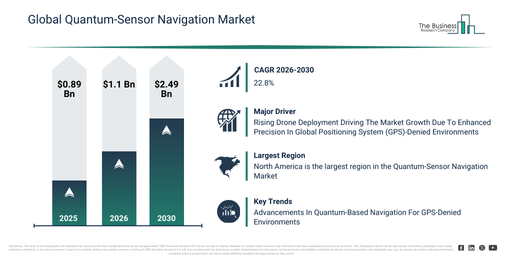
Quantum-Sensor Navigation Market Revenue Projected To Rise To $2.49 Billion By 2030
The quantum-sensor navigation market has experienced rapid expansion recently. It is projected to grow from $0.89 billion in 2025 to $1.1 billion in 2026, exhibiting a compound annual growth rate (CAGR) of 23.0%. Historically, this market expansion can be ascribed to advancements in quantum accelerometers and gyroscopes, their increasing adoption in submarine navigation, the critical need for GPS-independent navigation, integration into defense platforms, and a rising interest in autonomous vehicle guidance.
The quantum-sensor navigation market is anticipated to experience substantial expansion in the coming years. It is projected to reach $2.49 billion by 2030, demonstrating a compound annual growth rate (CAGR) of 22.8%. This growth during the forecast period can be attributed to several factors, including the commercialization of quantum navigation systems, their increasing adoption in aerospace and space sectors, integration with multi-sensor autonomous platforms, expanded use in deep-sea navigation, and the creation of miniaturized, portable quantum navigation devices. Key trends expected over this period encompass the miniaturization and SWaP (size, weight, and power) optimization of quantum inertial sensors, a shift from laboratory prototypes towards rugged, field-deployable navigation systems, increasing defense and aerospace investments in GPS-denied PNT (Positioning, Navigation, and Timing) solutions, greater integration of quantum accelerometers, gyroscopes, gravimeters, and magnetometers into hybrid classical–quantum inertial navigation systems (INS), and the expansion of government initiatives and standards to validate and certify quantum-navigation performance.
Want Deeper Quantum-Sensor Navigation Market Insights? Get A Free Sample Report:
Primary Growth Driver Shaping The Quantum-Sensor Navigation Market Outlook
The increasing use of drones is anticipated to drive expansion in the quantum-sensor navigation market in the future. Drones, also known as unmanned aerial vehicles (UAVs), are capable of remote control or autonomous operation for various purposes such as surveillance, deliveries, agricultural tasks, and photography. This surge in drone deployment stems from technological progress, making them more economical, effective, and versatile for a range of industrial and commercial uses. Quantum-sensor navigation improves drone capabilities by providing highly accurate positioning and navigation independently of the global positioning system (GPS), enabling precise functioning even in GPS-denied or difficult areas like interiors, subterranean locations, or crowded urban settings. For example, in June 2025, the UK Ministry of Defence, a UK government body, reported that the UK is allocating an unprecedented $477.74 million (£350 million) to enhance Ukraine’s drone provisions, with the goal of expanding the fleet from 10,000 in 2024 to 100,000. Consequently, the expanding deployment of drones is a significant impetus for the growth of the quantum-sensor navigation market.
Quantum-Sensor Navigation Market Structure: A Detailed Look At Segments And Subsegments
The quantum-sensor navigation market covered in this report is segmented –
1) By Component: Sensors, Control Systems, Software, Other Components
2) By Technology: Cold Atom, Nv-Center, Optical Atomic Clocks, Other Technologies
3) By Platform: Airborne, Land, Naval, Space
4) By Application: Aerospace And Defense, Marine, Automotive, Industrial, Other Applications
5) By End User: Commercial, Military, Research, Other End-Users
Subsegments:
1) By Sensors: Quantum Accelerometers, Quantum Gyroscopes, Gravimeters
2) By Control Systems: Inertial Navigation Control Units, Sensor Fusion Systems, Feedback And Stabilization Systems
3) By Software: Navigation Algorithms, Simulation And Modeling Software, Data Processing And Analytics
4) By Other Components: Signal Processing Units, Power Management Systems, Communication Modules
Quantum-Sensor Navigation Market Innovation And Strategy Trends Among Leading Companies
Leading companies within the quantum-sensor navigation market are concentrating on developing advanced technological solutions, such as field-tested quantum navigation systems, to improve positioning precision, reliability, and operational capabilities in environments where GPS is inaccessible. A field-tested quantum navigation system refers to a navigation solution that utilizes quantum technologies, including quantum sensors or quantum accelerometers, and has undergone practical evaluation in real-world conditions to confirm its accuracy, dependability, and performance outside of laboratory settings. For instance, in April 2025, Q-CTRL PTY LTD., an Australia-based software company, introduced Ironstone Opal, a compact quantum navigation system designed to enhance the stability, performance, and reliability of quantum technologies. This system is engineered to deliver exact positioning without relying on GPS, by integrating advanced quantum sensors with AI-powered software. Ironstone Opal achieves an accuracy up to 50 times greater than traditional GPS backup systems; it is fully passive, unjammable, and undetectable, making it ideal for GPS-denied scenarios. Its primary objective is to enable secure and resilient navigation for autonomous vehicles, aircraft, and defense platforms, ensuring mission success even when GPS signals are unavailable or compromised.
Top Companies Competing In The Quantum-Sensor Navigation Market
Major companies operating in the quantum-sensor navigation market are Raytheon Technologies Corporation, Lockheed Martin Corporation, Northrop Grumman Corporation, Honeywell International Incorporated, Thales Group, Keysight Technologies, Rohde & Schwarz GmbH & Co. KG, Exail, Teledyne e2v Ltd., Mesa Quantum Inc., Q.ANT, Atomionics Corporation, Q-CTRL Pty Ltd., Dirac Labs Inc., Infleqtion Inc., AOSense Inc., ColdQuanta Inc., SandboxAQ Inc., Aquark Technologies, Bosch Quantum Sensing, KWAN-TEK Co. Ltd.
View The Complete Quantum-Sensor Navigation Market Study With Segment And Regional Data:
Quantum-Sensor Navigation Market Regional Outlook Across Major Geographies
North America was the largest region in the quantum-sensor navigation market in 2025. Asia-Pacific is expected to be the fastest-growing region in the forecast period. The regions covered in the quantum-sensor navigation market report are Asia-Pacific, South East Asia, Western Europe, Eastern Europe, North America, South America, Middle East, Africa.
Reach Out To Our Team:
The Business Research Company: https://www.thebusinessresearchcompany.com/
Americas: +1 310-496-7795
Asia: +44 7882 955267 & +91 8897263534
Europe: +44 7882 955267
Email us at: marketing@tbrc.info
Follow us on:
LinkedIn: https://in.linkedin.com/company/the-business-research-company
YouTube: https://www.youtube.com/channel/UC24_fI0rV8cR5DxlCpgmyFQ
Global Market Model: https://www.thebusinessresearchcompany.com/global-market-model

Wasay has over a decade of experience in market research, data modelling, and analytics, with prior experience at GlobalData and Decision Tree Consulting Services. At The Business Research Company , he leads research operations across syndicated studies, customized consulting engagements, and the Global Market Model platform. His professional experience includes supporting organizations such as Boston Consulting Group, KPMG, and Ernst & Young. Wasay holds a degree in Electronics and Communications Engineering, postgraduate management qualifications from International Management Institute Belgium and Indian School of Business and Entrepreneurship, and completed the Integrated Program in Business Analytics from Indian Institute of Management Indore.

