Through market attractiveness analysis, total addressable market evaluation, company benchmarking matrices, interactive Excel dashboards, expanded supply chain intelligence, emerging startup coverage, and detailed product insights, The Business Research Company’s 2026 market reports provide more actionable and strategically valuable research.
#Radioisotope Battery Market Size And Revenue Forecast Through 2030
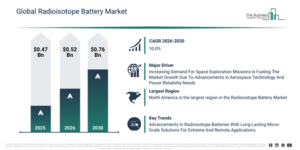
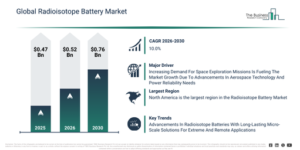
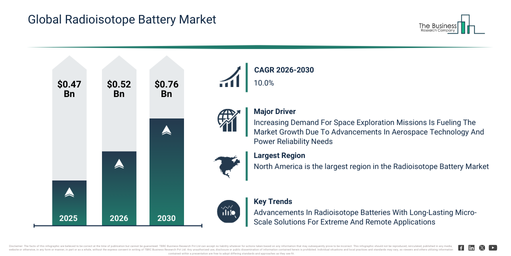
The radioisotope battery market size has experienced significant expansion in recent years. Projections indicate its value will increase from $0.47 billion in 2025 to $0.52 billion by 2026, reflecting a compound annual growth rate (CAGR) of 10.6%. Historically, this market’s expansion was propelled by several key factors: the growing use of radioisotope thermoelectric generators in deep-space missions requiring long-duration power, the increasing deployment of thermocouples and ceramic heat sources in remote scientific equipment, the early adoption of beta-voltaic cells for low-power medical and industrial devices, the expansion of encapsulation materials to enhance the safety and containment of radioactive isotopes, and rising government investment in nuclear power technologies which supports radioisotope battery development.
The radioisotope battery market size is projected to experience substantial expansion over the upcoming years. It is anticipated to achieve a valuation of $0.76 billion by 2030, demonstrating a compound annual growth rate (CAGR) of 10.0%. This growth during the forecast period can be attributed to several factors: increasing demand for extended-life power systems in space exploration and lunar infrastructure, rising adoption of advanced beta-voltaic cells with enhanced conversion efficiency, expanding utilization of compact RTGs in autonomous sensors and remote monitoring applications, technological progress in encapsulation and shielding materials that improve battery safety, and the broadening commercialization of radioisotope batteries for industrial operations in extreme environments. Prominent trends throughout the forecast period include the increasing development of high-efficiency thermoelectric materials, a greater uptake of betavoltaic batteries for miniaturized devices, an escalating demand for long-duration energy sources for space missions, continuous advancements in radiation shielding and encapsulation technologies, and the wider deployment of radioisotope-based power systems in remote industrial monitoring.
Download A Free Sample Report For Comprehensive Market Insights:
#Radioisotope Battery Market Growth Drivers And Industry Catalysts
The increasing frequency of space exploration missions is anticipated to fuel the expansion of the radioisotope battery market in the coming years. These missions represent scientific or exploratory endeavors undertaken beyond Earth’s atmosphere to investigate celestial bodies, cosmic environments, and the prospects for life or human settlement. The surge in space exploration missions is predominantly driven by innovations in aerospace technology, which have led to improvements in the reliability, cost-efficiency, and capabilities of launch vehicles, spacecraft, and satellite systems. Radioisotope batteries are essential for space exploration missions, offering a durable and dependable power source for spacecraft and instruments operating in conditions where solar energy is either inadequate or completely absent. As an illustration, in May 2024, the National Space Operations Centre (NSpOC), a UK-based government agency, reported that the count of active satellites in orbit had exceeded 9,000 as of April 2024, with certain analyses projecting over 60,000 active satellites in space by 2030. Consequently, the rising need for space exploration missions is a primary catalyst for the growth of the radioisotope battery market.
Radioisotope Battery Market Segmentation And Category Breakdown
The radioisotope battery market covered in this report is segmented –
1) By Type: Plutonium-238 Batteries, Strontium-90 Batteries, Cobalt-60 Batteries, Promethium-147 Batteries
2) By Form Factor: Thin-Film Batteries, Solid-State Batteries, Microbatteries, Packaged Batteries
3) By Application: Space Exploration, Medical Devices, Military and Defense, Consumer Electronics, Industrial Applications
4) By End-User: Aerospace Sector, Healthcare Sector, Defense Sector, Telecommunications, Industrial Sector
Subsegments:
1) By Plutonium-238 Batteries: Thermoelectric Generators, Stirling Radioisotope Generators
2) By Strontium-90 Batteries: Betavoltaic Cells, Thermoelectric Devices
3) By Cobalt-60 Batteries: Gamma Radiation Sources, Industrial Power Units
4) By Promethium-147 Batteries: Betavoltaic Cells, Low-Power Electronic Devices
Radioisotope Battery Market Trends Reshaping Industry Growth
Leading companies within the radioisotope battery market are concentrating on developing advanced solutions, such as long-lasting micro-scale batteries, to energize compact devices in challenging and distant environments. These enduring micro-scale batteries are miniature energy storage units crafted to function efficiently for extended durations, often spanning years or decades, without requiring replacement or recharging. They provide reliable power to small and hard-to-access devices like medical implants, space instruments, and remote sensors, ensuring uninterrupted operation in crucial applications. For example, in January 2024, Beijing Betavolt New Energy Technology Company Ltd., a China-based new energy company, introduced the BV100, the world’s first mass-produced nuclear battery utilizing the radioisotope nickel-63. The BV100 is a compact 3V nuclear battery that uses nickel-63 as its energy source and a diamond semiconductor as its energy converter. It is engineered to deliver dependable, long-lasting power for up to 50 years without needing replacement or recharging. This innovative battery is designed for critical and compact devices, including medical implants, aerospace instruments, and remote sensors, in situations where regular maintenance or power replacement is difficult.
Radioisotope Battery Market Leading Players Shaping Industry Direction
Major companies operating in the radioisotope battery market are TDK Corporation, Teledyne Technologies Incorporated, General Atomics, Exide Technologies LLC, Energizer Holdings, NRG Pallas, COMSOL Inc., Nusano Inc., NDB Inc., American Elements Corp., Zeno Power Systems Inc., Oklo Inc., City Labs Inc., Direct Kinetic Solutions (DKS), Atomiq Inc., Widetronix Inc., Qynergy Corporation, Betavolt New Energy Technology Co. Ltd., Infinity Power, GE Vattenfall
Access The Complete Radioisotope Battery Market Report:
Radioisotope Battery Market Global Footprint: Which Region Holds Market Leadership?
North America was the largest region in the radioisotope battery market in 2025. Asia-Pacific is expected to be the fastest-growing region in the forecast period. The regions covered in the radioisotope battery market report are Asia-Pacific, South East Asia, Western Europe, Eastern Europe, North America, South America, Middle East, Africa.
Access a Customized Radioisotope Battery Market Report for Deeper Competitive Insights
https://www.thebusinessresearchcompany.com/customise?id=25479&type=smp
The Business Research Company: https://www.thebusinessresearchcompany.com/
Americas: +1 310-496-7795
Asia: +44 7882 955267 & +91 8897263534
Europe: +44 7882 955267
Email us at: marketing@tbrc.info
Follow us on:
LinkedIn: https://in.linkedin.com/company/the-business-research-company
YouTube: https://www.youtube.com/channel/UC24_fI0rV8cR5DxlCpgmyFQ
Global Market Model: https://www.thebusinessresearchcompany.com/global-market-model

Wasay has over a decade of experience in market research, data modelling, and analytics, with prior experience at GlobalData and Decision Tree Consulting Services. At The Business Research Company , he leads research operations across syndicated studies, customized consulting engagements, and the Global Market Model platform. His professional experience includes supporting organizations such as Boston Consulting Group, KPMG, and Ernst & Young. Wasay holds a degree in Electronics and Communications Engineering, postgraduate management qualifications from International Management Institute Belgium and Indian School of Business and Entrepreneurship, and completed the Integrated Program in Business Analytics from Indian Institute of Management Indore.