Designed to make market research more actionable and strategically valuable, The Business Research Company’s 2026 market reports feature market attractiveness scoring, total addressable market sizing, company benchmarking matrices, interactive Excel dashboards, deeper supply chain intelligence, emerging startup tracking, and granular product-level insights.
How Big Is The Remote Weapon Station Market In 2026, And How Fast Will It Grow?
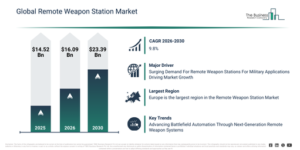
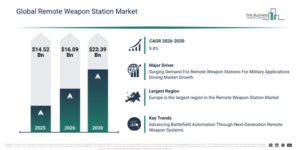
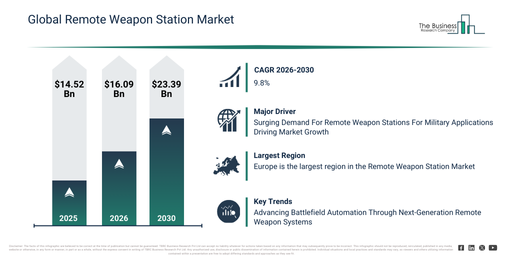
The remote weapon station market has shown rapid expansion in recent years. Its value is expected to rise from $14.52 billion in 2025 to $16.09 billion in 2026, reflecting a compound annual growth rate (CAGR) of 10.8%. Historically, this growth can be attributed to the increased adoption of remotely operated weapon systems to enhance soldier safety in combat environments, the growing integration of target tracking and image stabilization technologies into armored vehicle platforms, the escalating demand for precision engagement capabilities across land and naval forces, advancements in gyroscopic stabilization improving accuracy during mobile operations, and the broader deployment of remote weapon stations in counterterrorism and border security missions.
The remote weapon station market is projected to experience substantial expansion in the coming years. Its size is predicted to reach $23.39 billion by 2030, exhibiting a compound annual growth rate (CAGR) of 9.8%. This anticipated growth is driven by several factors, including increased investment in advanced remote weapon stations featuring improved sensor fusion capabilities, a rising need for modular weapon systems that can be integrated across various vehicles and platforms, progress in automated target recognition and artificial intelligence-powered engagement systems, greater uptake of lightweight remote weapon stations for unmanned ground and air vehicles, and the expansion of military modernization initiatives leading to the acquisition of enhanced remote weapon station solutions. Key trends during this period are expected to involve broader integration of modular weapon station designs, a surge in multi-sensor fusion for more effective targeting, an increasing preference for lightweight and compact remote weapon stations (RWS) suited for mobile platforms, breakthroughs in stabilization and precision targeting technologies, and wider deployment of RWS in homeland security and border surveillance applications.
Download A Free Remote Weapon Station Market Sample Report With Size And Forecast Data:
Remote Weapon Station Market Growth Driver: The Key Factor Behind Rising Demand
The remote weapon station market is projected to grow as a result of rising military demand for these applications. These stations represent remotely controlled equipment deployed in aircraft, ships, and ground vehicles for open combat situations. They provide significant benefits to the military, enabling precise engagement of both stationary and moving targets, and playing a role in managing cross-border conflicts, peacekeeping efforts, and humanitarian operations to bolster national security. As an illustration, The Army Recognition, a Belgium-based online defense and security magazine, reported in September 2024 that the global Remote Weapon Station market is anticipated to reach $24.76 billion by 2026, with an expected CAGR of 13.2% across the forecast period. Consequently, the escalating requirement for remote weapon stations in military contexts is propelling the expansion of this market.
Remote Weapon Station Market Segmentation: Key Segments And Subsegments Covered
The remote weapon station market covered in this report is segmented –
1) By Component: Payload, Sensors, Human Machine Interface (HMI), Fire Control Station, Other Components
2) By Technology: Close-In Weapon Systems, Remote Controlled Gun Systems, Other Technologies
3) By Platform: Land, Naval, Airborne
4) By Application: Military, Homeland Security
Subsegments:
1) By Payload: Machine Guns, Automatic Cannons, Missiles
2) By Sensors: Electro-Optical Sensors, Infrared Sensors, Radar Systems, Acoustic Sensors
3) By Human Machine Interface (HMI): Control Panels, Display Systems, Joysticks and Control Sticks
4) By Fire Control Station: Target Tracking Systems, Fire Control Computers, Stabilization Systems
5) By Other Components: Mounting Systems, Communication Systems, Power Supply Units
Remote Weapon Station Market Trends: Key Developments Shaping 2026 And Beyond
Companies operating in the remote weapon station (RWS) market are prioritizing the development of innovative solutions, such as multi-weapon integration, to enhance battlefield agility and overall combat effectiveness. Multi-weapon integration refers to the ability of a single RWS to deploy various weapon types from one system, which helps improve mission flexibility, speed up threat response, and boost combat effectiveness by allowing proportionate responses to different threats. It also reduces platform and logistical footprints, streamlines crew training, and permits rapid modular upgrades. For instance, in February 2025, Electro Optic Systems (EOS), an Australia-based defense technology company, introduced its R500 Remote Weapon System, a next-generation product. Building on its forerunner, the R400, the R500 features integration of a 25×137 mm cannon or a dual-feed 30×113 mm gun, an enhanced thermal and electro-optical sensor suite, AI-driven target tracking, and a counter-UAS radar system that enables high-elevation engagements. It additionally provides increased ammunition stowage capacity, a modular architecture for missiles and rockets, UGV-ready wireless control for unmanned ground vehicle integration, and optional STANAG Level 2 add-on armor for improved survivability.
Leading Companies Operating In The Remote Weapon Station Market
Major companies operating in the remote weapon station market are Aselsan A.S., BAE Systems PLC, Elbit Systems Ltd., Electro Optic Systems Pty Ltd., General Dynamics Corporation, Fn Herstal S.A., Imi Systems Ltd., Kongsberg Gruppen ASA, Leonardo SpA, Moog Inc., Raytheon Company, Rheinmetall AG, SAAB AB, ST Engineering, Kollmorgen, AeroVironment Inc., Ascent Vision Technologies LLC, Australian Target Systems Pty Ltd., Bharat Electronics Limited, Chess Dynamics Ltd., China Aerospace Science and Industry Corporation Limited, CMI Defence, Denel Land Systems, EOS Defence Systems Pty Ltd., FNSS Savunma Sistemleri A.S., Hanwha Defense, Instro Precision Ltd., Israel Military Industries Ltd., Jenoptik AG, Safran Electronics & Defense
Access The Full Remote Weapon Station Market Research Report:
Remote Weapon Station Market Regional Analysis: Largest Region And Key Geographies Covered
Europe was the largest region in the remote weapon station market in 2025. Asia-Pacific is expected to be the fastest-growing region in the remote weapon station market report forecast period. The regions covered in the remote weapon station market report are Asia-Pacific, South East Asia, Western Europe, Eastern Europe, North America, South America, Middle East, Africa.
Reach Out To Our Team:
The Business Research Company: https://www.thebusinessresearchcompany.com/
Americas: +1 310-496-7795
Asia: +44 7882 955267 & +91 8897263534
Europe: +44 7882 955267
Email us at: marketing@tbrc.info
Follow us on:
LinkedIn: https://in.linkedin.com/company/the-business-research-company
YouTube: https://www.youtube.com/channel/UC24_fI0rV8cR5DxlCpgmyFQ
Global Market Model: https://www.thebusinessresearchcompany.com/global-market-model

Wasay has over a decade of experience in market research, data modelling, and analytics, with prior experience at GlobalData and Decision Tree Consulting Services. At The Business Research Company , he leads research operations across syndicated studies, customized consulting engagements, and the Global Market Model platform. His professional experience includes supporting organizations such as Boston Consulting Group, KPMG, and Ernst & Young. Wasay holds a degree in Electronics and Communications Engineering, postgraduate management qualifications from International Management Institute Belgium and Indian School of Business and Entrepreneurship, and completed the Integrated Program in Business Analytics from Indian Institute of Management Indore.