The Business Research Company’s 2026 market reports combine market attractiveness scoring, total addressable market sizing, company benchmarking matrices, interactive Excel dashboards, deeper supply chain intelligence, emerging startup tracking, and granular product-level insights to deliver research that is more actionable and strategically valuable.
Robotic Arm For Space Market Size Trajectory: Key Numbers Every Industry Stakeholder Should Know
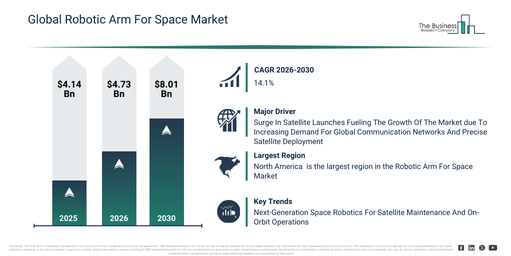
The market for robotic arms in space has seen swift expansion in recent years. It is predicted to increase from $4.14 billion in 2025 to $4.73 billion in 2026, achieving a compound annual growth rate (CAGR) of 14.3%. The historical growth of this market is attributable to a surge in satellite launches and demand for in-orbit servicing, advancements in actuator and sensor technologies, the rise in space infrastructure projects, an uptick in both government and private space missions, and the evolution of specialized robotic arm designs such as SCARA and delta arms.
The robotic arm for space market size is expected to experience significant expansion in the upcoming years, projected to reach $8.01 billion by 2030, exhibiting a compound annual growth rate (CAGR) of 14.1%. This growth during the forecast period can be attributed to the expansion of on-orbit satellite servicing services, the adoption of autonomous dexterous robotic operations, an increase in commercial space stations and orbital construction projects, the integration of AI and machine learning for precision tasks, and the demand for hybrid and telescopic robotic arms for complex operations. Notable trends in this period include on-orbit satellite servicing automation, dexterous payload handling and manipulation, space infrastructure assembly robotics, teleoperated and remote-controlled robotic arms, and maintenance and repair robotics in zero-gravity.
Looking For Reliable Robotic Arm For Space Market Data? Request A Free Sample:
What Is Behind The Rising Demand In The Robotic Arm For Space Market?
A rising volume of satellite launches is anticipated to boost the expansion of the robotic arm for the space market in the future. These launches involve the deployment of artificial satellites into orbit around Earth or other cosmic entities utilizing launch vehicles or rockets. The uptick in satellite deployments stems from an escalating need for worldwide communication infrastructure, requiring additional satellites to deliver quicker, more dependable internet, mobile connections, and data solutions globally. Space-based robotic arms facilitate satellite launches by accurately capturing, positioning, and releasing satellites into their assigned orbits from either spacecraft or space stations. An illustrative example is China’s plan, announced in February 2024 by the China Aerospace Science and Technology Corporation (CASC), a government-owned aerospace firm based in China, to execute approximately 100 launches in 2024, following 67 in 2023. Consequently, the rising frequency of satellite launches is fueling the expansion of the robotic arm for the space market.
Robotic Arm For Space Market Segment Coverage And Subsegment Analysis
The robotic arm for space market covered in this report is segmented –
1) By Type: Articulated, Selective Compliance Articulated Robot Arm, Cartesian, Cylindrical, Polar, Others Types
2) By Payload Capacity: Low, Medium, High
3) By Application: Satellite Servicing, Space Station Maintenance, Cargo Handling, Assembly, Others Applications
4) By End-User: Government Space Agencies, Commercial Space Companies, Research Institutes, Others End-Users
Subsegments:
1) By Cylindrical: Vertical Cylindrical, Horizontal Cylindrical, Rotational Cylindrical
2) By Polar: Spherical, Revolute, Radial
3) By Others Types: Selective Compliance Assembly Robot Arm, Delta, Hybrid
Robotic Arm For Space Market Future Trends: Where Is The Industry Heading?
Leading companies in the robotic arm for the space market are concentrating on technological innovations, such as in-space servicing, assembly, and manufacturing (ISAM), to enhance satellite upkeep, prolong spacecraft operational lives, facilitate the orbital assembly of structures, and advance autonomous space activities. ISAM itself refers to the utilization of robotic and autonomous systems to maintain, repair, assemble, and produce spacecraft or structures directly in orbit. For example, in January 2024, GITAI USA Inc., a US-based space robotics startup, deployed its 1.5-meter-long autonomous dual robotic arm system, S2, on SpaceX’s Falcon 9 NG-20 mission bound for the ISS. This particular robotic arm, engineered for tasks like satellite servicing, orbital assembly, on-orbit manufacturing, and various other in-space operations, includes a proprietary tool changer and is slated to execute maintenance, inspection, and life-extension functions for satellites, signifying a major achievement in autonomous space robotics.
Robotic Arm For Space Market Top Players List For 2026
Major companies operating in the robotic arm for space market are Airbus SE, Leonardo S.p.A., Kawasaki Heavy Industries Ltd., Oceaneering International Inc., SENER Grupo de Ingeniería S.A., Sierra Nevada Corporation, MDA Space Ltd., GITAI Inc., ClearSpace SA, Space Applications Services NV/SA, Astrobotic Technology Inc., Novium Inc., Motiv Space Systems Inc., Lunar Outpost Inc., PIAP Space Sp. z o.o., China Academy of Space Technology (CAST), Rovial Space Inc., Astrabionics Inc., Lodestar Space Ltd., Maxar Technologies Inc., Redwire Corporation, Northrop Grumman Corporation, Thales Alenia Space, Mitsubishi Electric Corporation, Honeybee Robotics
Order Your Copy Of The Robotic Arm For Space Market Report 2026:
How Does The Robotic Arm For Space Market Vary By Region?
North America was the largest region in the robotic arm for space market in 2025. Asia-Pacific is expected to be the fastest-growing region in the forecast period. The regions covered in the robotic arm for space market report are Asia-Pacific, South East Asia, Western Europe, Eastern Europe, North America, South America, Middle East, Africa.
Reach Out To Our Team:
The Business Research Company: https://www.thebusinessresearchcompany.com/
Americas: +1 310-496-7795
Asia: +44 7882 955267 & +91 8897263534
Europe: +44 7882 955267
Email us at: marketing@tbrc.info
Follow us on:
LinkedIn: https://in.linkedin.com/company/the-business-research-company
YouTube: https://www.youtube.com/channel/UC24_fI0rV8cR5DxlCpgmyFQ
Global Market Model: https://www.thebusinessresearchcompany.com/global-market-model

Wasay has over a decade of experience in market research, data modelling, and analytics, with prior experience at GlobalData and Decision Tree Consulting Services. At The Business Research Company , he leads research operations across syndicated studies, customized consulting engagements, and the Global Market Model platform. His professional experience includes supporting organizations such as Boston Consulting Group, KPMG, and Ernst & Young. Wasay holds a degree in Electronics and Communications Engineering, postgraduate management qualifications from International Management Institute Belgium and Indian School of Business and Entrepreneurship, and completed the Integrated Program in Business Analytics from Indian Institute of Management Indore.