Delivering more actionable and strategically valuable research, The Business Research Company’s 2026 market reports feature market attractiveness analysis, total addressable market evaluation, company benchmarking matrices, interactive Excel dashboards, expanded supply chain intelligence, emerging startup coverage, and detailed product insights.
Robotic Ship Hull Painting Market Size, Value And Growth Trends Through 2030
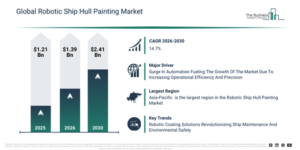
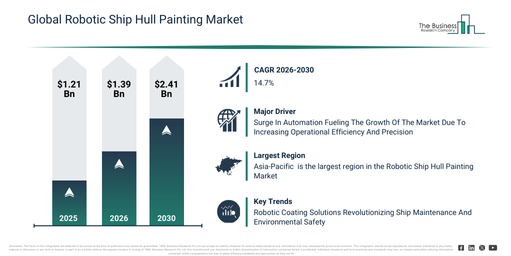
The robotic ship hull painting market has experienced swift expansion recently. Its size is projected to expand from $1.21 billion in 2025 to $1.39 billion in 2026, demonstrating a compound annual growth rate (CAGR) of 14.9%. This past growth is linked to factors such as the integration of automated hull painting systems within shipyards, the need for uniform and superior quality coatings, environmental regulations prompting safer painting methods, an increase in global shipbuilding and repair operations, and the introduction of robotic solutions for surface preparation and spraying.
The robotic ship hull painting market is projected to experience substantial expansion over the upcoming years. This market is forecast to reach $2.41 billion by 2030, exhibiting a compound annual growth rate (CAGR) of 14.7%. Key drivers for this growth during the projection period include the broadening of retrofitting services within current shipyards, the increasing adoption of AI-powered painting robots, a growing demand for economical hull upkeep, advancements in abrasion-resistant nozzles and coating substances, and the incorporation of sophisticated sensors for accurate oversight. Prominent trends anticipated over the forecast timeframe encompass automated preparation of hull surfaces, precise robotic painting technologies, automation of anti-corrosion coatings, robotics for maintenance and inspection, and eco-friendly robotic coating solutions.
Download A Free Sample Report For Comprehensive Market Insights:
Robotic Ship Hull Painting Market Development Factors: Which Trends Are Supporting Demand?
The expanding need for automation is anticipated to fuel the expansion of the robotic ship hull painting market in the future. Automation signifies the application of technology, machinery, or software to execute tasks with minimal human involvement, thereby enhancing efficiency, uniformity, and output across diverse sectors. The increasing adoption of automation stems from the necessity for superior operational efficiency, as it reduces human errors and accelerates recurring tasks, consequently boosting overall productivity. Robotic ship hull painting supports automation by executing accurate and uniform painting operations, lessening manual effort, decreasing mistakes, and improving general efficiency in ship upkeep. For example, in April 2024, data from the International Federation of Robotics (IFR), a non-profit organization based in Germany, indicated that in 2023, global industrial robot installations climbed by 12%, reaching a total of 44,303 units. Specifically within the automotive sector, deployments grew by 1%, establishing a new high of 14,678 robots. This follows a notable 47% increase in automotive installations during 2022, when 14,472 units were put into service. Consequently, the rising demand for automation is propelling the growth of the robotic ship hull painting market.
Robotic Ship Hull Painting Market Segments: Where Are The Largest Growth Opportunities?
The robotic ship hull painting market covered in this report is segmented –
1) By Component: Robots, Control Systems, Paints And Coatings, Services
2) By Technology: Automated Painting Robots, Semi-Automated Systems, Remote-Controlled Robots
3) By Application: Commercial Ships, Naval Vessels, Cargo Ships, Oil Tankers, Other Applications
4) By End-User: Shipyards, Shipping Companies, Defense Sector, Other End-Users
Subsegments:
1) By Robots: Articulated Robots, Selective Compliance Assembly Robot Arm (SCARA) Robots, Delta Robots, Gantry Robots
2) By Control Systems: Programmable Logic Controllers (PLCs), Human-Machine Interfaces (HMIs), Motion Controllers, Sensor Systems
3) By Paints And Coatings: Epoxy Coatings, Polyurethane Coatings, Anti-Fouling Coatings, Acrylic Coatings
4) By Services: Installation And Commissioning, Maintenance And Repair, Training And Support, Consulting Services
Robotic Ship Hull Painting Market Trends Reshaping Industry Growth
Leading firms within the robotic ship hull painting market are prioritizing sophisticated technologies, including adaptive trajectory-planning robots, to secure a competitive edge. Such robotic systems combine AI algorithms, laser sensors, and omnidirectional platforms to precisely and efficiently automate the processes of hull descaling and painting. A notable example is in February 2025, when Dingli, a company from China, introduced the world’s inaugural AI-driven robots for ship descaling and painting. These robots offer millimeter-level surface mapping, adaptive grinding pressure regulation for corrosion removal, and immediate vision-based feedback on quality. This technological evolution boosts processing speeds, improves coating uniformity, and lessens the need for extensive manual labor. Nonetheless, adopting these systems could demand significant capital outlay, proficient personnel, and seamless integration with current dry-dock procedures, potentially hindering their immediate adoption in more modest shipyards.
Robotic Ship Hull Painting Market Major Participants And Competitive Dynamics
Major companies operating in the robotic ship hull painting market are Akzo Nobel N.V., Palfinger AG, Hempel A/S, Jotun A/S, Graco Inc., Beerenberg AS, Sercel SAS, Chugoku Marine Paints Ltd., BlastOne International (Aust) Pty Ltd., Beijing Time River Technology Co. Ltd., Qlayers B.V., PaintJet Inc., Nippon Paint Holdings Co. Ltd., Neptune Robotics Limited, Salotech International B.V., Graphite Innovation and Technologies Inc., Shenzhen AKA Robotics Technology Co. Ltd., AMBPR SAS, Shenzhen AKA Robotics Technology Co. Ltd., Nakai Robotics Ltd.
Access The Complete Robotic Ship Hull Painting Market Report:
Robotic Ship Hull Painting Market Regional Distribution: Which Areas Drive Market Expansion?
Asia-Pacific was the largest region in the robotic ship hull painting market in 2025. The regions covered in the robotic ship hull painting market report are Asia-Pacific, South East Asia, Western Europe, Eastern Europe, North America, South America, Middle East, Africa.
Access a Customized Robotic Ship Hull Painting Market Report for Deeper Competitive Insights
https://www.thebusinessresearchcompany.com/customise?id=27808&type=smp
The Business Research Company: https://www.thebusinessresearchcompany.com/
Americas: +1 310-496-7795
Asia: +44 7882 955267 & +91 8897263534
Europe: +44 7882 955267
Email us at: marketing@tbrc.info
Follow us on:
LinkedIn: https://in.linkedin.com/company/the-business-research-company
YouTube: https://www.youtube.com/channel/UC24_fI0rV8cR5DxlCpgmyFQ
Global Market Model: https://www.thebusinessresearchcompany.com/global-market-model

Wasay has over a decade of experience in market research, data modelling, and analytics, with prior experience at GlobalData and Decision Tree Consulting Services. At The Business Research Company , he leads research operations across syndicated studies, customized consulting engagements, and the Global Market Model platform. His professional experience includes supporting organizations such as Boston Consulting Group, KPMG, and Ernst & Young. Wasay holds a degree in Electronics and Communications Engineering, postgraduate management qualifications from International Management Institute Belgium and Indian School of Business and Entrepreneurship, and completed the Integrated Program in Business Analytics from Indian Institute of Management Indore.