The Business Research Company’s 2026 market reports combine market attractiveness scoring, total addressable market sizing, company benchmarking matrices, interactive Excel dashboards, deeper supply chain intelligence, emerging startup tracking, and granular product-level insights to deliver research that is more actionable and strategically valuable.
Rocket Component Heat Exchangers Market Size Review: What Shaped Past Growth And What Will Drive Future Expansion?
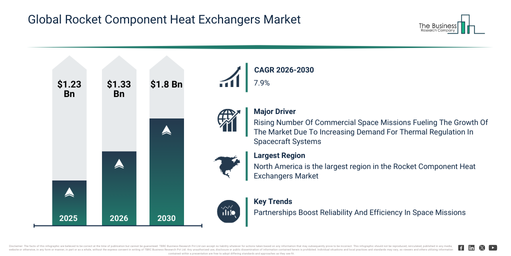
The market for rocket component heat exchangers has experienced significant expansion recently. This market is projected to expand from $1.23 billion in 2025 to $1.33 billion in 2026, demonstrating a compound annual growth rate (CAGR) of 8.1%. Historically, this expansion has been driven by several factors, including the increased uptake of regenerative heat exchangers for preheating propellants and boosting combustion efficiency; the expanding use of microchannel heat exchangers, which provide compact and lightweight thermal management; the growing application of printed circuit heat exchangers in high-pressure, high-temperature rocket engine settings; the initial deployment of double pipe heat exchangers in older propulsion systems; and the broader implementation of spiral heat exchangers, which enhance heat transfer in engine components.
The rocket component heat exchangers market is predicted to undergo significant expansion in the upcoming years, with its size projected to reach $1.8 billion in 2030 at a compound annual growth rate (CAGR) of 7.9%. This anticipated growth is driven by a rising demand for advanced thermal management systems essential for reusable and high-thrust rocket engines, along with increased adoption of additive-manufactured heat exchangers that enable complex geometries and improved efficiency. Further contributions come from the growing incorporation of microchannel and printed circuit heat exchangers into next-generation cryogenic propulsion systems, the expansion of commercial launch providers requiring robust, high-performance heat exchangers, and technological advancements that enhance heat exchanger materials, pressure resistance, and thermal cycling durability. Notable trends during this forecast period include the wider use of additive-manufactured heat exchanger designs, an increasing focus on cryogenic-compatible materials for high-efficiency cooling, a growing need for compact, high-pressure PCHE and microchannel configurations, improved integration of propellant pre-conditioning systems in engines, and expanded thermal management requirements for reusable launch vehicles.
Access Free Sample Pages From The Rocket Component Heat Exchangers Market Report 2026:
Understanding The Main Driver Of The Rocket Component Heat Exchangers Market
The escalating volume of commercial space missions is projected to drive the expansion of the rocket component heat exchangers market in the future. Commercial space missions are defined as privately funded and operated spaceflights executed by companies to provide services such as satellite deployment, space tourism, cargo transport, and scientific research for financial gain. The rise in these missions is attributed to increasing private sector investment in satellite-based communication and Earth observation, compelling companies to schedule more frequent operations. Rocket component heat exchangers support commercial space missions by ensuring efficient thermal regulation, which enhances engine performance and reliability. They enable longer mission durations by effectively managing extreme temperatures, significantly contributing to the success of modern aerospace endeavors. For instance, in November 2024, data from the Federal Aviation Administration, a US-based federal agency, indicated that commercial space operations grew by over 30% in 2023 to reach 148 launches, with forecasts suggesting they will more than double by 2028. Therefore, the growing number of commercial space missions is propelling the rocket component heat exchangers market forward.
Rocket Component Heat Exchangers Market Segment Mapping For 2026 And Beyond
The rocket component heat exchangers market covered in this report is segmented –
1) By Type: Plate-Fin, Tube-Fin, Shell And Tube, Other Types
2) By Material: Aluminum, Stainless Steel, Titanium, Other Materials
3) By Application: Propulsion Systems, Thermal Management Systems, Other Applications
4) By End-User: Commercial Space, Military And Defense, Other End Users
Subsegments:
1) By Plate-Fin: Aluminum Plate-Fin, Stainless Steel Plate-Fin, Compact Plate-Fin Heat Exchangers
2) By Tube-Fin: Straight Tube-Fin, Helical Tube-Fin, Multi-Pass Tube-Fin Designs
3) By Shell And Tube: Single-Pass Shell And Tube, Multi-Pass Shell And Tube, Double Pipe Heat Exchangers
4) By Other Types: Printed Circuit Heat Exchangers (PCHE), Spiral Heat Exchangers, Microchannel Heat Exchangers
What Key Trend Is Expected To Shape The Rocket Component Heat Exchangers Market Over The Forecast Period?
Leading companies within the rocket component heat exchangers market are prioritizing the development of innovative solutions through strategic collaborations. These partnerships aim to improve thermal efficiency, reduce weight, and enhance the overall performance and reliability of rocket systems. Strategic collaborations are defined as formal alliances between companies, designed to combine their expertise, resources, and technologies to create advanced solutions and improve the functionality of rocket component heat exchangers. For instance, in April 2023, Conflux Technology, an Australia-based additive manufacturing company, partnered with Rocket Factory Augsburg (RFA), a Germany-based aerospace company, to engineer and produce advanced 3D-printed aerospace heat exchangers for use in orbital rockets. This specific heat exchanger is manufactured using Conflux’s proprietary metal additive manufacturing techniques, notably utilizing the nickel-copper alloy Monel K 500, and is fabricated on the EOS M300-4 Direct Metal Laser Sintering (DMLS) platform. This collaborative effort seeks to bolster Australia’s space supply chain, support NASA’s initiatives for Moon and Mars missions, and underscore the growing importance of innovative thermal management solutions within the rapidly expanding space industry.
Rocket Component Heat Exchangers Market Major Players And Industry Competition Overview
Major companies operating in the rocket component heat exchangers market are RTX Corporation, Boeing Company, Lockheed Martin Corporation, Northrop Grumman Corporation, Honeywell International Inc., BAE Systems plc, Safran SA, Parker Hannifin Corporation, Air Products and Chemicals Inc., IHI Corporation, AMETEK Inc., Alfa Laval AB, Blue Origin LLC, Boyd Corporation, Meggitt PLC, Chart Industries Inc., Triumph Group, SGL Carbon SE, ERG Aerospace, Nammo Westcott, Rocket Lab USA Inc., TAT Technologies Ltd., Wall Colmonoy Corporation, Senior Flexonics, Advanced Cooling Technologies Inc., Conflux Technology, Brayton Energy, Space Engine Systems Inc.
Full Rocket Component Heat Exchangers Market Report: Market Size, Trends, Segments And Key Players:
Rocket Component Heat Exchangers Market Geographic Segmentation: Regions Covered In The Report
North America was the largest region in the rocket component heat exchangers market in 2025. The regions covered in the rocket component heat exchangers market report are Asia-Pacific, South East Asia, Western Europe, Eastern Europe, North America, South America, Middle East, Africa.
Reach Out To Our Team:
The Business Research Company: https://www.thebusinessresearchcompany.com/
Americas: +1 310-496-7795
Asia: +44 7882 955267 & +91 8897263534
Europe: +44 7882 955267
Email us at: marketing@tbrc.info
Follow us on:
LinkedIn: https://in.linkedin.com/company/the-business-research-company
YouTube: https://www.youtube.com/channel/UC24_fI0rV8cR5DxlCpgmyFQ
Global Market Model: https://www.thebusinessresearchcompany.com/global-market-model

Wasay has over a decade of experience in market research, data modelling, and analytics, with prior experience at GlobalData and Decision Tree Consulting Services. At The Business Research Company , he leads research operations across syndicated studies, customized consulting engagements, and the Global Market Model platform. His professional experience includes supporting organizations such as Boston Consulting Group, KPMG, and Ernst & Young. Wasay holds a degree in Electronics and Communications Engineering, postgraduate management qualifications from International Management Institute Belgium and Indian School of Business and Entrepreneurship, and completed the Integrated Program in Business Analytics from Indian Institute of Management Indore.