With a focus on actionable insights and strategic value, The Business Research Company’s 2026 market reports include market attractiveness scoring, total addressable market sizing, company benchmarking matrices, interactive Excel dashboards, deeper supply chain intelligence, emerging startup tracking, and granular product-level insights.
How Large Could The Rocket Component Miniaturization Market Become By 2030 At A 9.7% CAGR?
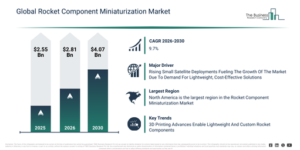
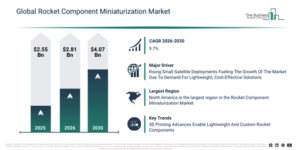
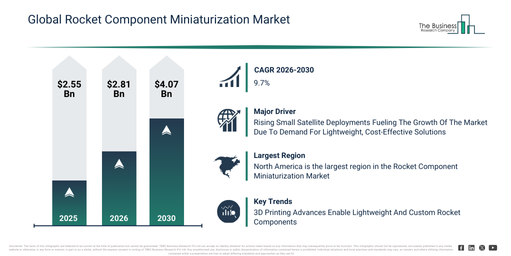
The rocket component miniaturization market size has experienced rapid expansion in recent years. This market is projected to grow from $2.55 billion in 2025 to $2.81 billion in 2026, achieving a compound annual growth rate (CAGR) of 10.2%. The historical growth can be attributed to the increasing adoption of miniaturized guidance systems to reduce rocket mass and improve efficiency, the rising development of compact propulsion units for small launch vehicles, the growing use of micro thrusters in nanosatellite deployment missions, the expansion of microfabrication services enabling the downsizing of rocket electronics, and the early integration of lightweight telemetry modules to enhance mission data transmission.
The rocket component miniaturization market is projected to experience substantial expansion in the coming years. This market is anticipated to reach $4.07 billion by 2030, exhibiting a compound annual growth rate (CAGR) of 9.7%. This projected growth is primarily driven by an increasing need for nanoscale power systems for future lightweight rocket designs, greater uptake of thermal and structural optimization services to facilitate smaller components, expanding deployment of miniaturized electronics in autonomous and reusable rocket systems, the rise of custom design and prototyping for small-launch commercial entities, and technological advancements yielding more durable, precise, and high-performance mini components. Key trends identified for this period encompass a rise in additive manufacturing for compact components, a growing requirement for high-density, low-power microelectronics, increasing incorporation of micropropulsion for accurate maneuvering, broadening system-level miniaturization efforts for cubesats and smallsats, and improved thermal and structural optimization techniques for extremely compact parts.
Get A Free Rocket Component Miniaturization Market Sample With 2030 Forecast Insights:
Rocket Component Miniaturization Market Outlook: Key Driver Supporting Long-Term Growth
The increasing need for small satellites is anticipated to drive the expansion of the rocket component miniaturization market in the future. These small satellites are light and compact spacecraft, typically weighing less than 500 kilograms, developed for purposes like Earth observation, communication, or experimenting with new technologies. The surging demand for small satellites stems from their affordability and adaptability, facilitating quicker deployment and simpler tailoring for various uses. Miniaturization of rocket components improves small satellite missions by allowing for lighter, more compact designs that fit into restricted payload spaces. This process boosts performance efficiency and lowers launch expenses, thereby catering to the increasing requirement for flexible and economical space solutions. As an illustration, in December 2024, Aerospace America, a US-based technical organization for aerospace professionals, reported that 475 small satellites were launched across 55 missions, with some missions deploying up to 120 spacecraft in one go, representing the highest deployment rate seen relative to 2023. Consequently, the increasing need for small satellites is fueling the expansion of the rocket component miniaturization market.
Segmentation Of The Rocket Component Miniaturization Market: Key Categories Explained
The rocket component miniaturization market covered in this report is segmented –
1) By Component Type: Micro Thrusters, Miniature Sensors, Microelectronics, Miniature Propulsion Systems, Other Component Types
2) By Material: Metals, Polymers, Ceramics, Composites
3) By Application: Satellites, Launch Vehicles, Space Probes, Other Applications
4) By End-User: Commercial, Military, Government
Subsegments:
1) By Micro Thrusters: Cold Gas Micro Thrusters, Micro-Electro-Mechanical Systems-Based Micro Thrusters, Electric Micro Thrusters
2) By Miniature Sensors: Pressure Sensors, Temperature Sensors, Inertial Measurement Units (IMUs)
3) By Microelectronics: Microcontrollers, Miniature Power Amplifiers, Signal Processors
4) By Miniature Propulsion Systems: Solid Micro Propulsion, Liquid Micro Propulsion, Hybrid Micro Propulsion
5) By Other Component Types: Miniature Actuators, Compact Communication Modules, Nanoscale Energy Storage Systems
Rocket Component Miniaturization Market Evolving Trends: What Businesses Should Know
Leading companies operating in the rocket component miniaturization market are concentrating on developing technologically advanced solutions, such as 3D printing, to produce rocket components that are lighter, more complex, and highly customized, while reducing production time and cost. 3D printing is an advanced fabrication technique that builds components layer by layer directly from digital models, enabling the creation of intricate, lightweight structures with enhanced design flexibility, reduced material usage, and faster production cycles. For instance, in March 2023, Relativity Space Inc., a US-based aerospace manufacturing company, launched its Terran 1 rocket, the first test vehicle made entirely from 3D-printed parts. The vehicle incorporated GRCop-42 copper alloy combustion chambers, a high-performance material developed by NASA’s Glenn Research Center under its Game-Changing Development program. This milestone, achieved at Cape Canaveral, demonstrated the viability of additive manufacturing for producing flight-ready rocket engines, marking a significant leap in cost-effective and rapid aerospace manufacturing.
Who Competes In The Rocket Component Miniaturization Market? Major Companies Listed
Major companies operating in the rocket component miniaturization market are Northrop Grumman Corporation, Space Exploration Technologies Corp, Cadence Design Systems Inc., Moog Inc., RUAG Space AG, Rocket Lab USA Inc., NMG Aerospace LLC, Ursa Major Technologies Inc., Phase Four Inc., ÅAC Microtec AB, Benchmark Lark RF Technology, QuesTek Innovations LLC, Tethers Unlimited Inc, GAUSS Srl, Beehive Industries LLC, Bellatrix Aerospace Pvt. Ltd., Elementum 3D Inc, Romar Engineering Pty Ltd, Space Engine Systems Inc., Mynaric AG
Read The Complete Rocket Component Miniaturization Market Forecast Report Through 2030:
Rocket Component Miniaturization Market Regional Ranking: Which Geography Comes First?
North America was the largest region in the rocket component miniaturization market in 2025. The regions covered in the rocket component miniaturization market report are Asia-Pacific, South East Asia, Western Europe, Eastern Europe, North America, South America, Middle East, Africa.
Reach Out To Our Team:
The Business Research Company: https://www.thebusinessresearchcompany.com/
Americas: +1 310-496-7795
Asia: +44 7882 955267 & +91 8897263534
Europe: +44 7882 955267
Email us at: marketing@tbrc.info
Follow us on:
LinkedIn: https://in.linkedin.com/company/the-business-research-company
YouTube: https://www.youtube.com/channel/UC24_fI0rV8cR5DxlCpgmyFQ
Global Market Model: https://www.thebusinessresearchcompany.com/global-market-model

Wasay has over a decade of experience in market research, data modelling, and analytics, with prior experience at GlobalData and Decision Tree Consulting Services. At The Business Research Company , he leads research operations across syndicated studies, customized consulting engagements, and the Global Market Model platform. His professional experience includes supporting organizations such as Boston Consulting Group, KPMG, and Ernst & Young. Wasay holds a degree in Electronics and Communications Engineering, postgraduate management qualifications from International Management Institute Belgium and Indian School of Business and Entrepreneurship, and completed the Integrated Program in Business Analytics from Indian Institute of Management Indore.