Built to provide research that’s more actionable and strategically valuable, The Business Research Company’s 2026 market reports include market attractiveness analysis, total addressable market sizing, company benchmarking matrices, interactive Excel dashboards, broader supply chain intelligence, emerging startup tracking, and in-depth product insights.
Rocket Engine Combustion Chambers Market Poised To Hit $1.79 Billion By 2030 With A 7.5% CAGR
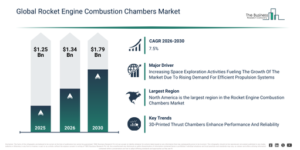
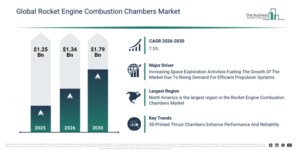
The market for rocket engine combustion chambers has seen significant expansion in recent years. It is projected to increase from $1.25 billion in 2025 to $1.34 billion in 2026, achieving a compound annual growth rate (CAGR) of 7.2%. Historically, this growth can be ascribed to progress in high-temperature alloys allowing for more resilient combustion chambers, an increase in government space missions stimulating demand for thrust chamber assemblies, the creation of regenerative cooling systems to handle extreme thermal loads, the early implementation of precision injector plates to enhance combustion efficiency, and the broadening of liquid propulsion programs necessitating advanced chamber liners and ablative materials.
The market for rocket engine combustion chambers is projected to experience robust expansion over the coming years. This market is set to reach $1.79 billion by 2030, exhibiting a compound annual growth rate (CAGR) of 7.5%. Several factors are contributing to this anticipated growth, including the proliferation of reusable launch vehicles which necessitates more durable combustion chamber materials, progress in additive manufacturing allowing for intricate chamber designs and reduced expenses, an increase in commercial space launches boosting the need for scalable combustion chamber manufacturing, breakthroughs in composite thermal protection materials enhancing operational performance and dependability, and the development of more ambitious deep-space and high-thrust missions demanding advanced injector and chamber innovations. Key trends anticipated during this period involve the adoption of advanced high-temperature alloys and ceramic matrix composites, the use of additive manufacturing (metal 3D printing) for thrust chambers, a focus on localizing supply chains and having multiple sources for essential components, initiatives for optimizing reusable launch vehicle engines and extending their operational lifespan, and an emphasis on stricter export controls coupled with prioritizing defense procurement.
Get A Free Sample Report With In-Depth Market Insights:
Rocket Engine Combustion Chambers Market Demand Drivers: What’s Powering Industry Growth?
The rocket engine combustion chambers market is anticipated to expand due to the rise in space exploration endeavors. These activities encompass the pursuit of scientific findings, technological progress, and business ventures beyond Earth, conducted through missions, research, and space operations. The surge in space exploration is fueled by a rising need for advanced communication and Earth observation satellites, which facilitate worldwide connectivity, environmental oversight, and improved security. Rocket engine combustion chambers play a crucial role in supporting space exploration by providing efficient propulsion, thereby being vital for launch vehicles and spacecraft. They are engineered to endure extreme conditions, guaranteeing dependable thrust, which boosts mission success and broadens access to space. For example, Novaspace, a French space industry consulting firm, reported in September 2023 that global government expenditure on space exploration amounted to $26 billion in 2023, with projections indicating an increase to nearly $33 billion by 2032. Consequently, the growing volume of space exploration initiatives is propelling the expansion of the rocket engine combustion chambers market.
Rocket Engine Combustion Chambers Market Segment Analysis And Revenue Potential
The rocket engine combustion chambers market covered in this report is segmented –
1) By Engine Type: Liquid Rocket Engines, Solid Rocket Engines, Hybrid Rocket Engines
2) By Material Type: Nickel Alloys, Titanium Alloys, Stainless Steel, Other Material Types
3) By Application: Space Launch Vehicles, Missiles, Satellites, Other Applications
4) By End User: Aerospace And Defense, Commercial Space, Other End Users
Subsegments:
1) By Liquid Rocket Engines: Pressure-Fed Engines, Pump-Fed Engines, Cryogenic Engines, Hypergolic Engines, Bipropellant Engines
2) By Solid Rocket Engines: Single-Stage Solid Motors, Multi-Stage Solid Motors, Tactical Solid Motors, Boosters
3) By Hybrid Rocket Engines: Monopropellant-Based Hybrids, Bipropellant-Based Hybrids, Paraffin-Based Hybrids, Nitrous Oxide-Based Hybrids
Rocket Engine Combustion Chambers Market Innovation Trends: What Developments Are Reshaping The Industry?
Leading companies within the rocket engine combustion chambers market are concentrating on creating sophisticated products, such as 3D-printed thrust chambers, with the goal of improving manufacturing efficiency, reducing part complexity, and maintaining high performance under extreme conditions. These 3D-printed thrust chambers are defined as rocket engine combustion chambers fabricated using additive manufacturing techniques, which enables the creation of complex geometries, a lower part count, and enhanced cooling efficiency. For example, in November 2024, L3Harris Technologies Inc., a US-based aerospace and defense company, introduced the RL10E-1 rocket engine. The RL10E-1 includes a fully 3D-printed copper thrust chamber that has 98% fewer parts, thereby providing improved performance, accelerated production, and increased reliability. It is engineered to power the upper stage of United Launch Alliance’s Vulcan rocket, assisting in both commercial and national security space missions.
Rocket Engine Combustion Chambers Market Key Players Shaping Industry Direction
Major companies operating in the rocket engine combustion chambers market are RTX Corporation, Boeing Company, Lockheed Martin Corporation, Northrop Grumman Systems Corporation, Mitsubishi Heavy Industries Ltd., Safran Aircraft Engines SAS, IHI Corporation, Space Exploration Technologies Corp., Blue Origin LLC, Rafael Advanced Defense Systems Ltd., ArianeGroup SAS, Rocket Lab USA Inc., Gilmour Space Technologies Pty Ltd., Stoke Space Inc., Orbex Limited, Roscosmos State Space Corporation, Virgin Galactic LLC, Indian Space Research Organisation, ISRO Propulsion Complex, PLD Space S.L.
View The Full Rocket Engine Combustion Chambers Market Report:
Rocket Engine Combustion Chambers Market Top Region: Where Does Most Revenue Come From?
North America was the largest region in the rocket engine combustion chambers market in 2025. The regions covered in the rocket engine combustion chambers market report are Asia-Pacific, South East Asia, Western Europe, Eastern Europe, North America, South America, Middle East, Africa.
Reach Out To Our Team:
The Business Research Company: https://www.thebusinessresearchcompany.com/
Americas: +1 310-496-7795
Asia: +44 7882 955267 & +91 8897263534
Europe: +44 7882 955267
Email us at: marketing@tbrc.info
Follow us on:
LinkedIn: https://in.linkedin.com/company/the-business-research-company
YouTube: https://www.youtube.com/channel/UC24_fI0rV8cR5DxlCpgmyFQ
Global Market Model: https://www.thebusinessresearchcompany.com/global-market-model

Wasay has over a decade of experience in market research, data modelling, and analytics, with prior experience at GlobalData and Decision Tree Consulting Services. At The Business Research Company , he leads research operations across syndicated studies, customized consulting engagements, and the Global Market Model platform. His professional experience includes supporting organizations such as Boston Consulting Group, KPMG, and Ernst & Young. Wasay holds a degree in Electronics and Communications Engineering, postgraduate management qualifications from International Management Institute Belgium and Indian School of Business and Entrepreneurship, and completed the Integrated Program in Business Analytics from Indian Institute of Management Indore.