Featuring market attractiveness scoring, total addressable market sizing, company benchmarking matrices, interactive Excel dashboards, deeper supply chain intelligence, emerging startup tracking, and granular product-level insights, The Business Research Company’s 2026 market reports are built to deliver research that is both more actionable and more strategically valuable.
Rocket Exhaust Plume Management Market Set To Climb From $1.35 Billion In 2026 To $1.86 Billion By 2030
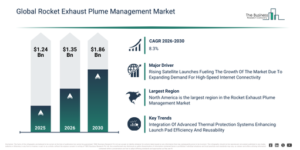
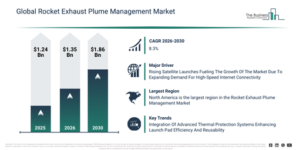
The market for managing rocket exhaust plumes has shown substantial growth recently. It is projected to expand from $1.24 billion in 2025 to $1.35 billion in 2026, achieving a compound annual growth rate (CAGR) of 8.9%. This historical expansion can be attributed to several factors, including higher thrust levels in launch vehicles, which increased demand for sophisticated plume pressure modeling, the early implementation of acoustic dampening systems to safeguard launch facilities, the creation of thermal protection materials designed to minimize erosion from intense exhaust heat, an increase in governmental space initiatives that necessitate plume signature and environmental evaluations, and progress in computational fluid dynamics, which allows for more precise analysis of exhaust flow.
The market for rocket exhaust plume management is anticipated to experience robust expansion in the coming years. This market is projected to reach $1.86 billion by 2030, demonstrating a compound annual growth rate (CAGR) of 8.3%. This anticipated growth during the forecast period stems from several factors, including an increase in commercial launch frequency leading to higher demand for scalable plume diagnostic and suppression systems. Stricter environmental regulations are also prompting the uptake of advanced plume impact consulting services. Furthermore, advancements in particle analysis technologies are enhancing plume monitoring accuracy, while the proliferation of reusable launch platforms demands improved protection for ground facilities and vehicle structures. Finally, growing investment in high-energy propulsion systems necessitates more intricate plume behavior modeling. Key trends identified for the forecast period encompass advanced plume simulation and modeling tools, the development of next-generation sound suppression systems, innovations in high-temperature thermal protection materials, improved plume signature reduction technologies, and integrated launch pad exhaust flow optimization.
Get A Free Sample Report With In-Depth Market Insights:
Rocket Exhaust Plume Management Market Expansion Drivers: What’s Shaping Future Growth?
The increasing volume of satellite deployments is expected to drive the growth of the rocket exhaust plume management market in the coming years. A satellite is an object placed in orbit around a celestial body, revolving due to gravitational forces. The number of satellite deployments is growing due to rising demand for high-speed internet, which in turn leads to the launch of large constellations for broader and more reliable coverage. This increase supports the demand for rocket exhaust plume management, as more frequent launches require precise control and analysis of exhaust plumes to prevent damage to onboard instruments, ensure flight safety, and maintain environmental compliance. For instance, in May 2024, according to the National Space Operations Centre (NSpOC), a UK-based organization focused on space surveillance and protection, there were more than 9,000 active satellites in orbit by April 2024, and estimates suggest this number could grow to over 60,000 by the year 2030. Therefore, the expanding number of satellite deployments will boost the growth of the rocket exhaust plume management market.
Rocket Exhaust Plume Management Market Segment Analysis Spotlighting Growth Areas
The rocket exhaust plume management market covered in this report is segmented –
1) By Component: Nozzles, Plume Deflectors, Exhaust Systems
2) By Technology: Active Control, Passive Control
3) By Application: Space Launch Vehicles, Military Missiles, Commercial Rockets
4) By End-User: Government, Commercial, Defense
Subsegments:
1) By Nozzles: Convergent-Divergent Nozzles, Aerospike Nozzles, Plug Nozzles, Expansion-Deflection Nozzles
2) By Plume Deflectors: Water-Cooled Deflectors, Steel Plate Deflectors, Flame Trenches, Movable Deflection Systems
3) By Exhaust Systems: Ducted Exhaust Systems, Open Flame Exhaust Systems, Subterranean Exhaust Systems, Refractory-Lined Exhaust Systems
Rocket Exhaust Plume Management Market Strategic Trends: What Defines The Next Growth Phase?
Leading companies in the rocket exhaust plume management market are concentrating on developing sophisticated solutions, such as thermally protected launchpads, to improve the lifespan and dependability of launch facilities. Thermally protected launchpads are structures engineered to withstand and manage intense heat and thermal stress produced during rocket liftoff. For instance, in December 2023, Equatorial Launch Australia (ELA), an Australia-based provider of space launch and related services, introduced the Arnhem Space Centre Advanced Launch Pad (ASCALP). These pads are specifically designed to support current NewSpace small launch vehicles with launch weights up to around 450,000 kg and payloads up to 3,000 kg. A key characteristic is the advanced plume deflector, built from multiple layers of steel, heat-resistant concrete, and specialized ablative coatings, which helps control and direct rocket exhaust while minimizing wear, enabling repeated launches without significant repairs. The structure features a 12-meter vertical clearance from the rocket base to the plume system, substantially assisting in regulating heat and noise during liftoff. This design capitalizes on the site’s natural terrain by situating the pads close to the escarpment’s edge, enhancing both safety and performance.
Rocket Exhaust Plume Management Market Leading Companies: Who Holds The Strongest Market Presence?
Major companies operating in the rocket exhaust plume management market are Lockheed Martin Corp., Northrop Grumman Corporation, Mitsubishi Heavy Industries Ltd., IHI Corp., Blue Origin LLC, ArianeGroup, Aerojet Rocketdyne Holdings Inc., Nammo Inc., Tecomet Inc., The Lee Company, Relativity Space Inc., Firefly Aerospace Inc., Weldaloy Products Co., Delta Centrifugal Corp., Advanced Structural Technologies Inc., PMF Industries Inc., Reaction Engines Ltd., NACCO Aerospace, Monterey Machine Products, Impact Innovations GmbH.
View The Full Rocket Exhaust Plume Management Market Report:
Rocket Exhaust Plume Management Market Regional Analysis And Top Geography
North America was the largest region in the rocket exhaust plume management market in 2025. The regions covered in the rocket exhaust plume management market report are Asia-Pacific, South East Asia, Western Europe, Eastern Europe, North America, South America, Middle East, Africa.
Reach Out To Our Team:
The Business Research Company: https://www.thebusinessresearchcompany.com/
Americas: +1 310-496-7795
Asia: +44 7882 955267 & +91 8897263534
Europe: +44 7882 955267
Email us at: marketing@tbrc.info
Follow us on:
LinkedIn: https://in.linkedin.com/company/the-business-research-company
YouTube: https://www.youtube.com/channel/UC24_fI0rV8cR5DxlCpgmyFQ
Global Market Model: https://www.thebusinessresearchcompany.com/global-market-model

Wasay has over a decade of experience in market research, data modelling, and analytics, with prior experience at GlobalData and Decision Tree Consulting Services. At The Business Research Company , he leads research operations across syndicated studies, customized consulting engagements, and the Global Market Model platform. His professional experience includes supporting organizations such as Boston Consulting Group, KPMG, and Ernst & Young. Wasay holds a degree in Electronics and Communications Engineering, postgraduate management qualifications from International Management Institute Belgium and Indian School of Business and Entrepreneurship, and completed the Integrated Program in Business Analytics from Indian Institute of Management Indore.