Built to provide research that’s more actionable and strategically valuable, The Business Research Company’s 2026 market reports include market attractiveness analysis, total addressable market sizing, company benchmarking matrices, interactive Excel dashboards, broader supply chain intelligence, emerging startup tracking, and in-depth product insights.
Rocket Fuel Cryogenic Storage Market Size, Value And Growth Trajectory Through 2030
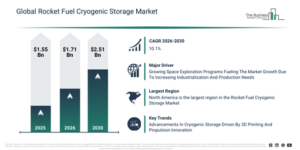
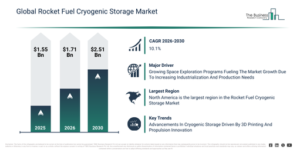
The rocket fuel cryogenic storage market has experienced rapid growth in recent years. It is forecast to increase from $1.55 billion in 2025 to $1.71 billion in 2026, demonstrating a compound annual growth rate (CAGR) of 10.3%. This historical expansion can be attributed to several key factors, including the increasing adoption of liquid hydrogen and liquid oxygen propulsion, which drives the demand for advanced cryogenic tanks. Other contributing elements include the development of high-performance insulation materials designed to reduce propellant boil-off losses, the expansion of government launch programs necessitating large-scale cryogenic storage infrastructure, initial advancements in cryogenic pumps and compressors facilitating reliable fueling operations, and the rise in cryogenic fluid handling services supporting more frequent test and launch activities.
The market for rocket fuel cryogenic storage is projected to experience substantial expansion over the upcoming years. This market is anticipated to reach $2.51 billion by 2030, demonstrating a compound annual growth rate (CAGR) of 10.1%. Several factors are driving this growth during the forecast period, including an escalating pace of commercial launches which boosts the need for scalable cryogenic storage and fueling systems, progress in monitoring and control technologies enhancing safety and operational efficiency, the proliferation of reusable rockets creating demand for quick-turnaround cryogenic fueling solutions, advancements in lightweight composite cryogenic tank materials that reduce mass and boost performance, and increasing investment in deep-space missions necessitating long-duration cryogenic storage capabilities. Key trends anticipated during this period encompass the development of advanced insulation materials, integrated cryogenic monitoring systems, innovations in boil-off reduction and pressure management, modular cryogenic tank architecture, and the expansion of methalox storage infrastructure.
Get A Free Sample Report With In-Depth Market Insights:
Rocket Fuel Cryogenic Storage Market Opportunity Drivers: What’s Unlocking New Revenue Potential?
The rocket fuel cryogenic storage market is anticipated to experience growth going forward, propelled by the increasing number of space exploration programs. These programs are defined as organized efforts by governments or private entities to investigate and explore outer space utilizing spacecraft, satellites, telescopes, and other associated technologies. The expansion of space exploration programs is a result of growing interest in scientific discovery, as nations and private companies aim to comprehend the universe, seek out life, and examine celestial bodies. Rocket fuel cryogenic storage is employed by space exploration programs for the secure containment and supply of supercooled propellants crucial for launching and energizing spacecraft. For instance, in May 2025, according to the Satellite Industry Association, a US-based organization, the industry demonstrated remarkable growth in 2024, characterized by a record 259 launches that delivered 2,172 tons of payload and 2,695 satellites into Earth orbit. By the conclusion of that year, a total of 11,539 satellites were actively orbiting Earth. Consequently, the rising number of space exploration programs is driving the growth of the rocket fuel cryogenic storage market.
Rocket Fuel Cryogenic Storage Market Segmentation: How Does The Market Break Down By Category?
The rocket fuel cryogenic storage market covered in this report is segmented –
1) By Storage Type: Liquid Hydrogen, Liquid Oxygen, Liquid Methane, Other Storage Types
2) By Application: Space Exploration, Military, Commercial Aviation, Other Applications
3) By End-User: Aerospace, Defense, Research Institutions, Other End-Users
Subsegments:
1) By Liquid Hydrogen: Ground-Based Storage Tanks, In-Flight Cryogenic Tanks, Mobile Cryogenic Tankers, Insulated Composite Cylinders
2) By Liquid Oxygen: Stationary Vacuum-Insulated Tanks, Cryogenic Dewars, Transportable Oxygen Tankers, Composite Overwrapped Pressure Vessels (COPVs)
3) By Liquid Methane: Vacuum-Jacketed Storage Tanks, Onboard Reusable Tanks, Methane-Compatible ISO Containers, Mobile Refueling Systems
4) By Other Storage Types: Liquid Nitrogen Tanks, Liquid Argon Vessels, Multi-Fuel Cryogenic Tanks, Custom Cryo Modules For Hybrid Propulsion Systems
Rocket Fuel Cryogenic Storage Market Innovation Trends Shaping Future Development
Leading companies in the rocket fuel cryogenic storage market are concentrating on developing innovative solutions, such as integrated 3D-printed engines, to enhance fuel efficiency and reduce the complexity of systems. A single-piece 3D-printed engine is characterized as an engine manufactured as one complete unit using 3D printing technology, thereby eliminating the need for individual components and traditional assembly processes. For example, in May 2024, Agnikul Cosmos Private Limited, an India-based aerospace manufacturer and commercial launch service provider, successfully launched a rocket powered by a semi-cryogenic engine. This engine type combines liquid oxygen with a refined kerosene-based fuel, providing greater thrust, improved payload capacity, and more efficient fuel handling. It also offers a cost-effective solution suitable for future heavy-lift and potentially reusable space missions. The primary goal is to enable the efficient launch of heavier satellites while significantly reducing mission expenses for space agencies.
Rocket Fuel Cryogenic Storage Market Competitive Overview And Top Companies
Major companies operating in the rocket fuel cryogenic storage market are The Boeing Company, Lockheed Martin Corporation, Linde plc, Air Liquide S.A., Ball Aerospace & Technologies Corp., Air Products and Chemicals Inc., Cryofab Inc., Space Exploration Technologies Corp., Hanwha Corporation, Eta Space LLC, ONNES Technologies B.V., ArianeGroup SAS, Kawasaki Heavy Industries Ltd., Chart Industries Inc., MT Aerospace AG, FIBA Technologies Inc., VRV S.p.A., SpaceDreams Inc., Cryonorm B.V., INOX India Limited.
View The Full Rocket Fuel Cryogenic Storage Market Report:
Rocket Fuel Cryogenic Storage Market Geographic Spread And Regional Opportunities
North America was the largest region in the rocket fuel cryogenic storage market in 2025. The regions covered in the rocket fuel cryogenic storage market report are Asia-Pacific, South East Asia, Western Europe, Eastern Europe, North America, South America, Middle East, Africa.
Reach Out To Our Team:
The Business Research Company: https://www.thebusinessresearchcompany.com/
Americas: +1 310-496-7795
Asia: +44 7882 955267 & +91 8897263534
Europe: +44 7882 955267
Email us at: marketing@tbrc.info
Follow us on:
LinkedIn: https://in.linkedin.com/company/the-business-research-company
YouTube: https://www.youtube.com/channel/UC24_fI0rV8cR5DxlCpgmyFQ
Global Market Model: https://www.thebusinessresearchcompany.com/global-market-model

Wasay has over a decade of experience in market research, data modelling, and analytics, with prior experience at GlobalData and Decision Tree Consulting Services. At The Business Research Company , he leads research operations across syndicated studies, customized consulting engagements, and the Global Market Model platform. His professional experience includes supporting organizations such as Boston Consulting Group, KPMG, and Ernst & Young. Wasay holds a degree in Electronics and Communications Engineering, postgraduate management qualifications from International Management Institute Belgium and Indian School of Business and Entrepreneurship, and completed the Integrated Program in Business Analytics from Indian Institute of Management Indore.