Market attractiveness scoring, total addressable market sizing, company benchmarking matrices, interactive Excel dashboards, deeper supply chain intelligence, emerging startup tracking, and granular product-level insights are among the key offerings featured in The Business Research Company’s 2026 market reports, designed to deliver more actionable and strategically valuable research.
What Is The Rocket Hydraulics Market Size In 2026, And Where Is It Heading By 2030?
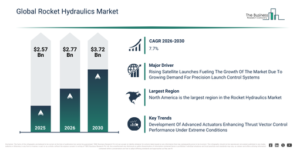
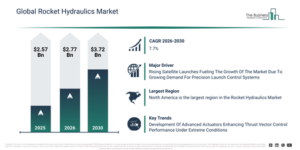
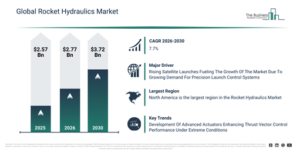
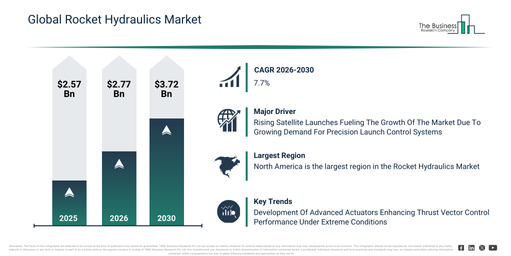
The rocket hydraulics market size has experienced robust expansion in recent years. This market is projected to expand from $2.57 billion in 2025 to $2.77 billion in 2026, demonstrating a compound annual growth rate (CAGR) of 7.8%. Historically, this growth has been driven by several key factors. These include the increased reliance on hydraulic actuators for thrust vector control in early launch vehicles, the advancement of high-pressure hydraulic cylinders to facilitate precise flight control, the integration of hydraulic dampers to stabilize rocket structures during dynamic maneuvers, the expansion of government launch programs which fueled demand for reliable pressure regulation hardware, and the introduction of sophisticated flow control devices that enhanced hydraulic system performance and responsiveness.
The rocket hydraulics market is projected to experience substantial expansion over the upcoming years. It will grow to $3.72 billion in 2030 at a compound annual growth rate (CAGR) of 7.7%. This expansion during the forecast period is propelled by several factors, including the proliferation of reusable launch vehicles, which heightens the demand for robust and easily maintainable hydraulic components. Furthermore, advancements in lightweight hydraulic reservoirs contribute by decreasing the overall vehicle mass. The escalating frequency of commercial launches fuels the need for scalable hydraulic system manufacturing. Innovations in high-efficiency pressure regulators enhance control precision under diverse loads. Lastly, the expansion of autonomous and precision landing technologies necessitates more responsive hydraulic actuation systems. Key developments anticipated in the forecast timeframe encompass the wider application of high-pressure hydraulic control systems, the integration of lightweight hydraulic reservoirs and components, the creation of hydraulic devices capable of tolerating high temperatures, the emergence of electrohydraulic hybrid actuation technologies, and the implementation of precision hydraulic flow control for reusable launch systems.
Request Your Free Rocket Hydraulics Market Sample With Segment And Regional Data:
Rocket Hydraulics Market Growth Drivers And Their Impact On Future Demand
The rocket hydraulics market is expected to expand in the coming years, driven by the increasing frequency of satellite launches. Satellites are artificial or natural objects orbiting a larger celestial body in space. The proliferation of satellites stems from a rising worldwide need for high-speed communication and data services, necessitating extensive satellite networks to guarantee broad coverage, stable connectivity, and dependability across both remote and urban regions. Rocket hydraulics play a crucial role in these launches, enabling control over engine direction, movement of aerodynamic surfaces, assistance with stage separation, and deployment of payload fairings. Their function ensures accurate guidance, stability, and successful satellite deployment during a launch. As an illustration, in May 2024, the National Space Operations Centre (NSpOC), a UK-based organization dedicated to space surveillance and protection, reported over 9,000 active satellites in orbit by April 2024, with projections indicating this figure could exceed 60,000 by the year 2030. Consequently, the growing number of satellite launches will stimulate the rocket hydraulics market.
What Categories Define The Rocket Hydraulics Market?
The rocket hydraulics market covered in this report is segmented –
1) By Component: Actuators, Pumps, Valves, Accumulators, Other Components
2) By Application: Launch Vehicles, Satellites, Space Probes, Other Applications
3) By End-User: Commercial, Military, Government
Subsegments:
1) By Actuators: Linear Actuators, Rotary Actuators, Electrohydraulic Actuators, Servo Actuators
2) By Pumps: Gear Pumps, Vane Pumps, Piston Pumps, Screw Pumps
3) By Valves: Directional Control Valves, Pressure Control Valves, Flow Control Valves, Proportional Valves
4) By Accumulators: Bladder Accumulators, Piston Accumulators, Diaphragm Accumulators, Spring-type Accumulators
5) By Other Components: Hydraulic Motors, Hydraulic Cylinders, Filters, Reservoirs
What New Developments Are Emerging In The Rocket Hydraulics Market?
Leading companies within the rocket hydraulics market are prioritizing the development of advanced products, such as actuators for the thrust vector control system, engineered to function effectively under extreme pressure conditions. Actuators in a thrust vector control system are mechanisms that move engine components or control surfaces to adjust the thrust direction, enabling the rocket to steer during flight. For instance, in January 2024, Moog Inc., a US-based aerospace and defense company, introduced its new electromechanical actuators specifically designed to steer United Launch Alliance’s (ULA) Vulcan Rocket. Hydraulic actuators were developed for the main engine’s first stage thrust vector control system, showcasing flawless performance throughout the flight. These actuators boast high power density, a fault-tolerant architecture, and lightweight construction. The advanced electromechanical actuators delivered exceptional precision, enhanced safety, and reduced maintenance during the inaugural launch of ULA’s Vulcan rocket. Additionally, Moog supplies the Vulcan rocket with upper-stage thrust vector control systems and cryogenic valve actuation solutions.
Major Players Driving Competition In The Rocket Hydraulics Market
Major companies operating in the rocket hydraulics market are Raytheon Technologies Corporation, Honeywell International Inc., Safran S.A., Eaton Corporation plc, Parker Hannifin Corporation, Liebherr International AG, KYB Corporation, Moog Inc., Curtiss-Wright Corporation, Woodward Inc., Triumph Group Inc., Sargent Aerospace And Defense LLC, HYDAC International GmbH, Dynamatic Technologies Limited, Marotta Controls Inc., Arkwin Industries Inc., Crissair Inc., Quiri Hydromechanics, JASC Incorporated, JSC Hydromash
View The Comprehensive Rocket Hydraulics Market Analysis:
Rocket Hydraulics Market Regional Leaders: Insights From The 2026 Report
North America was the largest region in the rocket hydraulics market in 2025. Asia-Pacific is expected to be the fastest-growing region in the forecast period. The regions covered in the rocket hydraulics market report are Asia-Pacific, South East Asia, Western Europe, Eastern Europe, North America, South America, Middle East, Africa.
Reach Out To Our Team:
The Business Research Company: https://www.thebusinessresearchcompany.com/
Americas: +1 310-496-7795
Asia: +44 7882 955267 & +91 8897263534
Europe: +44 7882 955267
Email us at: marketing@tbrc.info
Follow us on:
LinkedIn: https://in.linkedin.com/company/the-business-research-company
YouTube: https://www.youtube.com/channel/UC24_fI0rV8cR5DxlCpgmyFQ
Global Market Model: https://www.thebusinessresearchcompany.com/global-market-model

Wasay has over a decade of experience in market research, data modelling, and analytics, with prior experience at GlobalData and Decision Tree Consulting Services. At The Business Research Company , he leads research operations across syndicated studies, customized consulting engagements, and the Global Market Model platform. His professional experience includes supporting organizations such as Boston Consulting Group, KPMG, and Ernst & Young. Wasay holds a degree in Electronics and Communications Engineering, postgraduate management qualifications from International Management Institute Belgium and Indian School of Business and Entrepreneurship, and completed the Integrated Program in Business Analytics from Indian Institute of Management Indore.