With a focus on actionable insights and strategic value, The Business Research Company’s 2026 market reports include market attractiveness scoring, total addressable market sizing, company benchmarking matrices, interactive Excel dashboards, deeper supply chain intelligence, emerging startup tracking, and granular product-level insights.
Rocket Landing Accuracy Market Size Forecast Points To $2.12 Billion In Revenue By 2030
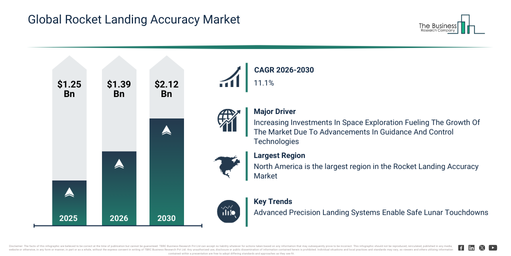
The rocket landing accuracy market size has seen swift expansion in recent years. This market is expected to expand from $1.25 billion in 2025 to $1.39 billion in 2026, demonstrating a compound annual growth rate (CAGR) of 11.2%. The past growth can be ascribed to several factors: the initial development of thrust vector control systems allowing better descent path correction, the introduction of grid fins to improve aerodynamic steering during booster reentry, advancements in autonomous flight control computers leading to enhanced real-time landing guidance, the adoption of landing legs and shock absorption systems to aid safe booster recovery, and increased trials with reusable launch operations that drove the need for precision landing technologies.
The market for rocket landing accuracy is projected to experience swift expansion over the coming years. This market is anticipated to reach $2.12 billion by 2030, demonstrating a compound annual growth rate (CAGR) of 11.1%. This projected growth is driven by several factors, including the increasing number of reusable rocket fleets necessitating highly accurate landing solutions, improvements in sensor fusion and onboard navigation enhancing landing precision, the expanding commercial launch schedule pushing for optimized launch site efficiency and quicker turnaround services, breakthroughs in adaptive control algorithms allowing for more dependable landings under diverse conditions, and a surge in investment towards lunar and planetary landing missions that demand superior precision landing systems. Key trends expected during this period involve the greater implementation of ultra-precise landing leg and shock absorption systems, the application of improved thrust vector control mechanisms for precise landings, the incorporation of high-fidelity autonomous flight control computers, the increasing embrace of aerodynamic optimization features like advanced grid fins, and the development of reusable booster landing infrastructure alongside rapid turnaround systems.
Get A Free Rocket Landing Accuracy Market Sample Covering Drivers, Trends And Key Players:
Rocket Landing Accuracy Market Driver Analysis: Key Factor Supporting Revenue Growth
The escalating investments in space exploration are anticipated to propel the expansion of the rocket landing accuracy market. Space exploration encompasses endeavors focused on scientific discovery, technological progress, and commercial ventures beyond Earth through various missions, research initiatives, and operations conducted in space. The surge in these activities is driven by the increasing need for advanced communication and Earth observation satellites, which provide global connectivity, environmental monitoring, and enhanced security. Investments in space exploration contribute to improved rocket landing accuracy by advancing guidance and control technologies, which are essential for the viability of reusable launch systems. These advancements mitigate mission risks through precise landings and support cost-effective, sustainable space operations. For instance, in September 2023, Novaspace, a France-based space consulting firm, reported that government spending on space exploration amounted to $27 billion in 2024 and is projected to reach nearly $31 billion by 2034. Consequently, the rising investments in space exploration are a key driver for the growth of the rocket landing accuracy market. The escalating defense spending is expected to boost the growth of the rocket landing accuracy market. Defense spending refers to government expenditures allocated to maintaining, equipping, and enhancing military and national security capabilities. This spending is increasing to strengthen national security by modernizing military assets and addressing emerging threats such as cyber warfare and advanced weapon systems. Increased defense spending supports rocket landing accuracy by facilitating greater investment in sophisticated guidance systems, precision sensors, and real-time navigation technologies. For example, in April 2024, the Stockholm International Peace Research Institute (SIPRI), a Sweden-based independent resource on global security, indicated that total global military expenditure reached $2,443 billion in 2023, representing a 6.8% increase in real terms compared to 2022. Therefore, rising defense spending is a significant factor driving the expansion of the rocket landing accuracy market.
Rocket Landing Accuracy Market Segmentation Framework: Major Segments At A Glance
The rocket landing accuracy market covered in this report is segmented –
1) By Component: Hardware, Software, Services
2) By Technology: Global Positioning System (GPS), Inertial Navigation Systems, Radio Detection And Ranging (Radar), Light Detection And Ranging (Lidar), Other Technologies
3) By Application: Commercial Space, Military, Research
4) By End-User: Space Agencies, Private Space Companies, Defense Organizations, Other End-Users
Subsegments:
1) By Hardware: Inertial Navigation Systems, Global Positioning System (GPS) Modules, Grid Fins, Landing Legs, Thrust Vector Control Systems, Radar Altimeters, Sensors
2) By Software: Landing Trajectory Prediction Algorithms, Guidance And Navigation Software, Real-Time Flight Control Systems, Data Processing And Telemetry Software, Simulation And Modeling Tools
3) By Services: System Integration Services, Calibration And Testing Services, Maintenance And Upgrades, Software Support And Updates, Consulting And Customization Services
Latest Rocket Landing Accuracy Market Developments And Emerging Trends
Leading companies operating in the rocket landing accuracy market are concentrating on developing advanced solutions, such as precision landing systems, to enhance safety, improve accuracy, and ensure successful lunar and planetary landings. Precision landing systems refer to sophisticated guidance and navigation technologies that enable spacecraft to land autonomously within meters of a targeted location, even in challenging extraterrestrial terrains. For instance, in April 2025, Astrobotic Technology Inc., a US-based space robotics company, completed a critical terrestrial flight test campaign for its lunar landing Guidance, Navigation, and Control (GNC) systems. These tests, utilizing both helicopter and suborbital rocket flights, validated the systems’ ability to autonomously detect and avoid lunar surface hazards as small as 15 cm, ensuring safe and precise landings by integrating real-time sensor data to select the safest landing sites within a targeted zone. This technology is crucial for future lunar missions, enabling spacecraft to land safely near resource-rich areas or pre-deployed infrastructure, and its successful tests mark a significant milestone in advancing reliable and autonomous landing capabilities for upcoming Moon and Mars missions.
Which Companies Are Shaping The Rocket Landing Accuracy Market?
Major companies operating in the rocket landing accuracy market are Safran S.A., Space Exploration Technologies Corp., Blue Origin LLC, Indian Space Research Organisation, Japan Aerospace Exploration Agency, Relativity Space Inc., Firefly Aerospace Inc., Astrobotic Technology Inc., Agnikul Cosmos Private Limited, Deep Blue Aerospace Technology Co. Ltd., ABL Space Systems Inc., LandSpace Technology Corporation Ltd., Ramon.Space Inc., ispace Inc., PLD Space S.L., OneSpace Technology Group Co. Ltd., Skyrora Ltd., KinetX Aerospace Inc., China National Space Administration, Lulav Space Ltd., Space Epoch Co. Ltd.
Dive Deeper Into The Rocket Landing Accuracy Market With The Full Report:
Rocket Landing Accuracy Market Regional Distribution: Where Is Revenue Concentrated?
North America was the largest region in the rocket landing accuracy market in 2025. The regions covered in the rocket landing accuracy market report are Asia-Pacific, South East Asia, Western Europe, Eastern Europe, North America, South America, Middle East, Africa.
Reach Out To Our Team:
The Business Research Company: https://www.thebusinessresearchcompany.com/
Americas: +1 310-496-7795
Asia: +44 7882 955267 & +91 8897263534
Europe: +44 7882 955267
Email us at: marketing@tbrc.info
Follow us on:
LinkedIn: https://in.linkedin.com/company/the-business-research-company
YouTube: https://www.youtube.com/channel/UC24_fI0rV8cR5DxlCpgmyFQ
Global Market Model: https://www.thebusinessresearchcompany.com/global-market-model

Wasay has over a decade of experience in market research, data modelling, and analytics, with prior experience at GlobalData and Decision Tree Consulting Services. At The Business Research Company , he leads research operations across syndicated studies, customized consulting engagements, and the Global Market Model platform. His professional experience includes supporting organizations such as Boston Consulting Group, KPMG, and Ernst & Young. Wasay holds a degree in Electronics and Communications Engineering, postgraduate management qualifications from International Management Institute Belgium and Indian School of Business and Entrepreneurship, and completed the Integrated Program in Business Analytics from Indian Institute of Management Indore.