Through market attractiveness analysis, total addressable market evaluation, company benchmarking matrices, interactive Excel dashboards, expanded supply chain intelligence, emerging startup coverage, and detailed product insights, The Business Research Company’s 2026 market reports provide more actionable and strategically valuable research.
Rocket Mission Control Systems Market Value Analysis: What Growth Is Expected Over The Forecast Period?
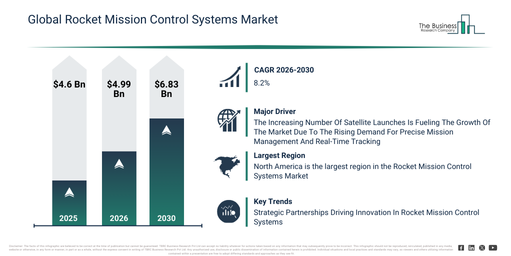
The market for rocket mission control systems has experienced substantial growth recently. This market is projected to expand from $4.6 billion in 2025 to $4.99 billion by 2026, exhibiting a compound annual growth rate (CAGR) of 8.5%. Historically, this expansion has been driven by several factors, including the rising complexity of launch operations necessitating sturdy mission control infrastructures, the creation of advanced telemetry receivers for precise real-time data monitoring, the broadening of tracking antenna networks to ensure worldwide mission coverage, the implementation of command and control consoles to optimize launch coordination, and the increase in government space programs demanding advanced systems for trajectory analysis and countdown management.
The market size for rocket mission control systems is anticipated to experience substantial expansion over the coming years, with projections indicating growth to $6.83 billion by 2030, at a compound annual growth rate (CAGR) of 8.2%. This expansion during the forecast period can be attributed to several factors: an increase in commercial launch frequency, which in turn elevates the demand for scalable and automated mission control platforms; advancements in data processing and AI tools that enhance anomaly detection and decision support; the expansion of reusable launch operations necessitating continuous mission monitoring across multiple flight cycles; innovations in high-bandwidth communications systems improving spacecraft-to-ground connectivity; and the growing establishment of global spaceports driving the adoption of modular and standardized mission control architectures. Concurrently, major trends expected in this period include the development of advanced telemetry processing capabilities, a rising demand for high-precision flight dynamics modeling, the broadening of integrated mission planning and post-launch analytics, enhanced redundancy systems to bolster mission reliability, and an increased adoption of distributed ground network architectures.
Download A Free Sample Report For Comprehensive Market Insights:
Rocket Mission Control Systems Market Expansion Drivers: What Is Shaping Future Growth?
The growth of the rocket mission control systems market is anticipated to be propelled by the increasing number of satellite launches going forward. Satellite launches involve the deployment of artificial satellites into space using launch vehicles for diverse applications such as communication, navigation, or Earth observation. The rising volume of satellite launches is due to the escalating global demand for satellite-based services, which has led both government and private organizations to expand their launch schedules. This surge in satellite launches boosts the requirement for advanced rocket mission control systems to effectively manage complex missions with accurate navigation and real-time tracking. These systems are essential for ensuring mission safety and efficiency amidst the growing launch frequency. For instance, in June 2024, as reported by the Satellite Industry Association, a US-based organization, the commercial satellite industry achieved record-breaking growth in 2023, launching 2,781 satellites, which was a 20% rise from 2022. The space industry also reached a new milestone with 190 total launches, the highest ever recorded. By the end of the year, the number of operational satellites reached 9,691, reflecting a 361% increase over the past five years. Therefore, the expanding number of satellite launches is a primary driver for the growth of the rocket mission control systems market.
Rocket Mission Control Systems Market Segment Outlook: Which Categories Are Expanding The Fastest?
The rocket mission control systems market covered in this report is segmented –
1) By Component: Hardware, Software, Services
2) By Application: Launch Operations, Satellite Operations, Deep Space Missions, Other Applications
3) By End-User: Government, Commercial, Defense, Other End-Users
Subsegments:
1) By Hardware: Control Consoles, Data Acquisition Systems, Telemetry Antennas, Tracking Systems, Communication Equipment, Display Panels, Power Supply Units
2) By Software: Flight Management Software, Mission Planning Software, Telemetry And Data Processing Software, Real-Time Operating Systems (RTOS), Command And Control Software, Simulation And Training Software
3) By Services: Integration And Installation Services, Maintenance And Support Services, Software Upgrades And Patch Management, Training And Simulation Services, Mission Design And Analysis Services, Consulting Services
Rocket Mission Control Systems Market Strategic Trends: What Is Defining The Next Phase Of Growth?
Leading companies within the rocket mission control systems market are increasingly emphasizing strategic partnerships to foster advancements in mission planning and execution. A strategic partnership represents a collaborative effort between entities designed to achieve shared goals by leveraging their respective strengths. This type of collaboration encourages mutual development through pooled resources, inventive solutions, and widened market access. For instance, in May 2025, Viasat, Inc., a US-based provider of satellite communications, formed a partnership with Blue Origin, a US-based astronautics company. Their objective is to showcase the InRange launch telemetry relay service on two upcoming New Glenn rocket missions, aiding NASA’s Communications Services Project (CSP) as the agency shifts from its traditional Tracking and Data Relay Satellite (TDRS) system to commercial satellite communications solutions. This joint effort will involve integrating Viasat’s InRange user terminal into Blue Origin’s New Glenn, enabling real-time, beyond-line-of-sight telemetry relay during launch and eliminating communication disruptions often associated with ground-based systems.
Rocket Mission Control Systems Market Key Players And Strategic Industry Positioning
Major companies operating in the rocket mission control systems market are Lockheed Martin Corporation, Raytheon Technologies Corporation, Northrop Grumman Corporation, Thales Group, L3Harris Technologies, Kratos Defense & Security Solutions, Iridium Communications, Telespazio Spa, TERMA, Kongsberg Gruppen, Swedish Space Corporation, Atlas Space Operations, Elecnor Deimos, Integrasys, Infostellar, Leaf Space, Goonhilly Earth Station, Alén Space, Vega, GMV Innovating Solutions S.L.
Access The Complete Rocket Mission Control Systems Market Report:
Rocket Mission Control Systems Market Regional Distribution: Which Areas Drive Market Expansion?
North America was the largest region in the rocket mission control systems market in 2025. The regions covered in the rocket mission control systems market report are Asia-Pacific, South East Asia, Western Europe, Eastern Europe, North America, South America, Middle East, Africa.
Access a Customized Rocket Mission Control Systems Market Report for Deeper Competitive Insights
https://www.thebusinessresearchcompany.com/customise?id=25530&type=smp
The Business Research Company: https://www.thebusinessresearchcompany.com/
Americas: +1 310-496-7795
Asia: +44 7882 955267 & +91 8897263534
Europe: +44 7882 955267
Email us at: marketing@tbrc.info
Follow us on:
LinkedIn: https://in.linkedin.com/company/the-business-research-company
YouTube: https://www.youtube.com/channel/UC24_fI0rV8cR5DxlCpgmyFQ
Global Market Model: https://www.thebusinessresearchcompany.com/global-market-model

Wasay has over a decade of experience in market research, data modelling, and analytics, with prior experience at GlobalData and Decision Tree Consulting Services. At The Business Research Company , he leads research operations across syndicated studies, customized consulting engagements, and the Global Market Model platform. His professional experience includes supporting organizations such as Boston Consulting Group, KPMG, and Ernst & Young. Wasay holds a degree in Electronics and Communications Engineering, postgraduate management qualifications from International Management Institute Belgium and Indian School of Business and Entrepreneurship, and completed the Integrated Program in Business Analytics from Indian Institute of Management Indore.