
Through market attractiveness analysis, total addressable market evaluation, company benchmarking matrices, interactive Excel dashboards, expanded supply chain intelligence, emerging startup coverage, and detailed product insights, The Business Research Company’s 2026 market reports provide more actionable and strategically valuable research.
Rocket Payload Heat Control Market Growth From $2.76 Billion In 2026 To $3.61 Billion By 2030 At A CAGR Of 6.94%
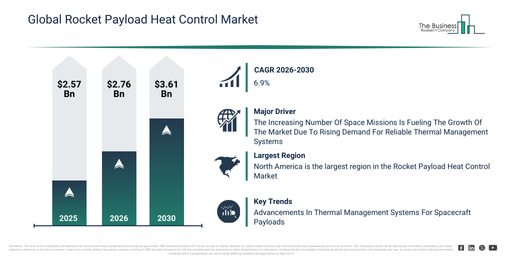
The rocket payload heat control market has experienced significant growth in recent years. It is projected to expand from $2.57 billion in 2025 to $2.76 billion in 2026, demonstrating a compound annual growth rate (CAGR) of 7.4%. The historical expansion of this market can be attributed to the increasing thermal sensitivity of scientific and commercial payloads driving the adoption of heat control solutions, the development of heat pipes and thermal straps designed to manage internal payload temperature gradients, the growing number of satellite deployment missions that require advanced payload thermal protection, the early integration of mechanical louvers to regulate heat rejection across varying thermal environments, and the expansion of cryogenic cooling technologies to support highly sensitive instrumentation.
The rocket payload heat control market is projected to experience substantial expansion in the coming years. This market is anticipated to reach $3.61 billion by 2030, demonstrating a compound annual growth rate (CAGR) of 6.9%. This expansion over the forecast period is driven by several factors: an increase in commercial satellite launches boosting the need for scalable thermal management, improvements in lightweight and high-conductivity materials enhancing device performance, the proliferation of deep-space and high-energy missions demanding advanced thermal protection, breakthroughs in adaptive and autonomous thermal regulation systems improving reliability, and the rising adoption of reusable rockets requiring compatible heat control for quick turnarounds. Key trends during this period are expected to involve the wider uptake of advanced cryogenic cooling, a greater reliance on lightweight composite materials for thermal protection, an increasing need for modular and reconfigurable payload thermal systems, the broader application of passive thermal control for smaller satellites, and the incorporation of high-performance thermal interfaces like heat pipes and thermal straps.
Download A Free Sample Report For Comprehensive Market Insights:
#Rocket Payload Heat Control Market Growth Drivers And Industry Catalysts
A rising volume of space missions is anticipated to fuel the expansion of the rocket payload heat control market in the future. These missions involve carefully planned operations in outer space, aiming to achieve scientific, exploratory, technological, or commercial goals. The surge in space missions stems from increased involvement by private aerospace firms, which are significantly investing in launch systems and space-related infrastructure. Rocket payload heat control is crucial for protecting vital instruments from extreme temperature fluctuations during both launch and flight through space. Such thermal management is vital for ensuring the payload’s operational efficiency, accuracy, and longevity throughout the mission. As an illustration, the Federal Aviation Administration, a US federal agency, reported in November 2024 that commercial space operations grew by over 30% in 2023, totaling 148 missions, with projections suggesting a doubling by 2028. Consequently, the growing frequency of space missions is a key factor boosting the rocket payload heat control market’s expansion.
Rocket Payload Heat Control Market Categorization By Product Type And Application
The rocket payload heat control market covered in this report is segmented –
1) By Component: Thermal Protection Systems, Heat Shields, Insulation Materials, Radiators, Other Components
2) By Payload Type: Satellites, Space Probes, Manned Spacecraft, Other Payload Types
3) By Material Type: Ceramics, Metals, Polymers, Composites
4) By Application: Commercial Space, Military And Defense, Scientific Research, Other Applications
Subsegments:
1) By Thermal Protection Systems: Ablative Thermal Protection, Reusable Thermal Protection, Passive Thermal Protection, Active Thermal Protection
2) By Heat Shields: Metallic Heat Shields, Ceramic Heat Shields, Composite Heat Shields, Flexible Heat Shields
3) By Insulation Materials: Multilayer Insulation (MLI), Foam Insulation, Aerogel Insulation, Fiberglass Insulation
4) By Radiators: Loop Heat Pipe Radiators, Deployable Radiators, Fixed Panel Radiators, Heat Pipe Embedded Radiators
5) By Other Components: Thermal Straps, Phase Change Materials (PCMs), Heaters, Coatings And Surface Treatments
#Rocket Payload Heat Control Market Trends Influencing Long-Term Demand
Companies operating within the rocket payload heat control market are prioritizing the development of technological improvements, including advanced thermal management systems, to enhance temperature regulation for payloads, guarantee component reliability, and maintain peak operational performance during space launches and missions. A thermal management system encompasses a range of technologies and mechanisms specifically designed to monitor, control, and disperse heat within a spacecraft or rocket to ensure payloads and vital components operate at their optimal temperatures. As an illustration, in November 2024, the Air Force Research Laboratory, a research and development center based in the US, launched its SPIRRAL (Space Power InfraRed Regulation and Analysis of Lifetime) experiment as part of SpaceX’s CRS-31 (SPX-31) mission to study thermal control and power regulation technologies in the space environment. This experiment tests Variable Emissivity Materials (VEMs) for thermal management applications in space. These materials passively control heat by altering their infrared emissivity to reduce severe temperature swings, thereby protecting spacecraft electronics without the need for heavy, power-consuming systems. The success of SPIRRAL could revolutionize thermal control in spacecraft, resulting in longer operational lives, greater resilience, and the enablement of space solar power systems for an uninterrupted energy supply.
Rocket Payload Heat Control Market Industry Leaders And Market Competition
Major companies operating in the rocket payload heat control market are Lockheed Martin Corporation, The Boeing Company, Saint-Gobain, Northrop Grumman Corporation, SpaceX, Blue Origin LLC, Ball Aerospace & Technologies Corp., Evonik Industries AG, Sierra Space, Meyer Tool & Mfg., Sheldahl, Aerospace Fabrication & Materials LLC, DHV Technology, Advanced Cooling Technologies, A&R Tarpaulins Inc., Admatis, Beyond Gravity, Technology Applications Inc., Dunmore Aerospace, Versiv Composites Limited, RAL Space
Access The Complete Rocket Payload Heat Control Market Report:
Rocket Payload Heat Control Market Regional Analysis And Leading Geography
North America was the largest region in the rocket payload heat control market in 2025. The regions covered in the rocket payload heat control market report are Asia-Pacific, South East Asia, Western Europe, Eastern Europe, North America, South America, Middle East, Africa.
Access a Customized Rocket Payload Heat Control Market Report for Deeper Competitive Insights
https://www.thebusinessresearchcompany.com/customise?id=25533&type=smp
The Business Research Company: https://www.thebusinessresearchcompany.com/
Americas: +1 310-496-7795
Asia: +44 7882 955267 & +91 8897263534
Europe: +44 7882 955267
Email us at: marketing@tbrc.info
Follow us on:
LinkedIn: https://in.linkedin.com/company/the-business-research-company
YouTube: https://www.youtube.com/channel/UC24_fI0rV8cR5DxlCpgmyFQ
Global Market Model: https://www.thebusinessresearchcompany.com/global-market-model

Wasay has over a decade of experience in market research, data modelling, and analytics, with prior experience at GlobalData and Decision Tree Consulting Services. At The Business Research Company , he leads research operations across syndicated studies, customized consulting engagements, and the Global Market Model platform. His professional experience includes supporting organizations such as Boston Consulting Group, KPMG, and Ernst & Young. Wasay holds a degree in Electronics and Communications Engineering, postgraduate management qualifications from International Management Institute Belgium and Indian School of Business and Entrepreneurship, and completed the Integrated Program in Business Analytics from Indian Institute of Management Indore.
