Delivering more actionable and strategically valuable research, The Business Research Company’s 2026 market reports feature market attractiveness analysis, total addressable market evaluation, company benchmarking matrices, interactive Excel dashboards, expanded supply chain intelligence, emerging startup coverage, and detailed product insights.
Rocket Payload Vibration Control Market Expected To Reach $2.31 Billion By 2030 At 7.65% CAGR
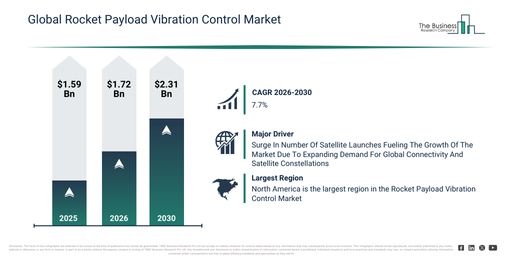
The rocket payload vibration control market size has demonstrated robust expansion in recent years. This market is projected to expand from $1.59 billion in 2025 to $1.72 billion in 2026, exhibiting a compound annual growth rate (CAGR) of 8.2%. The historical growth can be attributed to several factors: the increasing sensitivity of scientific and commercial payloads, which drives demand for vibration mitigation solutions; the development of viscoelastic dampers aimed at reducing launch-induced mechanical stresses; the early adoption of vibration testing and simulation services to validate payload survivability; the integration of electromagnetic damping technologies to enhance isolation performance; and the expansion of government and commercial launch programs necessitating post-flight vibration analysis.
The rocket payload vibration control market is expected to experience significant expansion in the coming years. Its valuation is projected to reach $2.31 billion by 2030, exhibiting a compound annual growth rate (CAGR) of 7.7%. This anticipated growth is influenced by several factors, including the increasing development of commercial satellite constellations, which drives the need for scalable vibration control systems; breakthroughs in hybrid isolation technologies that provide enhanced attenuation across wider frequency ranges; a growing reliance on rapid prototyping and custom fabrication to align vibration solutions with specific payload requirements; improvements in predictive modeling, which refine vibration environment forecasting; and the proliferation of reusable rockets, necessitating vibration control systems compatible with multiple launch cycles. Throughout the forecast period, prominent trends are expected to include the expanded deployment of hybrid vibration isolation systems, a rising demand for high-fidelity vibration testing and simulation services, the development of custom-engineered dampers tailored for small and modular payloads, the broader integration of advanced materials in passive vibration dampers, and increased adoption of non-contact electromagnetic isolation technologies.
Download A Free Sample Report For Comprehensive Market Insights:
#Rocket Payload Vibration Control Market Demand Drivers Creating New Revenue Opportunities
The increasing volume of satellite deployments is projected to fuel the expansion of the rocket payload vibration control market in the coming years. Satellite deployments involve placing satellites into orbits around Earth or other celestial bodies using rockets or specialized launch vehicles. The surge in satellite launches stems from the escalating need for high-speed global internet access, as groups of satellites facilitate improved connectivity in hard-to-reach and underserved regions. Rocket payload vibration control aids satellite missions by reducing vibrations and impacts during launch and flight, thereby ensuring the satellite’s sensitive instruments remain undamaged and fully functional upon reaching its destination orbit. For example, in June 2024, data from the Satellite Industry Association, a US-based entity, revealed that the commercial satellite industry experienced unprecedented growth in 2023, with 2,781 satellites launched, marking a 20% increase from 2022. The overall space sector also reached a new record of 190 total launches, the highest ever documented. By year-end, the count of operational satellites stood at 9,691, demonstrating a 361% rise over the preceding five years. Consequently, the growing number of satellite launches worldwide is a key driver for the rocket payload vibration control market.
Rocket Payload Vibration Control Market Segment Performance And Strategic Opportunities
The rocket payload vibration control market covered in this report is segmented –
1) By Type: Passive Control, Active Control, Semi-Active Control
2) By Payload Type: Satellites, Space Probes, Manned Spacecraft, Cargo
3) By Application: Commercial, Military, Scientific Research
4) By End-User: Aerospace, Defense, Research Institutions
Subsegments:
1) By Passive Control: Tuned Mass Dampers (TMD), Base Isolation Systems, Elastomeric Mounts, Shock Absorbers, Damping Pads
2) By Active Control: Electromagnetic Actuators, Piezoelectric Actuators, Hydraulic Actuators, Servo-Controlled Systems, Feedback Sensor Systems
3) By Semi-Active Control: Magnetorheological Dampers, Electro-Rheological Dampers, Variable Orifice Dampers, Smart Material-Based Dampers, Semi-Active Tuned Mass Dampers
Rocket Payload Vibration Control Market Competitive Analysis Of Major Industry Participants
Major companies operating in the rocket payload vibration control market are The Boeing Company, Lockheed Martin Corporation, Airbus SE, General Dynamics Corporation, Northrop Grumman Corporation, Honeywell International Inc., L3Harris Technologies Inc., Parker Hannifin Corporation, Trelleborg AB, Moog Inc., ITT Inc., Curtiss-Wright Corporation, Thales Group, Kaman Corporation, Beyond Gravity AG, Hutchinson Group, Crystal Instruments Inc., VibraSystems Inc., Technical Manufacturing Corporation, Minus K Technology Inc.
Access The Complete Rocket Payload Vibration Control Market Report:
Rocket Payload Vibration Control Market Geographic Distribution And Regional Opportunities
North America was the largest region in the rocket payload vibration control market in 2025. Asia-Pacific is expected to be the fastest-growing region in the forecast period. The regions covered in the rocket payload vibration control market report are Asia-Pacific, South East Asia, Western Europe, Eastern Europe, North America, South America, Middle East, Africa.
Access a Customized Rocket Payload Vibration Control Market Report for Deeper Competitive Insights
https://www.thebusinessresearchcompany.com/customise?id=25535&type=smp
The Business Research Company: https://www.thebusinessresearchcompany.com/
Americas: +1 310-496-7795
Asia: +44 7882 955267 & +91 8897263534
Europe: +44 7882 955267
Email us at: marketing@tbrc.info
Follow us on:
LinkedIn: https://in.linkedin.com/company/the-business-research-company
YouTube: https://www.youtube.com/channel/UC24_fI0rV8cR5DxlCpgmyFQ
Global Market Model: https://www.thebusinessresearchcompany.com/global-market-model

Wasay has over a decade of experience in market research, data modelling, and analytics, with prior experience at GlobalData and Decision Tree Consulting Services. At The Business Research Company , he leads research operations across syndicated studies, customized consulting engagements, and the Global Market Model platform. His professional experience includes supporting organizations such as Boston Consulting Group, KPMG, and Ernst & Young. Wasay holds a degree in Electronics and Communications Engineering, postgraduate management qualifications from International Management Institute Belgium and Indian School of Business and Entrepreneurship, and completed the Integrated Program in Business Analytics from Indian Institute of Management Indore.