Designed to make market research more actionable and strategically valuable, The Business Research Company’s 2026 market reports feature market attractiveness scoring, total addressable market sizing, company benchmarking matrices, interactive Excel dashboards, deeper supply chain intelligence, emerging startup tracking, and granular product-level insights.
High-Thrust Rocket Systems Market Revenue Expansion Outlook For The 2026–2030 Forecast Period
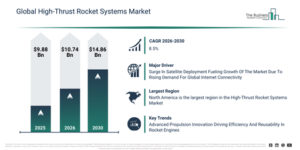
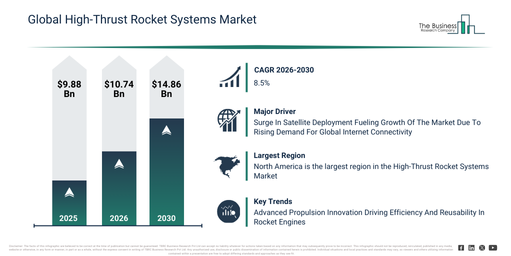
The high-thrust rocket systems market has experienced robust expansion recently. This market is projected to expand from $9.88 billion in 2025 to $10.74 billion by 2026, demonstrating a compound annual growth rate (CAGR) of 8.7%. The expansion witnessed historically stems from factors such as the increasing creation of high-thrust propulsion systems for heavy-lift launch vehicles, the growing use of semi-cryogenic propellants which enhance engine efficiency and performance, improvements in turbopump technologies allowing for greater pressure and flow rates, the invention of durable combustion chambers resistant to extreme thermal loads, and the growth of avionics systems that improve launch vehicle guidance and control.
The high-thrust rocket systems market is projected to experience robust expansion over the coming years. This market is set to reach $14.86 billion in 2030, with a compound annual growth rate (CAGR) of 8.5%. This anticipated growth is driven by several factors, including the increasing need for high-thrust systems for crewed missions to the moon and Mars, the ongoing development of paraffin-based hybrid fuels that enhance thrust, greater investment in reusable heavy-lift rocket technologies to lower launch expenses, the expansion of commercial space firms leading to the acquisition of advanced propulsion equipment, and the creation of next-generation engine designs that achieve higher thrust-to-weight ratios. Key trends during this period encompass innovations in high-efficiency turbopump technologies, a growing embrace of paraffin-based hybrid fuel systems, augmented investment in reusable high-thrust engine platforms, a movement towards domestically supplied propulsion parts, and the expansion of commercial heavy-lift launch vehicle initiatives.
Download A Free Sample For In-Depth High-Thrust Rocket Systems Market Intelligence:
High-Thrust Rocket Systems Market Demand Driver: How It Is Shaping Industry Growth
The increasing demand for satellite deployment is expected to drive the growth of the high-thrust rocket systems market in the future. Satellite deployment involves the process of releasing a satellite from its launch vehicle and positioning it into its designated orbit. This escalating demand for satellite deployment arises from the growing requirement for global connectivity, as users increasingly anticipate continuous communication and internet access even in the most remote areas. High-thrust rocket systems facilitate satellite deployments by providing the significant lift necessary to transport heavier payloads and multiple satellites into higher orbits more efficiently and reliably. For instance, in January 2024, according to the Space Foundation, a US-based nonprofit organization, global launch activity reached a record high in 2023 with 223 attempts and 212 successes, as US launch attempts rose 33%, commercial launches grew 50%, and satellite deployments increased 23% from 2022. Therefore, the rising demand for satellite deployment is a key factor propelling the expansion of the high-thrust rocket systems market.
High-Thrust Rocket Systems Market Segmentation Overview: Detailed Category Analysis
The high-thrust rocket systems market covered in this report is segmented –
1) By Type: Liquid Propellant, Solid Propellant, Hybrid Propellant
2) By Component: Engine, Nozzle, Propellant Tank, Other Components
3) By Application: Military, Commercial, Space Exploration, Other Applications
4) By End-User: Government, Private Sector, Other End-Users
Subsegments:
1) By Liquid Propellant: Cryogenic Propellant, Semi-Cryogenic Propellant, Hypergolic Propellant, Bi-Propellant Systems, Mono-Propellant Systems
2) By Solid Propellant: Homogeneous Solid Propellant, Composite Solid Propellant, Double-Base Propellant, Modified Double-Base (MDB) Propellant, Elastomer-Bonded Propellant
3) By Hybrid Propellant: Paraffin-Based Fuel With Liquid Oxidizer, Hydroxyl-Terminated Polybutadiene, Polymeric Fuel With Gaseous Oxidizer, LOX-HTPB Hybrid Engines, Additively Manufactured Hybrid Fuels
Top High-Thrust Rocket Systems Market Trends And Recent Industry Developments
Leading companies within the high-thrust rocket systems market are prioritizing advancements in next-generation propulsion. These innovations include advanced liquid and hybrid propulsion technologies, high-efficiency combustion systems, AI-assisted thrust control, and scalable modular engines, all aimed at boosting performance, ensuring reliability, and increasing mission versatility. AI-assisted thrust control specifically refers to systems that optimize engine output in real time, enhancing fuel efficiency and precision during both launch and in-orbit maneuvers. As an illustration, in October 2025, Venus Aerospace, a US-based aerospace propulsion company, revealed a strategic investment from Lockheed Martin, intended to accelerate the development of groundbreaking high-thrust propulsion systems. This partnership focuses on advancing modular, scalable rocket engines capable of delivering greater thrust with improved efficiency for a wide range of space applications. By integrating these developments, the resulting systems are designed to improve launch success rates, decrease operational costs, and broaden capabilities for both commercial and defense space missions.
High-Thrust Rocket Systems Market Company Landscape: Key Players To Watch
Major companies operating in the high-thrust rocket systems market are Lockheed Martin Corporation, Northrop Grumman Corporation, Mitsubishi Heavy Industries Ltd., BAE Systems plc, Safran S.A., L3Harris Technologies Inc., IHI Corporation, Space Exploration Technologies Corp., Hanwha Aerospace Co. Ltd., Blue Origin LLC, Moog Inc., Nammo AS, Korea Aerospace Research Institute (KARI), Japan Aerospace Exploration Agency, Relativity Space Inc., Avio S.p.A., Stoke Space Technologies Inc., Galactic Energy, Stratolaunch LLC, Panega Aerospace Inc., Indian Space Research Organisation.
Explore The High-Thrust Rocket Systems Global Market Report For Full Insights:
High-Thrust Rocket Systems Market Region-Wise Analysis: Largest Regional Market Identified
North America was the largest region in the high-thrust rocket systems market in 2025. The regions covered in the high-thrust rocket systems market report are Asia-Pacific, South East Asia, Western Europe, Eastern Europe, North America, South America, Middle East, Africa.
Reach Out To Our Team:
The Business Research Company: https://www.thebusinessresearchcompany.com/
Americas: +1 310-496-7795
Asia: +44 7882 955267 & +91 8897263534
Europe: +44 7882 955267
Email us at: marketing@tbrc.info
Follow us on:
LinkedIn: https://in.linkedin.com/company/the-business-research-company
YouTube: https://www.youtube.com/channel/UC24_fI0rV8cR5DxlCpgmyFQ
Global Market Model: https://www.thebusinessresearchcompany.com/global-market-model

Wasay has over a decade of experience in market research, data modelling, and analytics, with prior experience at GlobalData and Decision Tree Consulting Services. At The Business Research Company , he leads research operations across syndicated studies, customized consulting engagements, and the Global Market Model platform. His professional experience includes supporting organizations such as Boston Consulting Group, KPMG, and Ernst & Young. Wasay holds a degree in Electronics and Communications Engineering, postgraduate management qualifications from International Management Institute Belgium and Indian School of Business and Entrepreneurship, and completed the Integrated Program in Business Analytics from Indian Institute of Management Indore.