Market attractiveness scoring, total addressable market sizing, company benchmarking matrices, interactive Excel dashboards, deeper supply chain intelligence, emerging startup tracking, and granular product-level insights are among the key offerings featured in The Business Research Company’s 2026 market reports, designed to deliver more actionable and strategically valuable research.
Rocket Solid Propulsion Market Valued At $320.61 Billion In 2026, Projected To Reach $376.37 Billion By 2030
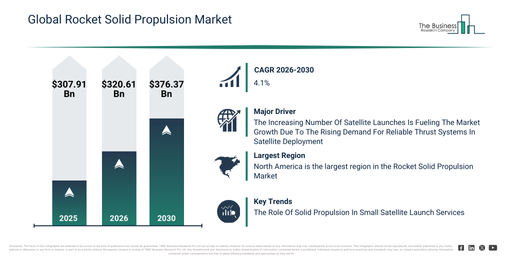
The rocket solid propulsion market size has demonstrated consistent growth in recent years. It is anticipated to expand from $307.91 billion in 2025 to $320.61 billion in 2026, with a compound annual growth rate (CAGR) of 4.1%. The growth observed in prior periods stemmed from the extensive deployment of solid propellants in military and space rockets, improvements in grain formulation and combustion stability, the broadening of defense and space research programs, the creation of robust ignition and control systems, and a rise in the production of solid propulsion motors for tactical and strategic applications.
The rocket solid propulsion market is projected to experience consistent expansion over the next few years. It is anticipated to grow to $376.37 billion by 2030, exhibiting a compound annual growth rate (CAGR) of 4.1%. This growth during the forecast period can be attributed to factors such as the rising demand for high-thrust solid rocket motors in defense and aerospace applications, a focus on developing environmentally safer and more stable propellant compositions, the integration of advanced guidance and control systems, an increase in commercial space launch activities that utilize solid propulsion, and the development of modular and versatile solid rocket motor designs. Major trends expected in the forecast period include advancements in high-energy solid propellants, the adoption of lightweight composite motor casings, an increased demand for multi-stage solid boosters, growth in commercial satellite launch services, and enhanced safety and quality assurance standards.
Request A Complimentary Rocket Solid Propulsion Market Research Sample:
Key Factor Propelling The Rocket Solid Propulsion Market Forward
The rocket solid propulsion market is anticipated to experience growth driven by the rising volume of satellite launches. Satellite launches encompass the process of deploying artificial satellites into space using rockets for various purposes such as communication, navigation, research, or earth observation. The increase in satellite launches is primarily attributed to the escalating demand for communication, where satellites are crucial for enhancing connectivity and enabling faster, more reliable data transmission for internet, television, and telecommunications services, especially in remote and underserved areas. Rocket solid propulsion is essential for the effective deployment of satellites, providing the necessary thrust and reliability to accurately position them into their intended orbits. For instance, the Government Accountability Office, a US-based government agency, noted that as of spring 2022, there were nearly 5,500 active satellites in orbit, with projections suggesting the deployment of an additional 58,000 by 2030. Thus, the increasing number of satellite launches is a significant factor boosting the growth of the rocket solid propulsion market.
Rocket Solid Propulsion Market Segments And Subsegments Explained
The rocket solid propulsion market covered in this report is segmented –
1) By Type: Boosters, Upper Stages, In-Space Propulsion
2) By Rocket Type: Launch Vehicles, Spacecraft Propulsion, Military Rockets
3) By Propellant Type: Ammonium Perchlorate Composite Propellant (APCP), Hydroxyl-Terminated Polybutadiene (HTPB), Polyurethane (PU)
4) By Application: Earth Observation, Navigation, Communication, Space Exploration
5) By End User: Government, Commercial, Research Institutions
Subsegments:
1) By Boosters: Strap-On Boosters, First Stage Boosters, Dual Thrust Boosters, Tandem Boosters
2) By Upper Stages: Single-Stage Upper Modules, Multi-Stage Upper Modules, Restartable Upper Stages, Kick Stages
3) By In-Space Propulsion: Apogee Kick Motors (AKM), Orbit Insertion Motors,
Emerging Trends Transforming The Rocket Solid Propulsion Market
Major companies operating in the rocket solid propulsion market are concentrating on developing innovative products, such as solid propellant rockets, to improve launch efficiency and reduce mission costs. A solid propellant rocket refers to a type of rocket that utilizes a solid mixture of fuel and oxidizer as its propellant, which is pre-packed into the combustion chamber and ignites to produce thrust when launched. For instance, in June 2023, Guangzhou Zhongke Aerospace Exploration Technology Co., Ltd., a China-based commercial space launch provider, successfully launched its largest solid propellant rocket, Lijian-1, deploying 26 satellites into orbit in a single mission, thereby showcasing enhanced launch efficiency and reduced mission costs through the application of solid propulsion technology. The launch marked the second flight of Lijian-1, indicating growing reliability and the technological maturity of the solid propellant system. The rocket incorporated breakthroughs in six key technologies and utilized 13 domestic innovations for the first time, highlighting China’s advancements in solid carrier rocket development.
Rocket Solid Propulsion Market Key Players: Major Companies In The 2026 Report
Major companies operating in the rocket solid propulsion market are The Boeing Company, Northrop Grumman Corporation, Mitsubishi Heavy Industries Ltd., Safran S.A., Aerojet Rocketdyne Holdings Inc., L3Harris Technologies Inc., Rolls-Royce Holdings plc, Aerojet Rocketdyne Holdings Inc., Airbus SE, Sierra Nevada Corporation, Arianespace SA, Anduril Industries Inc., Firefly Aerospace Inc., Avio S.p.A., Gilmour Space Technologies Pty Ltd., EDePro – Engine Development and Production d.o.o., Skyroot Aerospace Private Limited, Firehawk Aerospace Inc., Virgin Galactic Holdings Inc., Thiokol Propulsion.
Explore The Full Rocket Solid Propulsion Market Report With Forecasts To 2030:
Rocket Solid Propulsion Market By Region: Where Is Demand Strongest?
North America was the largest region in the rocket solid propulsion market in 2025. Asia-Pacific is expected to be the fastest-growing region in the forecast period. The regions covered in the rocket solid propulsion market report are Asia-Pacific, South East Asia, Western Europe, Eastern Europe, North America, South America, Middle East, Africa.
Reach Out To Our Team:
The Business Research Company: https://www.thebusinessresearchcompany.com/
Americas: +1 310-496-7795
Asia: +44 7882 955267 & +91 8897263534
Europe: +44 7882 955267
Email us at: marketing@tbrc.info
Follow us on:
LinkedIn: https://in.linkedin.com/company/the-business-research-company
YouTube: https://www.youtube.com/channel/UC24_fI0rV8cR5DxlCpgmyFQ
Global Market Model: https://www.thebusinessresearchcompany.com/global-market-model

Wasay has over a decade of experience in market research, data modelling, and analytics, with prior experience at GlobalData and Decision Tree Consulting Services. At The Business Research Company , he leads research operations across syndicated studies, customized consulting engagements, and the Global Market Model platform. His professional experience includes supporting organizations such as Boston Consulting Group, KPMG, and Ernst & Young. Wasay holds a degree in Electronics and Communications Engineering, postgraduate management qualifications from International Management Institute Belgium and Indian School of Business and Entrepreneurship, and completed the Integrated Program in Business Analytics from Indian Institute of Management Indore.