
The Business Research Company’s 2026 market reports combine market attractiveness scoring, total addressable market sizing, company benchmarking matrices, interactive Excel dashboards, deeper supply chain intelligence, emerging startup tracking, and granular product-level insights to deliver research that is more actionable and strategically valuable.
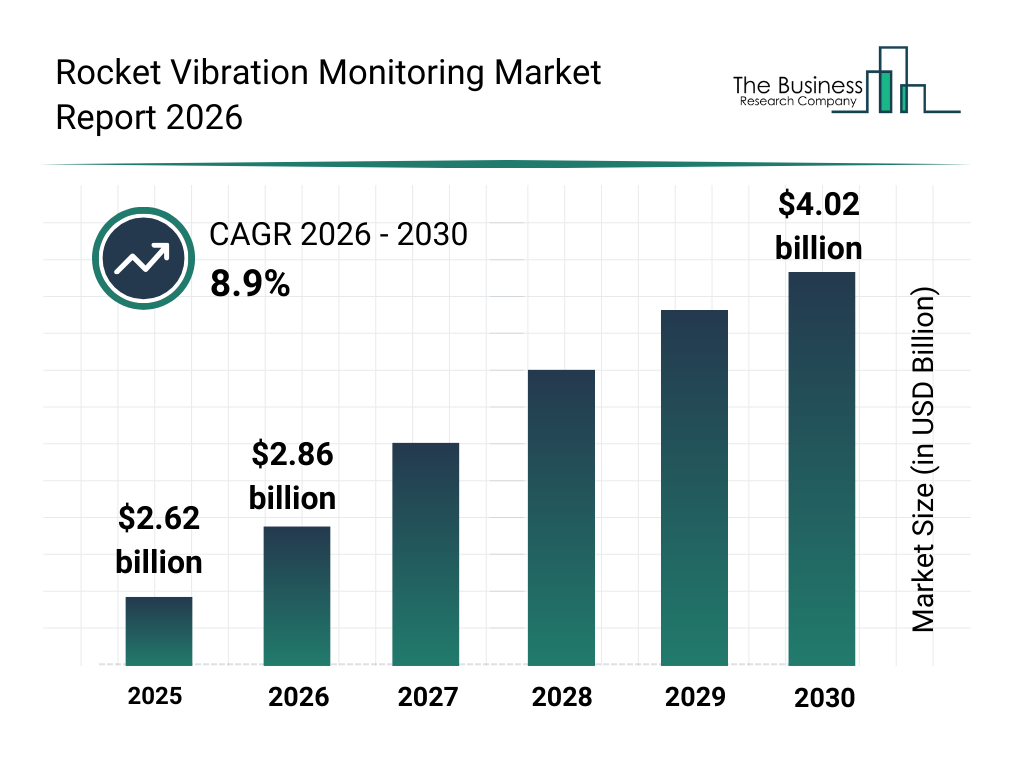
Rocket Vibration Monitoring Market Revenue Forecast: $2.86 Billion In 2026 Rising To $4.02 Billion In 2030
The rocket vibration monitoring market has experienced substantial expansion in recent years. It is expected to expand from $2.62 billion in 2025 to $2.86 billion in 2026, exhibiting a compound annual growth rate (CAGR) of 9.2%. This historical growth can be attributed to several factors, including the increasing complexity of rocket propulsion systems which fueled an early demand for vibration diagnostics. Other contributing elements were the development of vibration data loggers, enabling detailed measurement of launch-induced stresses, and the adoption of multi-axis accelerometers to capture comprehensive structural response profiles. Furthermore, the expansion of telemetry processing capabilities improved real-time vibration analysis, alongside the growth of government and commercial launch programs that necessitated rigorous sensor calibration services.
The rocket vibration monitoring market is projected to experience substantial expansion over the coming years. This market is anticipated to reach $4.02 billion by 2030, exhibiting a compound annual growth rate (CAGR) of 8.9%. This expansion during the projection period stems from several factors, including an increasing pace of commercial launches driving demand for continuous vibration monitoring, progress in condition-based maintenance boosting the dependability of reusable launch vehicles, new developments in rugged enclosures and sensors improving resilience in harsh conditions, the increasing adoption of AI-powered analytics enhancing the precision of anomaly detection, and the proliferation of autonomous flight systems necessitating more advanced real-time structural diagnostic capabilities. Key trends anticipated throughout this period encompass the development of high-precision multi-axis sensing, the broadening application of real-time telemetry diagnostics, a greater emphasis on condition-based maintenance, innovations in launch system vibration modeling, and improved methodologies for structural-vibration correlation.
Free Sample Report: Rocket Vibration Monitoring Market Size, Trends And Forecast To 2030:
Rocket Vibration Monitoring Market Growth Catalyst: What Is Creating New Demand?
The expanding volume of rocket launches is projected to fuel the future expansion of the rocket vibration monitoring market. Rocket launches involve the ascent of vehicles built to transport payloads like satellites, probes, or cargo into space. This surge in launches is primarily driven by the escalating demand for satellite deployment, with an increasing number of governments and private entities deploying satellites for purposes such as communication, Earth observation, navigation, and scientific studies. Rocket vibration monitoring assists these launches by continuously tracking and analyzing structural vibrations, guaranteeing the launch vehicle’s safety, stability, and peak performance during ascent, and facilitating the early identification of potential anomalies that might jeopardize mission success. For example, a report from the US-based non-profit organization Space Foundation stated that in January 2025, orbital launch attempts rose by 16% in 2024, totaling 259 launches, which translates to one launch every 34 hours – five hours more frequent than in 2023. Consequently, the rising frequency of rocket launches is propelling the expansion of the rocket vibration monitoring market.
Global Rocket Vibration Monitoring Market Driver: Rising Private Investments In Space Exploration Fuel The Market Growth Due To Increasing Funding For Advanced Launch Technologies
Rocket Vibration Monitoring Market Segment Overview: Categories Covered In The 2026 Report
The rocket vibration monitoring market covered in this report is segmented –
1) By Component: Sensors, Software, Services
2) By Application: Launch Vehicles, Satellites, Space Probes, Other Applications
3) By End-User: Commercial, Military, Government, Research Organizations
Subsegments:
1) By Sensors: Accelerometers, Velocity Sensors, Proximity Probes, Displacement Sensors, Strain Gauges, Piezoelectric Sensors, Micro-Electro-Mechanical Systems Sensors
2) By Software: Data Acquisition Software, Vibration Analysis Software, Signal Processing Software, Predictive Maintenance Software, Real-Time Monitoring Software, Simulation And Modeling Software
3) By Services: Installation And Calibration Services, Maintenance And Repair Services, Remote Monitoring Services, Data Analysis And Interpretation Services, Technical Support And Training, System Integration Services
Rocket Vibration Monitoring Market Players: Key Companies Shaping Competition
Major companies operating in the rocket vibration monitoring market are Honeywell International Inc., Parker Hannifin Corporation, Emerson Electric Co., Analog Devices Inc., SKF Group, Bruel & Kjaer Sound & Vibration Measurement A/S, Thermotron Industries, General Electric Company, Metrix Instrument Co. L.P., Unholtz-Dickie Corp., m+p international, SPM Instrument AB, Crystal Instruments, Data Physics Corporation, Team Corporation, ETS Solutions, IRF Kiruna, RMS Ltd., Kistler Group, Meisei Electric Co. Ltd.
Access Complete Rocket Vibration Monitoring Market Data, Forecasts And Competitive Insights:
Rocket Vibration Monitoring Market Regional Performance And Geographic Coverage
North America was the largest region in the rocket vibration monitoring market in 2025. Asia-Pacific is expected to be the fastest-growing region in the forecast period. The regions covered in the rocket vibration monitoring market report are Asia-Pacific, South East Asia, Western Europe, Eastern Europe, North America, South America, Middle East, Africa.
Reach Out To Our Team:
The Business Research Company: https://www.thebusinessresearchcompany.com/
Americas: +1 310-496-7795
Asia: +44 7882 955267 & +91 8897263534
Europe: +44 7882 955267
Email us at: marketing@tbrc.info
Follow us on:
LinkedIn: https://in.linkedin.com/company/the-business-research-company
YouTube: https://www.youtube.com/channel/UC24_fI0rV8cR5DxlCpgmyFQ
Global Market Model: https://www.thebusinessresearchcompany.com/global-market-model

Wasay has over a decade of experience in market research, data modelling, and analytics, with prior experience at GlobalData and Decision Tree Consulting Services. At The Business Research Company , he leads research operations across syndicated studies, customized consulting engagements, and the Global Market Model platform. His professional experience includes supporting organizations such as Boston Consulting Group, KPMG, and Ernst & Young. Wasay holds a degree in Electronics and Communications Engineering, postgraduate management qualifications from International Management Institute Belgium and Indian School of Business and Entrepreneurship, and completed the Integrated Program in Business Analytics from Indian Institute of Management Indore.

