
Featuring market attractiveness scoring, total addressable market sizing, company benchmarking matrices, interactive Excel dashboards, deeper supply chain intelligence, emerging startup tracking, and granular product-level insights, The Business Research Company’s 2026 market reports are built to deliver research that is both more actionable and more strategically valuable.
Satellite-As-A-Service (SataaS) Market Size And Revenue Outlook Through 2030
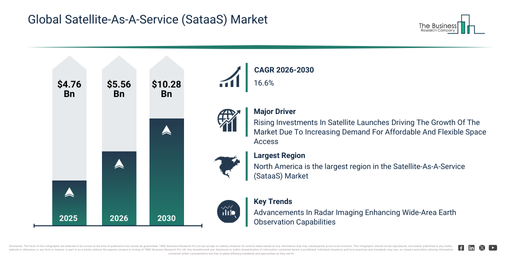
The satellite-as-a-service (sataas) market has experienced significant growth in recent years. This market is projected to expand from $4.76 billion in 2025 to $5.56 billion by 2026, reflecting a compound annual growth rate (CAGR) of 16.9%. Historically, this growth can be attributed to the proliferation of subscription-based satellite data services, its uptake in the agriculture and defense sectors, the evolution of ground station access platforms, the escalating demand for remote sensing and analytics, and the emergence of service aggregators facilitating connections between satellite operators and end users.
The satellite-as-a-service (sataas) market is projected for significant expansion in the coming years. This market is anticipated to reach $10.28 billion by 2030, demonstrating a compound annual growth rate (CAGR) of 16.6%. Several factors will drive this growth during the forecast period, including the broadening of IoT connectivity through satellite-as-a-service, advancements in on-demand mission management and data processing, integration with AI-based analytics platforms, increasing adoption across new commercial sectors, and enhanced global satellite coverage for sataaS offerings. Key trends expected in the same period encompass a move towards comprehensive mission-as-a-service solutions, rising uptake of standardized and modular satellite platforms, an increase in private-public co-funding arrangements for satellite services, industry consolidation alongside strategic alliances throughout the satellite value chain, and the expansion of multi-orbit (LEO/MEO/GEO) service portfolios.
Get A Free Sample Report With In-Depth Market Insights:
Satellite-As-A-Service (SataaS) Market Growth Catalysts And Demand Drivers
The future expansion of the satellite-as-a-service (SataaS) market is anticipated, fueled by increasing investments in satellite launches. Satellite launches involve placing satellites into various orbits utilizing either disposable or reusable launch vehicles for diverse purposes like communications, Earth observation, and navigation. Increased funding for satellite launches stems from a growing need for adaptable and cost-effective access to space, a demand propelled by innovations in reusable launch technologies and the proliferation of small satellite constellations. Satellite-as-a-service supports satellite launches by providing comprehensive services, such as mission oversight, ground activities, and data provision, thereby enhancing the commercial feasibility and accessibility of launches for various entities. An example of this trend is observed in January 2024, when the Space Foundation, a US-based non-profit organization, reported that commercial launches in 2023 saw a 50% increase from the previous year, 2022. Consequently, the uptick in satellite launch investments is a key factor propelling the expansion of the satellite-as-a-service (SataaS) market.
Satellite-As-A-Service (SataaS) Market Segment Landscape And Growth Outlook
The satellite-as-a-service (sataas) market covered in this report is segmented –
1) By Services: Satellite Launch, Payload Design And Integration, Ground Station Management, Data Processing And Management, Satellite Operations Management
2) By Type: Small Satellites, Large Satellites
3) By Application: Satellite Internet Of Things, Earth Observation, Ship Tracking, Air Traffic Monitoring, Weather Forecasting, Other Applications
4) By End Use Industry: Media And Entertainment, Government, Aviation, Defense, Transportation And Logistics, Other End Use Industries
Subsegments:
1) By Satellite Launch: Ride-Sharing Launch Services, Dedicated Launch Services, Small Satellite Launch Services, Reusable Launch Services
2) By Payload Design And Integration: Custom Payload Design, Standardized Payload Modules, Integration And Testing Services, Hosted Payloads
3) By Ground Station Management: Ground Station Infrastructure Hosting, Antenna And RF Management, Network Connectivity Services, Ground Station-As-A-Service (GSaaS)
4) By Data Processing And Management: Data Acquisition And Downlink Services, Data Storage And Archiving, Data Analytics And Visualization, Cloud-Based Data Services
5) By Satellite Operations Management: Mission Planning And Scheduling, Satellite Health Monitoring, Telemetry, Tracking, And Command (TT&C), End-Of-Life And Deorbiting Services
Satellite-As-A-Service (SataaS) Market Trends Shaping Long-Term Demand
Major companies within the satellite-as-a-service (SataaS) market are prioritizing the development of advanced solutions, including synthetic aperture radar imaging modes, to enhance wide-area Earth observation capabilities across all weather conditions and at any point in the day. Synthetic aperture radar imaging modes are sophisticated radar-based observation methods that allow satellites to capture exceptionally large sections of Earth’s surface in a single, high-detail image, thereby supporting applications in maritime monitoring, disaster response, and defense intelligence. As an example, in August 2024, ICEYE, a Finland-based synthetic aperture radar satellite operator, deployed four new satellites into orbit. These new satellites not only expand ICEYE’s own constellation but also support both commercial and client-specific missions. They come equipped with advanced radar payloads capable of acquiring very wide-area images covering up to 60,000 km² in a single scene, with the potential to extend coverage up to 120,000 km² using multi-frame tasking. These satellites are engineered to reinforce global monitoring services by offering customers versatile imaging modes for maritime surveillance, environmental monitoring, and national security uses.
Satellite-As-A-Service (SataaS) Market Competitive Landscape: Who Leads The Industry?
Major companies operating in the satellite-as-a-service (sataas) market are Amazon.com Inc., SES S.A, SpaceX Corp., Eutelsat Communications SA, Spacety, Telesat, OneWeb, Planet Labs PBC, York Space Systems LLC, Loft Orbital, EnduroSat EAD, Spire Global Inc., Capella Space, NanoAvionics LLC, Kepler Communications Inc., BlackSky Technology Inc., Hawkeye 360 Inc., Astro Digital Inc., Satellogic Inc., SKY Perfect JSAT Holdings Inc.
View The Full Satellite-As-A-Service (SataaS) Market Report:
Satellite-As-A-Service (SataaS) Market Regional Split: Which Areas Are Fueling Growth?
North America was the largest region in the satellite-as-a-service (SataaS) market in 2025. Asia-Pacific is expected to be the fastest-growing region in the forecast period. The regions covered in the satellite-as-a-service (sataas) market report are Asia-Pacific, South East Asia, Western Europe, Eastern Europe, North America, South America, Middle East, Africa.
Reach Out To Our Team:
The Business Research Company: https://www.thebusinessresearchcompany.com/
Americas: +1 310-496-7795
Asia: +44 7882 955267 & +91 8897263534
Europe: +44 7882 955267
Email us at: marketing@tbrc.info
Follow us on:
LinkedIn: https://in.linkedin.com/company/the-business-research-company
YouTube: https://www.youtube.com/channel/UC24_fI0rV8cR5DxlCpgmyFQ
Global Market Model: https://www.thebusinessresearchcompany.com/global-market-model

Wasay has over a decade of experience in market research, data modelling, and analytics, with prior experience at GlobalData and Decision Tree Consulting Services. At The Business Research Company , he leads research operations across syndicated studies, customized consulting engagements, and the Global Market Model platform. His professional experience includes supporting organizations such as Boston Consulting Group, KPMG, and Ernst & Young. Wasay holds a degree in Electronics and Communications Engineering, postgraduate management qualifications from International Management Institute Belgium and Indian School of Business and Entrepreneurship, and completed the Integrated Program in Business Analytics from Indian Institute of Management Indore.
