
Delivering more actionable and strategically valuable research, The Business Research Company’s 2026 market reports feature market attractiveness analysis, total addressable market evaluation, company benchmarking matrices, interactive Excel dashboards, expanded supply chain intelligence, emerging startup coverage, and detailed product insights.
Satellite Propulsion System Market Expansion From $6.92 Billion In 2026 To $12.22 Billion In 2030
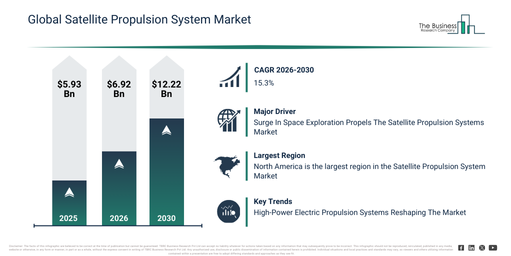
The market size for satellite propulsion systems has expanded swiftly over recent years. It is anticipated to increase from $5.93 billion in 2025 to $6.92 billion in 2026, achieving a compound annual growth rate (CAGR) of 16.6%. This historical expansion can be attributed to several factors, including the increasing deployment of satellites that require dependable station-keeping propulsion systems, a rise in the application of hydrazine monopropellant thrusters for orbital maneuvering, continuous advancements in chemical propulsion technologies leading to improved thrust efficiency, the enlargement of commercial and government satellite programs which boosts the demand for propulsion components such as propellers and turbines, and a growing necessity for orbit adjustment and attitude control in communication and earth observation satellites.
The satellite propulsion system market is projected for swift expansion in the coming years. By 2030, this market is forecast to reach $12.22 billion, exhibiting a compound annual growth rate (CAGR) of 15.3%. This anticipated growth during the forecast timeframe is attributable to several factors, including the increasing integration of electric propulsion systems that provide superior fuel efficiency for both small and large satellites. Additionally, there is a rising need for lightweight, high-performance propulsion options to support mega-constellations, alongside advancements in hybrid propulsion technologies that facilitate adaptable mission profiles. The growing number of satellite launches is also fueling the demand for sophisticated propulsion subsystems, while the expansion of in-orbit servicing and debris mitigation efforts is boosting the need for accurate and efficient maneuvering capabilities. Key trends during this period encompass the increased use of electric propulsion for highly efficient orbital maneuvers, a burgeoning demand for eco-friendly propellants as substitutes for hydrazine, and the expanding deployment of small satellites necessitating compact propulsion modules. Furthermore, the integration of modular propulsion subsystems for missions involving multiple orbits and the broader scope of in-orbit servicing, which requires advanced maneuvering functionalities, are significant developments.
Download A Free Sample Report For Comprehensive Market Insights:
Satellite Propulsion System Market Expansion Supported By Key Demand Factors
The increasing trend in space exploration is projected to boost the demand for satellite propulsion systems in the future. Space exploration encompasses the investigation and discovery of celestial bodies through continuously evolving and expanding space technologies. The expansion of space exploration is attributed to an escalating demand for scientific discoveries, commercial prospects, and technological innovations that enable humanity to reach beyond Earth. Advanced satellite propulsion systems play a crucial role in space exploration, enhancing deep space capabilities by facilitating travel through space and enabling precise landings. For instance, in January 2025, a report from the Space Foundation, a US-based non-profit organization, indicated that orbital launch attempts rose by 16% in 2024, with 259 launches occurring at an average of one every 34 hours, which was five hours more frequent than in 2023. Therefore, the advancement in space exploration is a key driver for the satellite propulsion systems market.
Satellite Propulsion System Market Segmentation And Category Breakdown
The satellite propulsion system market covered in this report is segmented –
1) By Type: Chemical Propulsion, Electric Propulsion, Hybrid Propulsion, Other Types
2) By Orbit: Low Earth Orbit (LEO), Medium Earth Orbit (MEO), Geostationary Earth Orbit (GEO), Beyond Geosynchronous Orbit
3) By Application: Commercial Use, Science And Environment, National Security And Military, Meteorology, Other Applications
Subsegments:
1) By Chemical Propulsion: Monomethyl Hydrazine (MMH), Hydrazine, Hypergolic Propellants, Solid Propellant Systems
2) By Electric Propulsion: Ion Thrusters, Hall Effect Thrusters, Pulsed Plasma Thrusters
3) By Hybrid Propulsion: Hybrid Rocket Motors, Hybrid Electric Propulsion Systems
4) By Other Types: Cold Gas Thrusters, Green Propulsion Systems, Solar Sail Propulsion
Satellite Propulsion System Market Strategic Trends: What Is Defining The Next Phase Of Growth?
Leading companies in the satellite propulsion systems market are actively developing novel propulsion technologies, such as electric propulsion systems, to achieve a competitive advantage. Electric propulsion systems are a class of technology utilized in spacecraft and satellites that generate thrust using electrical or electromagnetic principles. As an example, in January 2023, APT Satellite Holdings, a Hong Kong-based satellite telecommunications firm, launched its APSTAR-6E satellite from the Xichang Satellite Launch Center. The APSTAR-6E communication satellite is equipped with a high-power electric propulsion system. Noteworthy as China’s first all-electric satellite, this system incorporates advanced ion and Hall electric propulsion technology. The satellite, designed for a 15-year operational period, functions autonomously and discards all its rocket engines once in near-earth orbit. This specific propulsion system enhances efficiency and extends the satellite’s operational life. Moreover, the satellite employs artificial intelligence to guarantee efficient and dependable high-speed communication services for users across Southeast Asia, delivering a total bandwidth exceeding 30 Gbps.
Satellite Propulsion System Market Leading Companies Driving Competitive Growth
Major companies operating in the satellite propulsion system market are Airbus SAS, Aerojet Rocketdyne Holdings Inc., Moog Inc., Busek Co Inc., Bellatrix Aerospace Private Limited, Exotrail SA, ENPULSION GmbH, Cobham Limited, Ball Corporation, The Boeing Company, Mitsubishi Electric Corporation, OHB System AG, Safran S A, Thales Group, Northrop Grumman Corporation, CU Aerospace, Rocket Lab, Rafael Advanced Defense Systems Ltd., Ariane Group, General Dynamics Mission Systems, Blue Origin, Lockheed Martin Corporation, Bradford Space, Sierra Nevada Corporation, Clyde Space Ltd., Comtech AeroAstro Inc., Dawn Aerospace, Deep Space Industries, Firefly Aerospace, General Atomics Electromagnetic Systems
Access The Complete Satellite Propulsion System Market Report:
#Satellite Propulsion System Market Largest Region: Which Geography Holds The Highest Market Share?
North America was the largest region in the satellite propulsion system market in 2025. The regions covered in the satellite propulsion system market report are Asia-Pacific, South East Asia, Western Europe, Eastern Europe, North America, South America, Middle East, Africa.
Access a Customized Satellite Propulsion System Market Report for Deeper Competitive Insights
https://www.thebusinessresearchcompany.com/customise?id=9300&type=smp
The Business Research Company: https://www.thebusinessresearchcompany.com/
Americas: +1 310-496-7795
Asia: +44 7882 955267 & +91 8897263534
Europe: +44 7882 955267
Email us at: marketing@tbrc.info
Follow us on:
LinkedIn: https://in.linkedin.com/company/the-business-research-company
YouTube: https://www.youtube.com/channel/UC24_fI0rV8cR5DxlCpgmyFQ
Global Market Model: https://www.thebusinessresearchcompany.com/global-market-model

Wasay has over a decade of experience in market research, data modelling, and analytics, with prior experience at GlobalData and Decision Tree Consulting Services. At The Business Research Company , he leads research operations across syndicated studies, customized consulting engagements, and the Global Market Model platform. His professional experience includes supporting organizations such as Boston Consulting Group, KPMG, and Ernst & Young. Wasay holds a degree in Electronics and Communications Engineering, postgraduate management qualifications from International Management Institute Belgium and Indian School of Business and Entrepreneurship, and completed the Integrated Program in Business Analytics from Indian Institute of Management Indore.
