
Backed by market attractiveness analysis, total addressable market sizing, company benchmarking matrices, interactive Excel dashboards, wider supply chain intelligence, emerging startup coverage, and detailed product-level insights, The Business Research Company’s 2026 market reports are designed to offer research that is more actionable and strategically valuable than ever.
Seabed Security Market Size And Revenue Outlook Through 2030
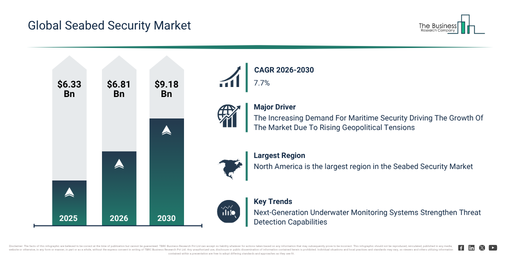
The seabed security market has experienced substantial growth in recent years. It is projected to expand from $6.33 billion in 2025 to $6.81 billion in 2026, with a compound annual growth rate (CAGR) of 7.5%. Historically, this market expansion has been driven by increasing offshore oil and gas exploration, rising submarine cable installations, the adoption of ROVs and AUVs for inspection, growth in offshore renewable energy projects, and rising government and defense monitoring initiatives.
The seabed security market is projected to experience substantial expansion in the coming years, reaching $9.18 billion by 2030 at a compound annual growth rate (CAGR) of 7.7%. This growth during the forecast period is propelled by several factors, including the escalating demand for securing deep and ultra-deepwater infrastructure, the increased adoption of AI-powered threat detection software, the broadening of remote monitoring and analytics functionalities, the rising incorporation of IoT-enabled underwater sensors, and a surge in investments directed towards subsea security services. Key trends anticipated during this period encompass the growing uptake of real-time subsea monitoring systems, the increased deployment of autonomous underwater vehicles for security purposes, the deepening integration of threat detection software with existing infrastructure, the expansion of maintenance and consulting services pertinent to subsea assets, and an elevated focus on safeguarding vital submarine communication cables.
Get A Free Sample Report With In-Depth Market Insights:
Seabed Security Market Expansion Drivers: What’s Shaping Future Growth?
The expanding need for maritime security is projected to fuel the advancement of the seabed security market in the future. Maritime security involves safeguarding a country’s oceanic territory, encompassing its waterways, harbors, ships, offshore infrastructure, and digital frameworks, from dangers like piracy, terrorism, illicit trafficking, unlawful operations, and cyber incidents, thereby guaranteeing safe and protected navigation and commerce. This growing requirement for maritime security mainly stems from escalating geopolitical instability, given that disagreements concerning maritime borders, vital sea lanes, and offshore resources amplify the potential for conflicts, piratical acts, and cyber dangers, thus requiring enhanced monitoring and safeguarding protocols. Seabed security supports maritime security by enabling the oversight and defense of essential underwater facilities and facilitating the prompt identification of subsea threats or unapproved actions, consequently enhancing observation, protecting communications, and reinforcing comprehensive maritime safety and defense. For instance, in October 2023, according to the Offshore Energy Exhibition & Conference (OEEC), a Netherlands-based event management company, the average cost of a cyberattack in the maritime industry increased from $182,000 in 2022 to $550,000 in 2023. Consequently, the heightened need for maritime security is propelling the expansion of the seabed security market.
Seabed Security Market Segment Outlook: Which Categories Are Growing Fastest?
The seabed security market covered in this report is segmented –
1) By Component: Hardware, Software, Services
2) By Depth Of Operation: Shallow And Mid Water, Deep Water, Ultra-Deep Water
3) By Deployment Type: Permanent Installations, Submarine Communication Cables, Oil And Gas Pipelines, Offshore Energy Infrastructure, Military And Defense Assets, Scientific And Research Infrastructure, Other Subsea Infrastructure
4) By Industry: Telecommunications Companies, Oil And Gas Companies, Renewable Energy Developers And Operators, Government And Defense Agencies, Marine Research And Scientific Institutions
Subsegments:
1) By Hardware: Sonar Systems, Underwater Sensors, Autonomous Underwater Vehicles, ROVs
2) By Software: Threat Detection Software, Navigation Software, Data Analytics Software, Monitoring And Surveillance Software
3) By Services: Installation Services, Maintenance Services, Consulting Services, Training Services
Seabed Security Market Strategic Trends: What Defines The Next Growth Phase?
Major companies operating in the seabed security market are prioritizing advancements in underwater surveillance systems, including underwater early warning sensor networks, to identify intrusions or anomalies and provide immediate alerts regarding potential threats. An underwater early warning sensor network is characterized as a system of subsea sensors and detection devices deployed across strategic underwater areas to monitor and protect critical seabed infrastructure, with networked communication linking these sensors to a central command center for real-time data analysis and alerting. For instance, in October 2025, Fincantieri S.p.A., an Italy-based shipbuilding and defense company, introduced the DEEP underwater drone system, an advanced seabed security solution crafted to enhance the protection of vital underwater infrastructure. This system incorporates an early-warning sensor network for continuous subsea oversight, autonomous underwater vehicles (AUVs) for swift anomaly detection and inspection, and a centralized command-and-control platform that leverages real-time data integration and AI-driven analytics to pinpoint and prioritize potential threats. It provides scalable, persistent security for assets such as pipelines and submarine cables, while offering flexible, modular deployment for both shore-based and fixed installations. Furthermore, the system supports dual-use applications spanning civil and defense sectors and can be smoothly integrated with existing maritime surveillance networks to improve situational awareness and facilitate quicker responses across extensive seabed areas.
Seabed Security Market Industry Leaders And Competitive Landscape
Major companies operating in the seabed security market are Thales Group, Teledyne Technologies, Covelya Group, AP Sensing, Optics11, ATLAS ELEKTRONIK GmbH, Sintela Limited, Royal IHC, Anduril, TIM Groups, RTX Corporation, Northrop Grumman, L3Harris Technologies, Inc, AXISCADES, Elbit Systems Limited, L3Harris Technologies, Inc., Fugro N.V., Oceaneering International, Inc., BAE Systems plc, General Dynamics Corporation, Leonardo S.p.A., Kongsberg Gruppen, Saab AB.
View The Full Seabed Security Market Report:
Seabed Security Market Regional Analysis And Top Geography
North America was the largest region in the seabed security market in 2025. Asia-Pacific is expected to be the fastest-growing region in the forecast period. The regions covered in the seabed security market report are Asia-Pacific, South East Asia, Western Europe, Eastern Europe, North America, South America, Middle East, Africa.
Reach Out To Our Team:
The Business Research Company: https://www.thebusinessresearchcompany.com/
Americas: +1 310-496-7795
Asia: +44 7882 955267 & +91 8897263534
Europe: +44 7882 955267
Email us at: marketing@tbrc.info
Follow us on:
LinkedIn: https://in.linkedin.com/company/the-business-research-company
YouTube: https://www.youtube.com/channel/UC24_fI0rV8cR5DxlCpgmyFQ
Global Market Model: https://www.thebusinessresearchcompany.com/global-market-model

Wasay has over a decade of experience in market research, data modelling, and analytics, with prior experience at GlobalData and Decision Tree Consulting Services. At The Business Research Company , he leads research operations across syndicated studies, customized consulting engagements, and the Global Market Model platform. His professional experience includes supporting organizations such as Boston Consulting Group, KPMG, and Ernst & Young. Wasay holds a degree in Electronics and Communications Engineering, postgraduate management qualifications from International Management Institute Belgium and Indian School of Business and Entrepreneurship, and completed the Integrated Program in Business Analytics from Indian Institute of Management Indore.