The Business Research Company’s 2026 market reports are designed to deliver research that is more actionable and strategically valuable. Key offerings include market attractiveness scoring, total addressable market sizing, company benchmarking matrices, interactive Excel dashboards, deeper supply chain intelligence, emerging startup tracking, and granular product-level insights.
Aerospace Nanotechnology Market Size, Growth Rate And Key Forecast Highlights For 2026–2030
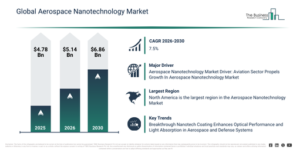
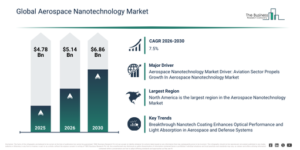
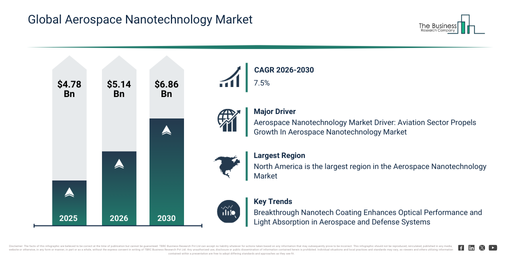
The aerospace nanotechnology market has demonstrated robust growth in recent years. It is anticipated to increase from $4.78 billion in 2025 to $5.14 billion in 2026, registering a compound annual growth rate (CAGR) of 7.5%. The expansion observed historically can be attributed to several factors, including the early adoption of nanomaterials such as carbon nanotubes to enhance sensor performance in aircraft, a growing requirement for miniaturized sensors to monitor complex engine and structural parameters, the initial integration of nanoclays and nanofibers to improve material strength and thermal stability, an increasing emphasis on lightweight materials to support aerospace efficiency goals, and the development of graphene-based components enabling improved electrical and mechanical properties.
The aerospace nanotechnology market is projected to experience substantial expansion in the coming years. Its valuation is anticipated to reach $6.86 billion by 2030, demonstrating a compound annual growth rate (CAGR) of 7.5%. This anticipated growth during the forecast period is driven by several factors, including the rising need for advanced nanosensors to facilitate real-time health monitoring of aircraft systems, the increasing utilization of high-performance nanomaterials in next-generation aerospace structures, expanded research into graphene’s multifunctional applications for avionics and propulsion systems, greater integration of nanotechnology in composite manufacturing for improved durability and reduced weight, and technological progress that allows for the scalable production of aerospace-grade nanomaterials. Key trends expected during this period involve the incorporation of carbon nanotubes into aerospace sensors, broader application of graphene for manufacturing lightweight components, the development of nanoclays for enhancing structural reinforcement, the miniaturization of aircraft monitoring devices, and the integration of nanomaterials into engine performance analytical tools.
See What’s Inside The Aerospace Nanotechnology Market Report With A Free Sample:
Aerospace Nanotechnology Market Expansion: The Major Factor Driving Growth
The anticipated vigorous expansion of the aviation industry is projected to boost the aerospace nanotechnology market moving ahead. This sector encompasses both private and public enterprises engaged in manufacturing hardware or software for the aviation or aerospace domain, offering maintenance, repair, and overhaul services, supplying components to the aviation or aerospace industry, undertaking research and development of aviation or aerospace technology systems, and educating and training aviation or aerospace staff. Within the aviation sector, aerospace nanotechnology finds application in achieving lightweight structures, providing improved aircraft protection against challenging materials, and enabling sensors for monitoring an aircraft’s fuel levels, temperature, and engines. As an illustration, a report released by Aircraft Interiors International, a UK-based media firm, in January 2024 indicated that aircraft orders saw a 91% increase in 2023 relative to 2022. This was primarily due to a 78% increase in single-aisle aircraft orders and a 169% jump in widebody aircraft orders. Furthermore, new aircraft deliveries totaled 1,265 units in 2023, representing an 11% rise year-over-year. Consequently, the robust expansion of the aviation sector is propelling the aerospace nanotechnology market.
Understanding Aerospace Nanotechnology Market Segmentation For Strategic Planning
The aerospace nanotechnology market covered in this report is segmented –
1) By Nanomaterial Type: Nanoparticles, Nanocoatings, Other Nanomaterial Types
2) By Material: Alloys, Ceramics, Composites, Polymers
3) By Applications: Space And Defense, Commercial Aviation
Subsegments:
1) By Nanoparticles: Metallic Nanoparticles, Ceramic Nanoparticles, Polymeric Nanoparticles, Composite Nanoparticles
2) By Nanocoatings: Anti-corrosion Coatings, Thermal Barrier Coatings, Self-cleaning Coatings, Anti-fogging Coatings
3) By Other Nanomaterial Types: Nanofibers, Nanotubes, Nanocomposites
Key Aerospace Nanotechnology Market Trends To Watch In 2026
Leading companies in the aerospace nanotechnology market are concentrating on developing innovative solutions, such as advanced nanomaterials for optical and defense systems, to boost performance, durability, and efficiency in aerospace applications. These advanced nanomaterials, designed at the nanoscale, are engineered to enhance characteristics like light absorption, thermal resistance, and strength, thereby enabling aerospace components to be lighter, more resilient, and more efficient than traditional materials. For instance, in May 2025, STRAYPROTECT S.A., a Luxembourg-based startup and spin-off from the Luxembourg Institute of Science and Technology (LIST), launched STRAYPROTECT Nanotech. This groundbreaking super-black coating absorbs 99.4% of light to improve optical performance in aerospace and defense applications. Developed using advanced carbon nanostructures, this innovative coating functions as a “light sponge,” effectively eliminating unwanted reflections that can distort data in high-precision optical devices like telescopes, sensors, and imaging systems. Originating from a collaboration with the European Space Agency (ESA) and the Luxembourg Space Agency (LSA), the technology has achieved Technology Readiness Level 5 (TRL 5), confirming its functionality under real-world conditions.
Key Companies Active In The Aerospace Nanotechnology Market
Major companies operating in the aerospace nanotechnology market are Airbus SE, CHOOSE NanoTech Corporation, Flight Shield Inc., HR ToughGuard LLC, Lockheed Martin Corporation, Metamaterial Technologies Inc., TripleO Performance Solution Ltd., Zyvex Corp., Huntsman International LLC, Nanotechnology Company Glonatech SA, General Nano LLC, Raymor Industries Inc., Boeing Company, Northrop Grumman Corporation, General Electric Company, Rolls-Royce Holdings plc, Safran S.A., Raytheon Technologies Corporation, Honeywell International Inc., BAE Systems plc, Thales Group, Leonardo S.p.A., Saab AB, Israel Aerospace Industries Ltd., Dassault Aviation SA, AeroVironment Inc., Mitsubishi Heavy Industries Ltd., Ruag Group, Reaction Engines Ltd.
Explore Detailed Aerospace Nanotechnology Market Research And Forecasts:
Which Geography Dominates The Aerospace Nanotechnology Market?
North America was the largest region in the aerospace nanotechnology market in 2025. The regions covered in the aerospace nanotechnology market report are Asia-Pacific, South East Asia, Western Europe, Eastern Europe, North America, South America, Middle East, Africa.
Reach Out To Our Team:
The Business Research Company: https://www.thebusinessresearchcompany.com/
Americas: +1 310-496-7795
Asia: +44 7882 955267 & +91 8897263534
Europe: +44 7882 955267
Email us at: marketing@tbrc.info
Follow us on:
LinkedIn: https://in.linkedin.com/company/the-business-research-company
YouTube: https://www.youtube.com/channel/UC24_fI0rV8cR5DxlCpgmyFQ
Global Market Model: https://www.thebusinessresearchcompany.com/global-market-model

Wasay has over a decade of experience in market research, data modelling, and analytics, with prior experience at GlobalData and Decision Tree Consulting Services. At The Business Research Company , he leads research operations across syndicated studies, customized consulting engagements, and the Global Market Model platform. His professional experience includes supporting organizations such as Boston Consulting Group, KPMG, and Ernst & Young. Wasay holds a degree in Electronics and Communications Engineering, postgraduate management qualifications from International Management Institute Belgium and Indian School of Business and Entrepreneurship, and completed the Integrated Program in Business Analytics from Indian Institute of Management Indore.