Enhanced with market attractiveness analysis, total addressable market evaluation, company benchmarking matrices, interactive Excel dashboards, expanded supply chain intelligence, emerging startup coverage, and detailed product insights, The Business Research Company’s 2026 market reports deliver more actionable and strategically valuable research.
Signal Jammer Market Size Outlook: How Fast Will Revenue Grow Through 2030?
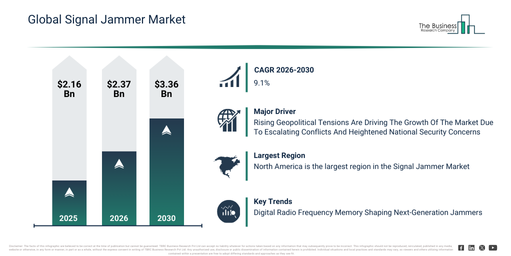
The signal jammer market is anticipated to experience substantial expansion in the coming years. Projections indicate its value will reach $3.36 billion by 2030, driven by a compound annual growth rate (CAGR) of 9.1%. This anticipated growth during the forecast period is fueled by several factors, including broader use in protecting critical infrastructure, the emergence of intelligent adaptive jamming technologies, its extended application in disrupting drone and vehicle signals, its incorporation into security and law enforcement activities, and a rise in demand from government and defense sectors. Key trends for this period encompass the increasing deployment of multi-band and multi-mode signal jammers, a heightened need for portable and handheld jamming devices, the widening scope of anti-drone and UAV-specific jamming solutions, stricter regulatory control and licensing requirements for jammer implementation, and the growing establishment of jamming systems in prisons and critical infrastructure sites.
Heightened geopolitical tensions are anticipated to drive the expansion of the signal jammer market moving ahead. These tensions describe intensifying political and military clashes among countries or regions, frequently resulting in conflict or instability. Major power competition and territorial disagreements are primary contributors to these escalating tensions, as countries focus more on national security and engage in strategic rivalry, which erodes conventional diplomatic collaboration. By interfering with communications and electronic signals, a signal jammer impacts geopolitical tension, making coordination and information exchange difficult in disputed territories. For example, data from February 2024, provided by the Stockholm International Peace Research Institute (SIPRI), a Sweden-based international research organization, showed a rise in conflict fatalities from 153,100 in 2022 to 170,700 in 2023, indicating increased severity across various global conflict zones. Consequently, an increase in geopolitical tensions is fueling the expansion of the signal jammer market.
Download A Free Sample Report For Comprehensive Market Insights:
Signal Jammer Market Growth Drivers: What Factors Are Accelerating Expansion?
Leading firms within the signal jammer market are prioritizing technological innovations, particularly digital radio frequency memory (DRFM), to secure a competitive edge. This DRFM technology functions as an an electronic method for capturing, storing, and subsequently re-transmitting radio frequency signals while minimizing distortion. An illustrative example occurred in April 2023, when DroneShield Ltd., an Australian defense technology enterprise, introduced the DroneGun Mk4. This handheld jamming device, which weighs approximately 3.2 kg, allows for single-handed operation and is designed to disrupt control, video, and GNSS links across multiple bands. It also includes mission-configurable indicators to provide quick feedback to the operator, rendering it appropriate for tactical deployment in busy settings. Despite ongoing challenges, such as regulatory restrictions on jamming, potential interference with authorized services, and export limitations in non-military applications, this introduction enhances counter-drone functionalities by providing a lightweight, portable system capable of precisely disrupting numerous frequency bands and facilitating quick deployment in tactical scenarios.
Signal Jammer Market Segmentation: How Is The Market Structured Across Key Categories?
The signal jammer market covered in this report is segmented –
1) By Type: Handheld Signal Jammers, Vehicle Mounted Signal Jammers, Fixed Signal Jammers
2) By Technology: Radio Frequency Jammers, Global Positioning System Jammers, Cellular Jammers, Wi-Fi Jammers
3) By Frequency Band: Very High Frequency (VHF), Ultra-High Frequency (UHF), High Frequency (HF), Other Frequency Bands
4) By Application: Military And Defense, Law Enforcement, Commercial, Other Applications
5) By End-User: Government Agencies, Private Security Films, Industrial Organizations, Individuals
Subsegments:
1) By Handheld Signal Jammers: Portable Jammers, Pocket Jammers, Drone Jammers
2) By Vehicle Mounted Signal Jammers: Car Jammers, Truck Jammers, Military Vehicle Jammers
3) By Fixed Signal Jammers: Indoor Jammers, Outdoor Jammers, Perimeter Jammers
Signal Jammer Market Strategic Trends: What Is Defining The Next Phase Of Growth?
Leading firms within the signal jammer market are prioritizing technological innovations, particularly digital radio frequency memory (DRFM), to secure a competitive edge. This DRFM technology functions as an an electronic method for capturing, storing, and subsequently re-transmitting radio frequency signals while minimizing distortion. An illustrative example occurred in April 2023, when DroneShield Ltd., an Australian defense technology enterprise, introduced the DroneGun Mk4. This handheld jamming device, which weighs approximately 3.2 kg, allows for single-handed operation and is designed to disrupt control, video, and GNSS links across multiple bands. It also includes mission-configurable indicators to provide quick feedback to the operator, rendering it appropriate for tactical deployment in busy settings. Despite ongoing challenges, such as regulatory restrictions on jamming, potential interference with authorized services, and export limitations in non-military applications, this introduction enhances counter-drone functionalities by providing a lightweight, portable system capable of precisely disrupting numerous frequency bands and facilitating quick deployment in tactical scenarios.
Signal Jammer Market Competitive Landscape And Leading Companies
Major companies operating in the signal jammer market are Lockheed Martin Corporation, Northrop Grumman Corporation, BAE Systems plc, Thales Group SA, L3 Harris Technologies Inc., Leonardo SPA, Israel Aerospace Industries Ltd., Saab AB, Rohde And Schwarz GmbH & Co. KG, SPX Corporation, Kvertus, Wolves Fleet Technology, Mctech Technology, Homeland Security Solutions Inc., Security Pro USA, Startign FZE, Texin Electronics, Jammers Pro, Texin, Jammer store.
Access The Complete Signal Jammer Market Report:
Signal Jammer Market Regional Analysis: Which Region Leads By Revenue?
North America was the largest region in the signal jammer market in 2025. Asia-Pacific is expected to be the fastest-growing region in the forecast period. The regions covered in the signal jammer market report are Asia-Pacific, South East Asia, Western Europe, Eastern Europe, North America, South America, Middle East, Africa.
Access a Customized Signal Jammer Market Report for Deeper Competitive Insights
https://www.thebusinessresearchcompany.com/customise?id=28817&type=smp
The Business Research Company: https://www.thebusinessresearchcompany.com/
Americas: +1 310-496-7795
Asia: +44 7882 955267 & +91 8897263534
Europe: +44 7882 955267
Email us at: marketing@tbrc.info
Follow us on:
LinkedIn: https://in.linkedin.com/company/the-business-research-company
YouTube: https://www.youtube.com/channel/UC24_fI0rV8cR5DxlCpgmyFQ
Global Market Model: https://www.thebusinessresearchcompany.com/global-market-model

Wasay has over a decade of experience in market research, data modelling, and analytics, with prior experience at GlobalData and Decision Tree Consulting Services. At The Business Research Company , he leads research operations across syndicated studies, customized consulting engagements, and the Global Market Model platform. His professional experience includes supporting organizations such as Boston Consulting Group, KPMG, and Ernst & Young. Wasay holds a degree in Electronics and Communications Engineering, postgraduate management qualifications from International Management Institute Belgium and Indian School of Business and Entrepreneurship, and completed the Integrated Program in Business Analytics from Indian Institute of Management Indore.