Built to provide research that’s more actionable and strategically valuable, The Business Research Company’s 2026 market reports include market attractiveness analysis, total addressable market sizing, company benchmarking matrices, interactive Excel dashboards, broader supply chain intelligence, emerging startup tracking, and in-depth product insights.
#Small Satellite Market Size Forecast: How Big Could The Market Get By 2030?#_x000D_
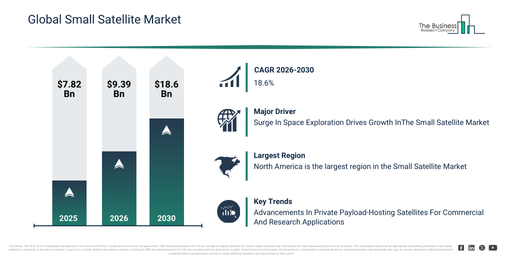
The small satellite market has experienced rapid expansion in recent years. Its size is anticipated to grow from $7.82 billion in 2025 to $9.39 billion in 2026, with a compound annual growth rate (CAGR) of 20.0%. This historical growth can be attributed to several factors, including the increasing demand for cost-efficient satellite missions, which in turn has driven the adoption of small spacecraft buses. Additionally, the rising deployment of small satellites for earth-observation and communication applications has played a significant role. Further contributions come from advancements in lightweight materials, enabling reduced satellite mass and simplified subsystem design. The expansion of commercial launch providers offering dedicated and rideshare launch options, coupled with the broadening of manufacturer-provided warranty-period services for small satellite systems, has also supported this market’s development._x000D_
_x000D_
The small satellite market is projected to experience substantial expansion over the upcoming years. By 2030, its value is anticipated to reach $18.6 billion, demonstrating a compound annual growth rate (CAGR) of 18.6%. This anticipated growth during the forecast period stems from several factors, including the swift expansion of low-earth-orbit constellations, which drives demand for high-volume small satellite manufacturing. Other contributing factors are increased investments in advanced compact spacecraft buses featuring improved power and propulsion, greater use of small satellites for broadband and IoT networks, the growing requirement for integrated ground systems tailored for extensive constellations, and the projected rise in bundled launch and lifecycle support services provided by small satellite manufacturers. Key trends anticipated within this period involve the miniaturization of satellite components to reduce costs and weight, a greater uptake of rideshare launch services for small satellites, the creation of highly efficient propulsion and power systems, the proliferation of commercial small satellite constellations for earth observation, and the broadening of small satellite ground station networks._x000D_
_x000D_
#Get A Free Sample Report With In-Depth Market Insights:#_x000D_
_x000D_
#Small Satellite Market Demand Drivers: What’s Powering Industry Growth?#_x000D_
The increasing number of space exploration missions is a significant driver for the growth of the small satellite market. Governments globally are expanding their space endeavors, where small satellites play a crucial role in mission completion. According to the Economic Times, China’s National Space Administration (CNSA) projects that the government will deploy around 100 satellites by 2025. Similarly, the US Air Force Research Laboratory, a scientific research organization operated by the United States Air Force Materiel Command, has stated that the US military intends to broaden its space awareness capabilities beyond geostationary orbit and aims to begin patrolling the Moon, extending the mission to the other side of Moon about 1000 times higher. These advancements are expected to positively impact the global requirement for and utilization of small satellites._x000D_
_x000D_
#Small Satellite Market Segment Trends And Revenue Contributors#_x000D_
The small satellite market covered in this report is segmented – _x000D_
_x000D_
1) By Type: Minisatellite, Microsatellite, Nanosatellite, Pico-Satellites, Femtosatellites _x000D_
2) By Orbit: Low Earth Orbit (LEO), Middle Earth Orbit (MEO), Geostationary Earth Orbit (GEO)_x000D_
3) By Component: Structures, Payload, Electric Power System, Solar Panel And Antenna Systems, Propulsion Systems, Other Components _x000D_
4) By Application: Earth Observation And Remote Sensing, Satellite Communication, Science And Exploration, Mapping And Navigation, Space Observation, Other Applications _x000D_
5) By End-User: Commercial, Academic, Government And Military, Other End-Users_x000D_
_x000D_
Subsegments:_x000D_
1) By Minisatellite: 100-1,000 kg Satellites_x000D_
2) By Microsatellite: 10-100 kg Satellites_x000D_
3) By Nanosatellite: 1-10 kg Satellites_x000D_
4) By Pico-Satellites: 0.1-1 kg Satellites_x000D_
5) By Femtosatellites: Less than 0.1 kg Satellites_x000D_
_x000D_
#Small Satellite Market Innovation Trends: What Developments Are Reshaping The Industry?#_x000D_
Leading companies within the small satellite market are prioritizing technological advancements, such as the introduction of the first private payload hosting satellite. This innovation aims to offer commercial clients adaptable and budget-friendly access to space for purposes including research, communications, and Earth observation. A private payload-hosting satellite is defined as a commercial spacecraft that transports and operates payloads for private enterprises, granting them access to space without requiring ownership of the entire satellite. For example, in March 2025, HEX20, a manufacturing firm based in India, deployed Nila to deliver sophisticated small satellite services for Earth observation and commercial space applications. The primary goal of this mission is to demonstrate HEX20’s payload-agnostic satellite platform and to bolster educational research through in-orbit technology validation and ground station operations. This initiative promotes innovation and skill enhancement, effectively positioning HEX20 for future ambitious satellite endeavors within the private space sector._x000D_
_x000D_
#Small Satellite Market Competitive Landscape: Which Companies Lead The Industry?#_x000D_
Major companies operating in the small satellite market are Terran Orbital Corporation, Raytheon Technologies Corporation, The Boeing Company, Lockheed Martin Corporation, Airbus SE, Northrop Grumman Corporation, Honeywell International Inc., GomSpace Group AB, L3Harris Technologies Inc., Ball Corporation, Singapore Technologies Engineering Ltd., Israel Aerospace Industries Ltd., Space Exploration Technologies Corp, Thales Alenia Space, Orbital ATK Inc., Sierra Nevada Corporation, QinetiQ Group plc, OHB SE, The Aerospace Corporation, Planet Labs Inc., Blue Canyon Technologies Inc., Surrey Satellite Technology Ltd., Spire Global Inc., Axelspace Corporation, Innovative Solutions In Space B.V., LeoStella LLC, Capella Space Corp, Astrocast SA, Adcole Maryland Aerospace LLC, Satlantis LLC, Kongsberg NanoAvionics _x000D_
_x000D_
#View The Full Small Satellite Market Report:#_x000D_
_x000D_
#Small Satellite Market Largest Region: Which Geography Holds The Biggest Share?#_x000D_
North America was the largest region in the small satellite market in 2025. Asia-Pacific is expected to be the fastest-growing region in the forecast period. The regions covered in the small satellite market report are Asia-Pacific, South East Asia, Western Europe, Eastern Europe, North America, South America, Middle East, Africa._x000D_
_x000D_
#Reach Out To Our Team:#_x000D_
_x000D_
The Business Research Company: https://www.thebusinessresearchcompany.com/_x000D_
Americas: +1 310-496-7795_x000D_
Asia: +44 7882 955267 & +91 8897263534_x000D_
Europe: +44 7882 955267_x000D_
Email us at: marketing@tbrc.info_x000D_
_x000D_
#Follow us on:#_x000D_
_x000D_
LinkedIn: https://in.linkedin.com/company/the-business-research-company_x000D_
YouTube: https://www.youtube.com/channel/UC24_fI0rV8cR5DxlCpgmyFQ_x000D_
Global Market Model: https://www.thebusinessresearchcompany.com/global-market-model

Wasay has over a decade of experience in market research, data modelling, and analytics, with prior experience at GlobalData and Decision Tree Consulting Services. At The Business Research Company , he leads research operations across syndicated studies, customized consulting engagements, and the Global Market Model platform. His professional experience includes supporting organizations such as Boston Consulting Group, KPMG, and Ernst & Young. Wasay holds a degree in Electronics and Communications Engineering, postgraduate management qualifications from International Management Institute Belgium and Indian School of Business and Entrepreneurship, and completed the Integrated Program in Business Analytics from Indian Institute of Management Indore.